I
Setbacks—unanticipated, unwanted, and often sudden interruptions and checks on moving forward—are fairly common and typically treated as negative in policymaking, implementation, and operations.
Less discussed are the positive setbacks. Arguably best known is when a complex organization transitions from one stage of a life cycle to another by overcoming obstacles characteristic of the stage in which the organization finds itself. Moving from start-up to on-going operations is one such transition.
Other positive setbacks serve as a test bed for developing better practices, whatever the stage the organization finds itself. Some setbacks are better thought of as design probes for whether that organization is on the “right track,” or if not, what track it could/should be on. In yet other circumstances, setbacks serve to point managers in the direction of things about which they had been unaware but which matter.
II
To summarize, setbacks are positive in terms of their degree of importance and of the time horizon over which they are important:
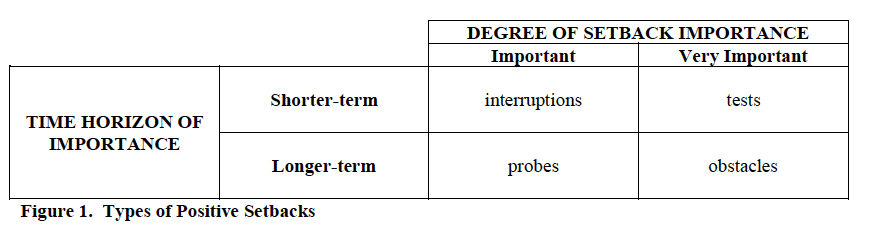
Did the 2008 financial crisis, by way of example, served as a timely interruption to remind us how central regulators are to the continuity of the financial and credit systems? Did the crisis end up as a much-needed probe of how well the financial and credit institutions are keeping their sectors on track and under mandate? Was the 2008 crisis a test bed for more resilient or anticipatory strategies in credit lending and investing? Did the crisis in effect served as an obstacle, whose surmounting has been necessary to promote the operational redesign of the financial and credit sectors in more reliable ways?
Note the obviously mixed answers to any such questions do not mean the setbacks are a priori negative.

 WHEN COMPLEX IS AS SIMPLE AS IT GETS