There are any number of critiques of neoclassical economics, particularly contemporary microeconomics. The best, most recent one I’ve found is:
Glick, Mark, Lozada, Gabriel A., and Darren Bush “Antitrust’s Normative Economic Theory Needs a Reboot” (December 9, 2024). Institute for New Economic Thinking Working Paper Series No. 231, https://www.ineteconomics.org/research/research-papers/antitrusts-normative-economic-theory-needs-a-reboot
It will be a hard slog to read for the non-specialist such as myself, but even a dedicated browse is worth the effort (downloading the pdf also took some time). Its point of departure is antitrust regulation in the US, but its focus is on one of the key pillars of mainstream economics, consumer surplus, and its critique brings together a wide range of arguments from across the critical literature. In so doing, it marshals a wonderful survey of why the economic sciences are like the rest of the social sciences, knee-deep in essential ambiguities.
Below are copied the paper’s abstract and table of contents for ease of reference:
Antitrust has adopted a normative economic theory based on maximizing economic surplus. The theory originates with Marshall but was introduced into antitrust as the Consumer Welfare Standard by Judge Robert Bork, and survives today in virtually every industrial organization textbook. This persistence is unwarranted. Welfare economists abandoned it several decades ago because the theory is inconsistent, and we review those inconsistencies. Moreover, welfare economists and moral philosophers have shown that the theory is biased in favor of wealthy individuals and corporations—the very powers the antitrust law is supposed to regulate. Finally, behavioral economists and psychologists have shown that the model of human behavior behind the economic surplus theory is simplistic and often in conflict with actual human behavior. We argue that antitrust should be brought into alignment with modern welfare economics. We also discuss how the New Brandeis Movement’s proposal to replace the consumer welfare standard with the protecting competition standard could be developed to accomplish this goal.
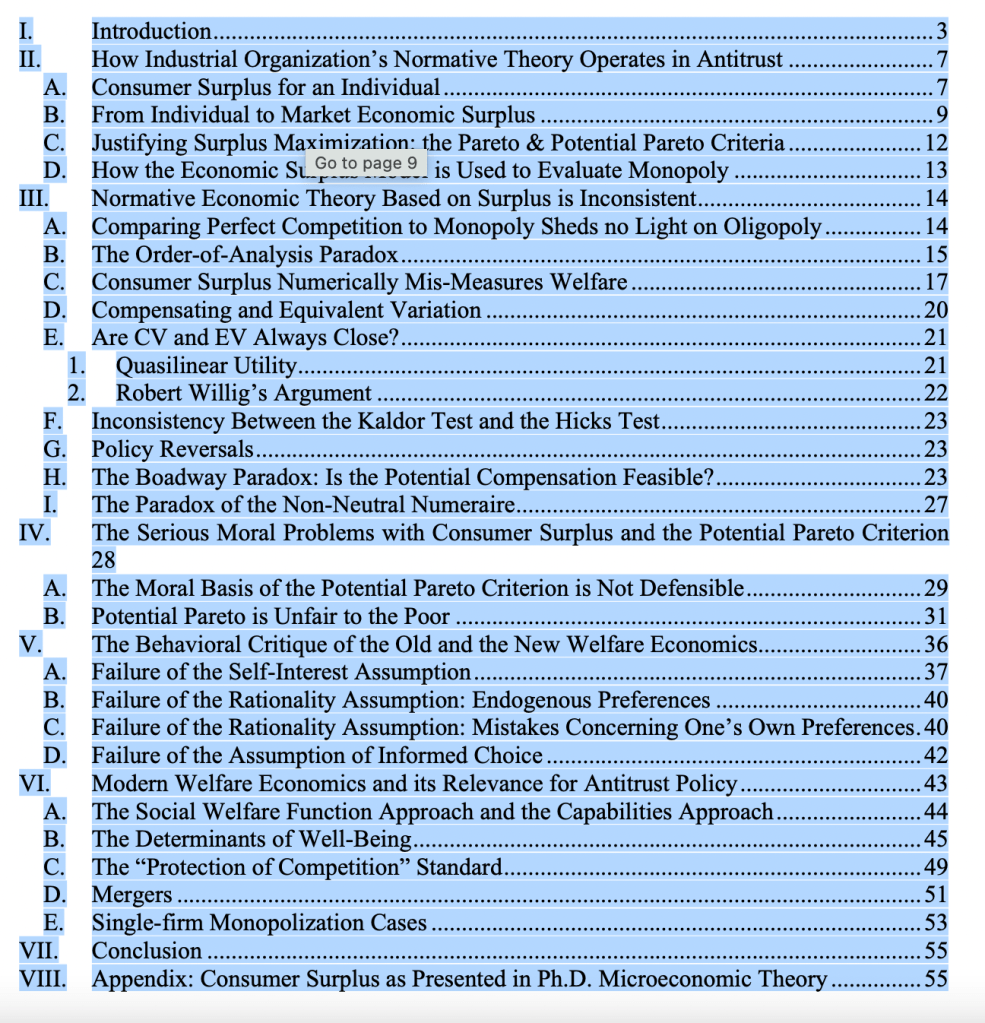

 WHEN COMPLEX IS AS SIMPLE AS IT GETS