Large proportions of the Chinese collection are perhaps copies in the eyes of those collectors and dealers, who believe that authentic African art has become largely extinct due to diminishing numbers of active traditional carvers and ritual practices. However, the ideological structure and colonial history of authenticity loses its effects and meanings in China, where anything produced and brought back from Africa is deemed to be “authentically African”. https://www.tandfonline.com/doi/full/10.1080/13696815.2021.1925089
But when. . .researching shanzhai art made in Dafen village, located in Shenzhen, Southern China, and home to hundreds of painter-workers who make reproductions in every thinkable style and period, I was struck by the diversity of the artworks and their makers. The cheerfulness with which artworks were altered was liberating, for example, the ‘real’ van Gogh was considered too gloomy by customers, so the painters made a brighter version (see Image 1).
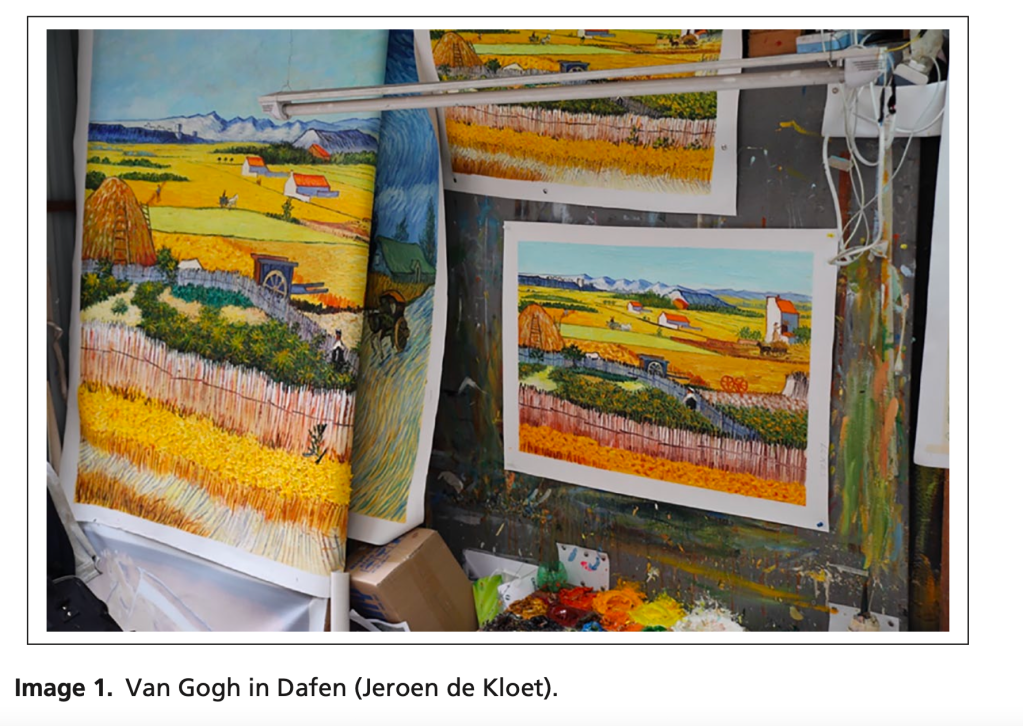
In another instance, I witnessed the face of Mona Lisa being replaced by one’s daughter to make it fit the household. When I brought an artwork home, the gallery called me later to ask if it matched my interior. Otherwise, I could change it. Such practices do turn conventional notions about art topsy-turvy. And shanzhai does not only concern art, it extends to phones, houses, cities, etc. As Lena Scheen (2019: 216) observes,
‘What makes shanzhai truly “unique” is precisely that it is not unique; that it refuses to pretend its uniqueness, its authenticity, its newness. A shanzhai resists the newness dogma dominating Euro-American cultures. Instead, it screams in our faces: “yes, I’m a copy, but I’m better and I’m proud of it”.’ https://journals.sagepub.com/doi/10.1177/13675494251371663
So what?
Any realistic attempt of ecological restoration with cloned bucardo [the Pyrenees ibex] would have to rely on hybridisation with other subspecies at some point; the genetic material from one individual could not be used to recreate a population on its own. Juan hypothesised: “we would have had to try to cross-breed in captivity, but you never know what could be possible, with new tools like CRISPR developing… and those [genome editing] technologies that come in the future, well, we don’t know, but maybe we could introduce some genetic diversity. This highlights a fundamental flaw in cloning as a means of preserving ‘pure’ bucardo—not only are ‘bucardo’ clones born with the mitochondrial DNA of domestic goats, but the hypothetical clone would also be subjected to further hybridisation. This begs the question, could such an animal ever be considered an authentic bucardo?”
https://rgs-ibg.onlinelibrary.wiley.com/doi/10.1111/tran.12478

 WHEN COMPLEX IS AS SIMPLE AS IT GETS
One thought on “When fakes are a brighter authenticity”