This photograph shows what were formerly residential lots now abandoned and empty in a part of Detroit, Michigan:

According to a major expert, these instances require us “to think about innovative and productive ways to manage and transform vacancy for long-term sustainability” not only in Detroit but in like now peri-urban areas (Dr. Toni Griffin, Professor in the Practice of Urban Planning at the Harvard Graduate School of Design commenting on the presentation, “Last House on the Block: Black Homeowners, White Homesteaders, and Failed Gentrification in Detroit,” accessed online at https://www.youtube.com/watch?v=umqU1xj5yPA).
I agree and take this opportunity to recast what you see in that picture in equally policy relevant ways for low-density grasslands in parts of Africa.
I
The poet, A.R. Ammons, also talks about the empty lot (TCP1, 28) and vacant land (TCP1, 49), and vacancy for him can indeed be complete emptiness (TCP2, 277). But many other times, vacancy is–as empty lots and vacant land–a bounded set full of properties (in multiple senses of that word). Here is an extract from his poem, Unsaid:
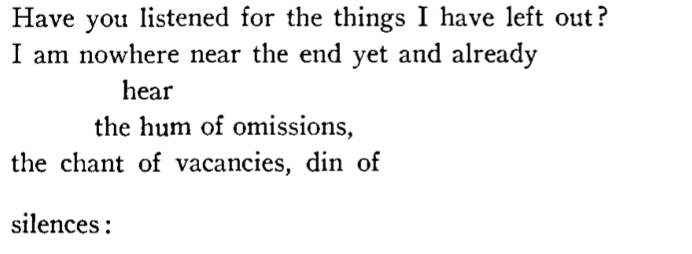
. . . . . .


To revert to social science terms, those gathered “boundaried vacancies” are both inlined and outlined. The above photo outlines only what we see at that time. What’s missing are the multiple inlined versions: not just the biophysical activities out of sight at that time and place, but the dense socio-economic relations that crisscross the space and the times we don’t see.
For all I know, there could be tents there at another time of year; or a craft and arts fair; or new construction to start the day after. Property is still being held, memories have been recorded; invisible expectations remain active for and about the photographed. The painter Gérard Fromanger noted that a blank canvas is ‘‘black with everything every painter has painted before me.” So too is the photo far more dense and opaque than what you see or can see.
II
So what? Just what does this mean for “the management of vacancy,” be it in peri-urban Detroit or the low-density rangelands of East or Southern Africa?
It means we have to think more densely, more granularly, than photographic reality could ever permit.
For example, what if the former settler ranches now subject to the mixed (arable, horticultural, animal) uses found in contemporary East and Southern Africa are in fact the result of that having “to think about innovative and productive ways to manage and transform vacancy for longer-term sustainability”?
In Detroit, we see by and large white urban farmers moving into these depopulated neighborhoods. In Africa examples, the racial demographics are largely reversed, but the analogy remains its strongest: Just as this urban farming has been mistakenly criticized as failed gentrification (the first wave of Detroit urban farmers never saw themselves as gentrifiers), so too arable and agro-pastoral farmers are mistakenly criticized for falling short of a livestock ranching thought to be more suitable by governments and their experts. Yet what to do with the finding that neither gentrification nor ranching, as ideal types, were ever part of the mixed-use practices on the ground?
More important (at least for me) the policy implications differ depending on the benchmark against which to assess really-existing variety on the ground. Is it any wonder that “gentrification”, like “dryland livestock ranching”, have no agreed-upon definitions? (Academics are still debating the causes and consequences of gentrification here in the US.) Is it any wonder then that both concepts are never so fiercely argued over as when they’re offered up as “solutions”?
But still: What to do? Here I think Ammons nails our collective starting point: It’s only that what is missing cannot be missed if spoken out.
Source
Ammons, A.R. (2017). The Complete Poems of A.R. Ammons, Volume 1 1955 – 1977 and Volume 2 1978 – 2005. Edited by Robert M. West with an Introduction by Helen Vendler. W.W. Norton & Company: New York, NY. (The poem, Unsaid, can be found in TCP1, 54 – 55.)
For more Ammons, see Major Read: Ammons and regulation

 WHEN COMPLEX IS AS SIMPLE AS IT GETS
One thought on “Managing vacancy across urban and rural landscapes”