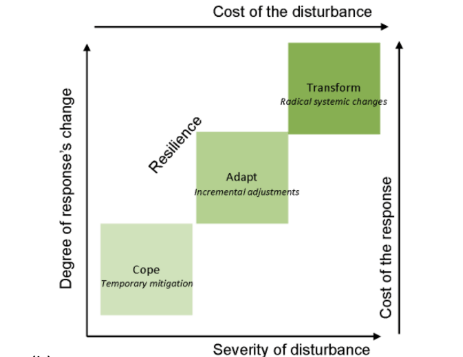
In the above figure, the cost of a disturbance and the cost of its response mirror the typology’s vertical and horizontal dimensions. As the disturbance severity grows larger, for example, so too is its parallel cost shown to increase.
Yet methodologically those main dimensions of the degree of response change and the severity of disturbance are to be independent of each other. Consequently, as the two costs are manifestly correlated and interdependent, the immediate implication is that the two dimensions are not in fact independent.
So what? Well, one thing this means is that the cost ranking from low to high of cope, adapt and transform resilience strategies is not presumptively as shown. That is, you can imagine (if not identify) cases where incremental adapting was less costly than indefinite coping or where transformation was not radically (more) costly.
Source
Roig Boixeda, P., E. Corbera, and J. Loos (2025). “Navigating a global crisis: impacts, responses, resilience, and the missed opportunity of African protected areas during the COVID-19 pandemic.” Ecology and Society 30(4):28. https://doi.org/10.5751/ES-16352-300428

 WHEN COMPLEX IS AS SIMPLE AS IT GETS