I
We are told to go beyond the enclosures of genre. (Which by the way is an old story: Ballet was a subgenre of dance, only later to be reclassified as a subgenre of theatre.) My preferred way of doing so means searching for the surprising but suggestive contrast, e.g.:
The artist, collector and critic Roger de Piles presented a defence of painting as make-up (la fard) in his 1708 Cours de peinture par principes. . .Piles argued that ‘it is well known that all painting is nothing but make-up, that it is part of its essence to deceive, and that the greatest deceiver in this art, is the greatest painter’.
(accessed online at https://academic.oup.com/fh/article/39/3/258/8202932)
Or to apply the contrast, I may say this practice is evidence-based, while you insist that all such evidence is little more or less than the testimony made up by someone or another–and we know the limits of eyewitness testimony! But “testimony” itself is a differentiated genre and can have cross-genre synergies that are policy relevant. Brazil’s leading literary critic, Roberto Schwarz, describes a play of his:
The most striking formal feature of the play, in my view, is the length of the characters’ lines. They don’t stop at the point that psychology or the art of realistic dialogue might dictate. They only end when their reasoning is complete. This turns some of them into miniature essays. The play becomes a sort of cantata of counterposed viewpoints, spoken or shouted at each other, on the brink of social transformation, in a space of crisis and public argument that transcends psychological theatre and the bourgeois view of life. The issues at stake decompose the individual, go beyond him, exceed him.
(accessed online at https://newleftreview.org/issues/ii153/articles/roberto-schwarz-political-polyphonies)
(One early boss insisted my official correspondence should have sentences no longer than seven words or 13 syllables, when writing to him at headquarters.)
In other words, grabbing one practice to reinterpret another practice from elsewhere also means reminding oneself of intra-genre differences. And with those differences come limitations. Postcards are a genre, but they really don’t do well in reducing paintings and sculptures to the same size for comparison’s sake. Or to keep to my point, if by “evidence-based” I reduce my comparison through one and only one method or framing, then I must at the same time admit the policy and management limitations, often evidential in their own right, of doing so. (This is why I agree with those who say the real contribution of social sciences is the mixed methods sample survey.)
From another direction, recasting is the policy analyst’s curatorial exercise of assembling not only new installations, but also reinstallations–both of which defamiliarize in order to create a new viewing public or reanimate an existing one. And let’s not forget that this curatorial function of (re)installation can be improvisational as in bricolage:
. . .the Fukushima Daiichi nuclear power plant were forced to practise bricolage after the accident caused by the earthquake in Japan on 11 March 2011. In order to try to mitigate the effects of the accident, the plant’s operators working in Reactor 1 engaged in multiple acts of bricolage, diverting the functions of whatever was at hand to address the situation. For instance, as their monitoring system had ceased to function, they diagnosed the state of the reactor using sounds, and the colour of steam, as this was their only option. Likewise, as the water pipes inside the nuclear plant were no longer working, they had to change the function of a diesel pump so that it would pump water directly into the reactor.
(accessed online at https://vbn.aau.dk/ws/portalfiles/portal/767416353/verger-et-al-2024-creative-preservation-a-framework-of-creativity-in-support-of-degrowth.pdf)
II
It was argued that for the classical ballerina, “every posture of her dance must be so natural and full of taste that any moment of it could serve as a model for an artist or sculptor.”
So too in policy we find professionals even today calling for blueprints and implementation according to the plan. But just as ballet, painting and sculpture are different genres, so too the stages of the now classic policy cycle–agenda setting, policy formulation, adoption, implementation (including operations), and evaluation–are themselves different genres. This difference is why “implementation”–let alone really-existing versions of the other stages–is easily a permanent critique of something as abstract as “a policy cycle.” (There’s no little irony that the early promoters of the policy cycle thought it a more professional way of describing what others up to that point considered low and meaning cunning in “the politics of the budgetary process.”)
So what? Implementation is often said to be defacto policymaking, in the sense that operations make the real policy on the ground. That, however, misses implementation and “policy-making” being different genres, the importance of which is that implementation offers the prospect of a different closure (beginning–middle–end) than, say, setting the agenda and initial policy formulation–or for that matter, evaluation. Which leads us to the next point.
III
Although most songwriting teams in the Great American Songbook wrote music first and lyrics second, most studies of music-text interaction in this repertoire still evince a lyrics-first mindset, in which the music is viewed as text-setting. In this article, I propose the opposite approach: considering lyrics as a form of music-setting, in which the lyricist’s superimposition of a verbal form (the rhyme scheme) upon the composer’s pre-existing musical form counts as an act of analysis. . . .
Not all performances from this era make the same changes as Hepburn [Audrey Hepburn singing in the 1957 film Funny Face]. But her performance is nonetheless representative of an evolutionary process that propagates throughout this repertoire: the composer supplies a musical form; the lyricist superimposes a different form above it; and the performer implicitly revises the music to better tally with the lyrics.
John Y. Lawrence (2023). Lyricist as Analyst: Rhyme Scheme as Music-Setting in the Great American Songbook. Music Theory Spectrum XX: 1 – 15 (accessed online at https://academic.oup.com/mts/advance-article-abstract/doi/10.1093/mts/mtad015/7492927?redirectedFrom=fulltext)
For some, it’s the shortcut: Policy is about writing the lyrics, implementation/operations about making those words real, and evaluation about assessing the good and bad in those words and performances.
That policy instead is the music and that implementers/operators are like lyricists trying to find, among many possibilities, an implementation that fits better than others offers a revealing twist. So too that evaluations, formal and informal, of the policy-as-implemented are performed in ways that offer up nuanced interpretations of what is seen, heard and done.
Revealing? For one thing, this suggests that the closure posed to policy by its operations is not once and for all as long as evaluations (interpretations) are ongoing (literally, performed). In this way, think of repair and maintenance as part and parcel of formal and informal evaluations. Yes, even classical ballet had no stable choreography, yet how still to separate the dancer from the dance when performance is not just evolving maintenance but also its own kind of repair?
IV
In explaining how he came to write his 2024 Stranger than Fiction: Lives of the Twentieth Century Novel, Edwin Frank offers this background,
My thoughts turned again to the Russian novel, and the way it had made such an extraordinary impression on the literature of the world almost entirely in translation. “In translation” was the key, opening the way into the story of the novel, which was, as I suddenly saw it, a story of translation in the largest sense, not only from language to language and place to place but more broadly as the translation of lived reality into written form, something the expansive and adaptable form of the novel had from the start been uniquely open to, which the last century had provided the perfect—what?—petri dish in which it could further develop. On one hand, the twentieth century had been a century of staggering transformation—world war, revolution, women voting, empires falling, cities sprawling, expanded life spans and lives cut short, mass media, genocide, the threat of nuclear extinction, civil and human rights, and so on—a century to boggle the mind, which demanded and stretched and beggared description. On the other hand we had the novel, emerging from the nineteenth century as a robust presence with a tenacious worldly curiosity and a certain complacent self-regard, a form that was both ready to shake things up and asking to be shook up. Hadn’t the two, as the phrase goes, been made for each other?
(accessed online at https://publicseminar.org/2024/11/excerpt-stranger-than-fiction/)
It’s difficult for me not to see “development” in just these terms. Development remains consumed by twentieth-century languages of transformation, a hangover (yes, the intention is to jar) from a century of already great transformations. And yet development remains what it has always been, the translation of lived reality into reduced forms that look like stories with beginnings, middles and ends, albeit your fiction their non-fiction; your performance their performance.
V
Suspended somewhere between the always-incomplete pull of utopia and the never-good enough push from dystopia is more like the realism I know and experience. For those of us stuck in this unstable in-between, it’s an irony that we are not comfortable, let alone happy, with one future only. There must be multiple futures and choices, stuck as we are indefinitely in the here and now.
And the way we create these futures is to stay in a present that is so complex it cannot be interpreted one way only. This means no one genre is good enough for recasting forward the present. Roberto Schwartz in another essay provides a very pertinent example of this:
In Endgame, [Samuel] Beckett modifies the status of slapstick comedy, making it say something unexpected. As a genre, slapstick expresses a derisory vision of humanity—but as one view among others, with which it normally coexists. There are tragedies, serious dramas, light comedies, and each carries its own assessment of the human being. What did Beckett do? He took slapstick, and rather than conceiving of it as one genre among others, attempted to demonstrate that humanity today resembles its vision more than anything else. In doing so, slapstick ceased to be a conventional genre and paradoxically acquired the privileged function of realism, upsetting the established order of precedence.
Simone de Beauvoir once wrote that only a mad prince orders the seas to be thrashed. But press “forward,” and that’s what our princes do today. That slapstick is realism.
VI
Large proportions of the Chinese collection are perhaps copies in the eyes of those collectors and dealers, who believe that authentic African art has become largely extinct due to diminishing numbers of active traditional carvers and ritual practices. However, the ideological structure and colonial history of authenticity loses its effects and meanings in China, where anything produced and brought back from Africa is deemed to be “authentically African”. https://www.tandfonline.com/doi/full/10.1080/13696815.2021.1925089
But when. . .researching shanzhai art made in Dafen village, located in Shenzhen, Southern China, and home to hundreds of painter-workers who make reproductions in every thinkable style and period, I was struck by the diversity of the artworks and their makers. The cheerfulness with which artworks were altered was liberating, for example, the ‘real’ van Gogh was considered too gloomy by customers, so the painters made a brighter version (see Image 1).
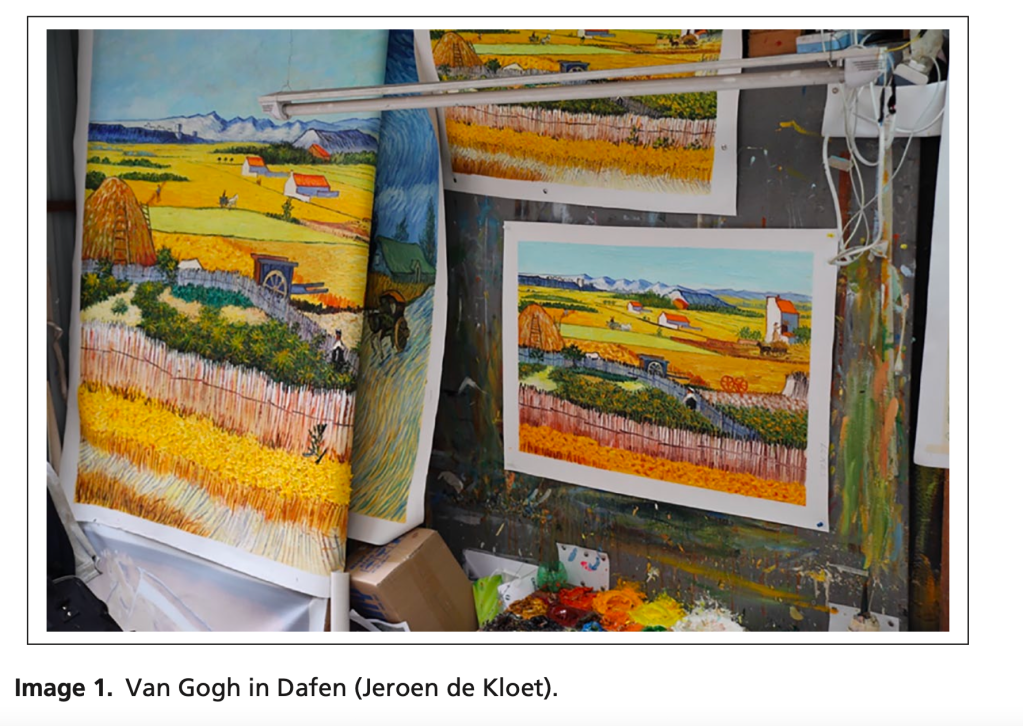
In another instance, I witnessed the face of Mona Lisa being replaced by one’s daughter to make it fit the household. When I brought an artwork home, the gallery called me later to ask if it matched my interior. Otherwise, I could change it. Such practices do turn conventional notions about art topsy-turvy. And shanzhai does not only concern art, it extends to phones, houses, cities, etc. As Lena Scheen (2019: 216) observes,
‘What makes shanzhai truly “unique” is precisely that it is not unique; that it refuses to pretend its uniqueness, its authenticity, its newness. A shanzhai resists the newness dogma dominating Euro-American cultures. Instead, it screams in our faces: “yes, I’m a copy, but I’m better and I’m proud of it”.’ https://journals.sagepub.com/doi/10.1177/13675494251371663
So what?
Any realistic attempt of ecological restoration with cloned bucardo [the Pyrenees ibex] would have to rely on hybridisation with other subspecies at some point; the genetic material from one individual could not be used to recreate a population on its own. Juan hypothesised: “we would have had to try to cross-breed in captivity, but you never know what could be possible, with new tools like CRISPR developing… and those [genome editing] technologies that come in the future, well, we don’t know, but maybe we could introduce some genetic diversity. This highlights a fundamental flaw in cloning as a means of preserving ‘pure’ bucardo—not only are ‘bucardo’ clones born with the mitochondrial DNA of domestic goats, but the hypothetical clone would also be subjected to further hybridisation. This begs the question, could such an animal ever be considered an authentic bucardo?”
https://rgs-ibg.onlinelibrary.wiley.com/doi/10.1111/tran.12478
Other sources
de Beauvoir in https://www.marxists.org/reference/subject/ethics/de-beauvoir/ambiguity/ch03.htm
On classical ballerina and no stable choreography, see https://global.oup.com/academic/product/impossible-project-9780197653050?cc=us&lang=en&
On postcards, see https://www.e-flux.com/notes/6783418/koj-ve-and-photography-the-visualization-of-logos
On testimony, see https://www.commonwealmagazine.org/frailties-reason
Please also see my ongoing blog: Sixteen short examples on how differences in genre affect the structure and substance of policy and management [4 newly added]

 WHEN COMPLEX IS AS SIMPLE AS IT GETS
I love it Emery! At a time like this new ways of interpreting may be the only escape from insanity. Thanks so much for sharing.
We’re looking at perhaps 14 inches of snow/ice here in northwester Maryland. Stay warm, stay safe. Thinking about the linemen storm crews makes me recall when a kid with all the lines overhead and a big ice storm came through. We were all out taking the crews hot coffee, chocolate, etc. Hope people still do the same.
Earl
LikeLike