Engineers talk about the need for large hazardous systems to “fail gracefully.” That assumes a degree of control over technological failure as it is happening and, as far as I can tell, there is nothing “graceful” about a large technical system failing right now.
So what?
It’s not just the sheer hubris expressed in phrases like “engineering a soft landing of the economy.” It also means that even anti-utopians have been delusional at times. Karl Popper, philosopher, was known for contrasting Utopian engineering with what he called the more realistic approach of piecemeal engineering:
It is infinitely more difficult to reason about an ideal society. Social life is so complicated that few men, or none at all, could judge a blueprint for social engineering on the grand scale; whether it is practicable; whether it would result in a real improvement; what kind of suffering it may involve; and what may be the means for its realization. As opposed to this, blueprints for piecemeal engineering are comparatively simple. They are blueprints for single institutions, for health and unemployed insurance, for instance. . . If they go wrong, the damage is not very great, and a re-adjustment not very difficult. They are less risky, and for this very reason less controversial.
“If they go wrong, the damage is not very great”!? It’s the case that blueprints for piecemeal health insurance–and educational reform, government budgeting and financial deregulation, for that matter–have also been damaging. Utopian engineering is the least of our problems here.
An AI-generated definition is good enough to start: “The ‘foundational economy’ (FE) is the infrastructure of everyday life, including essential services like water, electricity, healthcare, and housing, that are required for society to function.” (The key website is The Foundational Economy.) Even at that level of abstraction, it’s clear there is no one and only FE with one and only one set of critical infrastructures in each.
More important than their numbers and diversity, it’s that “infrastructure” I take up here and expand below: Since critical infrastructures and their operating networks of personnel are required so as to make it possible for a collective to exist and thrive economically let alone societally, so too agrarian reform and the foundational economy are instrumentally linked in ways that commend further elaboration.
How so?
II
Here are ten propositions by way of answer:
1. By definition, a foundational economy would not exist if it were not for the reliable provision of electricity, water, telecoms, and transportation. Here reliability means the safe and continuous provision of the critical service in question, even during (especially during) turbulent times. This means, for example, that the physical systems as actually managed and interconnected on the ground help establish the spatial limits of the FE in question.
2. By extension, no markets for goods and services in the FE would exist without critical infrastructure reliability supporting their operations. This applies to rural landscapes as well as urban ones.
3. Other infrastructures, including reliable contract and property law, are required for the creation and support of these markets, though this too varies by context. One can, for example, argue healthcare and education are among the other infrastructural prerequisites for many FEs (as above).
4. Preventing disasters in the face existing and prospective uncertainties is what highly reliable infrastructures do. Why? Because when the electricity grid islands, the water supplies cease, and transportation grinds to a halt, then people die and the foundational economy seizes up (Martynovich et al. 2022).
5. Another way to say this is that within a foundational economy you see clearest the tensions between economic transactions and reliability management. Economics assumes substitutability, where goods and services have alternatives in the marketplace; infrastructure reliability assumes practices for ensuring nonfungibility, where nothing can substitute for the high reliability of critical infrastructures without which there would be no markets for goods and services, right now when selecting among those alternative goods and services.
6. Which is to say, if you were to enter the market and arbitrage a price for high reliability of critical infrastructures, the market transactions would be such that you can never be sure you’re getting what you thought you were buying. Much discussion around moral economies and agrarian reform can be described in such terms.
7. This in turn means there are two very different standards of “economic reliability.” The retrospective standard holds the foundational economy–or any economy for that matter–is performing reliably when there have been no major shocks or disruptions from the last time to now. The prospective standard holds the economy is reliable only until the next major shock, where collective dread of that shock is why those networks of reliability professionals try to manage to prevent or otherwise attenuate it. The fact that past droughts have harmed the foundational economy in no way implies people are not managing prospectively to prevent future consequences of drought on their respective FEs–and actually accomplishing that feat.
8. Why does the difference between the two standards matter? In practical terms, the foundational economy is prospectively only as reliable as its critical infrastructures are reliable, right now when it matters for, say, economic productivity or societal sustainability. Indeed, if the latter were equated only with recognizing and capitalizing on retrospective patterns and trends, economic policymakers and managers in the FE could never be reliable prospectively in the Anthropocene.
9. For example, the statement by two well-known economists, “Our contention, therefore, following many others, is that, despite its flaws, the best guide to what the rate of return will be in the future is what it has been in the past” (Riley and Brenner 2025) may be true as far as it goes, but it in no way offers a prospective standard of high reliability in the foundational economy (let alone other economies).
10. So what? A retrospective orientation to where the economy is today is to examine economic and financial patterns and trends since, say, the 2008 financial crisis; a prospective standard would be to ensure that–at a minimum–the 2008 financial recovery could be replicated, if not bettered, for the next global financial crisis. Could the latter be said of the FE in your city, metropolitan area or across the rural landscape of interest?
III
In short, how does your version of agrarian reform shift the odds in favor of the prospective standard for a reliable foundational economy ahead?
Note by way of concluding that the policy-relevant priority isn’t scaling up your reforms beyond the FEs as much as your determining the openness of those FEs to being modified in light of evolving affordances under reforms during the Anthropocene.
Sources.
Martynovich, M., T. Hansen, and K-J Lundquist (2022). “Can foundational economy save regions in crisis?” Journal of Economic Geography, 1–23 (https://doi.org/10.1093/jeg/lbac027)
Riley, D. and R. Brenner (2025). “The long downturn and its political results: a reply to critics.” New Left Review 155, 25–70 (https://newleftreview.org/?pc=1711)
One of the ironies of infrastructure analysis is the finding that fixed infrastructures and continuous supply of services are saturated with and by contingencies, not least of which are shocks and surprises.
First, the fact that infrastructures involve on the ground assets has long been recognized as rendering them vulnerable to all manner of wider environmental contingencies:
Once developed, these infrastructural assets are difficult to relocate or repurpose. In effect, capital investments become affixed to specific built environments and localities, forming stable networks of spatial interdependence. These networks, on the one hand, facilitate circulation and accumulation by linking resource frontiers, but on the other, also expose capital to territorial and political contingencies inherent in fixed spatial arrangements. . .
So too at the start of infrastructure development with the lag between investing in new infrastructures and their provision of critical services:
. . .investments were by their very nature ‘fixed’ at a certain point in time, introducing another source of uncertainty: when money was converted into physical means of production, it took an extended period of time before it began to deliver returns, but it was hard to predict all the changes that could occur while the investor was waiting to realise them.
That extended period of time includes the shocks and surprises that explain those much-recorded gaps between infrastructure plan and implementation and between implementation and actual operations of what are in practice and on the ground, interconnected critical infrastructures.
It is in this context of unpredictability and contingency that we must understand the role of “infrastructure maintenance and repair”–at least as actually undertaken during really-existing infrastructure operations. M&R is, if you will, the best proof we have about whether or not infrastructure operations survive the unholy trinity of: the solutionism of fool-proof designers and planners; “advanced” technologies introduced prematurely only to become obsolete earlier than expected; and our intensified dependence on the resulting kluge and amalgam for actual services in real time and over time.
II
So what?
Well, we at least have a different answer to why people seek first to restore the infrastructures they have, even when as bad as they have been. For example, why doesn’t the persisting prospect of catastrophic failures with catastrophic consequences of a magnitude 9 earthquake in Oregon and Washington State convince the populations concerned that the economic system that puts them in such a position must be changed before the worst happens? The answer: Because critical service restoration–from the Latin restaurare, to repair, re-establish, or rebuild–is the real-time priority for immediate response after a catastrophe.
Yes, let’s talk about replacing or repurposing the infrastructures we have before a catastrophe; yes, let’s talk about alternative systems with entirely different demands for maintenance and repair. But never forget that, when that catastrophe hits, the priority is to get back to where we were before the disaster, if only to repair what we what we are familiar with and know how to maintain thereafter.
A huge challenge will be to design an international set of industrial policy standards to avoid the current trend towards highly nationalist policies at the expense of others, e.g. conflictual trade and tariff wars. The ultimate goal should be to develop a cooperative global governance that allows industrial policies on a national or transnational level, for reasons that are commonly seen as legitimate. Having such rules could even be a prerequisite for saving free trade in all other well-defined sectors where markets function to the benefit of the many. https://www.intereconomics.eu/contents/year/2025/number/5/article/winning-back-the-future-preparing-for-a-comeback-of-democracy.html
It’s not just that weasel phrase: “could even be a prerequisite,” which of course entails “may still not be one”. It’s not just that high-altitude floating signifier, “cooperative global governance”–think here the Academy of Lagado’s efforts to extract sunbeams from cucumbers. No, it’s that god-awful “design”.
Are there actually people who believe macro-design produces really-existing necessary and sufficient conditions for this or that human behavior? Design as control of inputs, processes and outputs of this most complex socio-political-economic-ecological globe?
I wish these believers the best, but in the absence of verification criteria for their claims, I’ll treat them as self-refuting propositions as in “everything is relative.”
The playhouse manuscript, Sir Thomas More, has been called “an immensely complex palimpsest of composition, scribal transcription, rewriting, censorship and further additions that features multiple hands”. One of those hands was Shakespeare–and that has contemporary relevance.
–The authoritative Arden Shakespeare text renders a passage from Shakespeare’s Scene 6 as follows (this being Thomas More speaking to a crowd of insurrectionists opposing Henry VIII):
What do you, then, Rising ’gainst him that God Himself installs, But rise ’gainst God? What do you to your souls In doing this? O, desperate as you are, Wash your foul minds with tears, and those same hands, That you, like rebels, lift against the peace, Lift up for peace; and your unreverent knees, Make them your feet to kneel to be forgiven. Tell me but this: what rebel captain…
The last two lines, however, had been edited by another of the play’s writers (“Hand C”), deleting the bolded lines Shakespeare had originally written,
Make them your feet. To kneel to be forgiven Is safer wars than ever you can make Whose discipline is riot. In, in to your obedience. While even your hurly Cannot proceed but by obedience. What rebel captain….
–What has been effaced away by the deletion is, first, the notion that contrition is itself a kind of war and a safer war, at that.
According to the Arden Shakespeare, “The act of contrition might be described as wars because the former rebels would enlist themselves in the struggle of good and evil, and would fight against their own sin of rebellion.” In either case—contrition or rebellion—obedience is required. Actually, nothing was less safe than rebellion whose “discipline is riot”.
–What has also been scored out, in other words, from Shakespeare’s original passage is the clear accent on contrition and peace over continued upheaval. But the absence of contrition by those involved in the formulation and implementation of war policies is precisely what we have seen and are seeing today.
For to prioritize contrition would mean refocusing obedience from battle to a very different struggle in securing peace and security, a mission in which our ministries of interior and defence are notably inferior, be they in Russia, the US, or elsewhere.
Principal sources
Sir Thomas More (2011), ed. John Jowett (Arden Shakespeare, third series. Bloomsbury, London)
Van Es, B. (2019). Troubles of a glorious breath. TLS (March 22)
What do we call the stage of knowledge-making between technological incompletion and delaying completion? Might it be something like learning from prototyping, or from repairing and repairing again?
But what if prototyping and repair seem without end these days? That is, obsolescence more and more precedes completion, which in turn leads us right back to unknowledge? What if no one saw the need to record the processes of prototyping or repair because something new or better always comes along early (or so they thought). Such indeed “is why we know the names of every Roman emperor but don’t know how they mixed their concrete, or why we have thousands of pages of Apollo program documents but couldn’t build a Saturn V today” (https://www.scopeofwork.net/ise-jingu-and-the-pyramid-of-enabling-technologies/).
An important, but under-acknowledged, consequence follows from technologies as well as technological processes always being immanently obsolete. This too supports the temporary and flexible over the permanent and institutional when it comes to organizational structures to handle technological policy and management. If wicked social problems by definition withstand institutional solutionism, then why expect permanent opposition to the short-run and adaptive in organizational response to technology?
II
The problem with the preceding paragraphs is that they stop short of the needful. “Short-run,” “adaptable” and “flexible” are not granular enough to catch the place-and-time specific–that is, often improvisational–properties of actually-existing adaptation, flexibility and performance under real-time urgencies. When in the face of complex technological disruption or failure, what you have before you are not distinct and separate probabilities and consequences, but rather the mess of contingencies and aftermaths.
To put the same point positively, we are talking about the requirement to be case-specific in regards to technological change. And just what cases would these be? Let me conclude with one example of what I am trying to describe above:
Like barcodes, QR codes were not originally designed to become components of global information infrastructures: their success as infrastructural gateways was largely unplanned and contingent on unpredictable sociotechnical convergences. Every step of this gradual historical process has been situated in specific national or regional contexts, scaling up “entire infrastructural systems out of situated local needs” (Edwards et al., 2009, p. 370): barcode standardization has shaped the U.S. market economy; the machine-readability of QR codes has enhanced the efficiency of Japanese manufacturing logistics; their uptake as analog portals was made possible by the rapid informatization of East Asian countries; their consolidation as meta-generic gateway was catalyzed by the infrastructuralization of Chinese digital platforms. Lastly, the emergence of QR codes as infrastructural gateways was opportunistic, as they occupied a niche that competing gateways were not flexible enough to cover: through services like Alipay and WeChat Pay, QR codes took on the role of debit and credit cards, which had never achieved the same success as a gateway in China as they did in 20th-century America (Lauer, 2020, p. 11)
The most telling feature of present-day crisis thinking is that it’s doubled. Not only are we said to be at the crossroads of so many dire consequences (think Woody Allen’s quip: “More than any other time in history, mankind faces a crossroads. One path leads to despair and utter hopelessness. The other, to total extinction. Let us pray we have the wisdom to choose correctly”).
But it’s worse than that. We’re also temporizing while in the crossroads. We’re not making the choices and are deluding ourselves with getting by, coping, delaying and waiting. As if the longer we can suspend choice, the greater chance the crossroads will go away. As if these were only rumors to be waited out.
So whether we find ourselves at the last, but always increasing number of, crossroads or procrastinating with no real escape route, the polycrisis of interconnected crises–that singular noun for multiple phenomena–is fast becoming its own plural, polycrises.
In brief, our problem is not only crisis-thinking but also its hackneyed metaphors–all those crossroads, all that tarrying while Rome burns, really? To puncture this thinking requires you to ask: But what about the accomplishments of real people, in real time, with real problems? Do they–both the people and the accomplishments–count for little or zilch, even if terms like “progress” and “success” are no longer as useful? This question is more complicated than the usual human persistence versus human endurance comparison. What do we do with the developmentfact that accomplishing things means less about “keep on going” than it is does about “this is what we have nevertheless done, now when it matters most”?
When people improvise in order to accomplish, then reducing that to coping and sub-par performance seems to me one crisis too many. Boris Pasternak, the Russian poet and novelist, is reported to have said that life creates events to distract our current attention away from it, so that we can get on with work that cannot be accomplished any other way.
II
But, so what?
So: Pose questions that offer up new metaphors on the principle that to change reality is at least to change the metaphors that last. Roberto Schwartz, the great Brazilian literary critic, recently described a play of his that tried to interrogate the certainties and contradictions in popular culture:
The problems are numerous: are cultural niches and racial quotas tantamount to prisons? Does a samba school band deserve the Nobel Prize? Is poverty picturesque, shameful, a solvable problem, a crucial world issue? The favela: rather than backward, don’t we all know that it’s the future of humanity? What are its teachings? Is popular culture revolutionary? Is individual success a betrayal? Does the favelado artist compete with contemporary art on an equal footing? Does it compete with him? The proliferation of questions and the critical freedom to confront them don’t guarantee a solution, but they bring fresh air and enjoyment.
Now we wouldn’t typically notice the accomplishments of “fresh air” and “enjoyment” while in the multiple crossroads of planetary polycrises.
But–and this is the thought experiment–if Schwartz’s questions are the ones we could be asking not only in Brazil but also everywhere, then the analyses of everywhere else is, importantly, with respect to samba school bands, the favela, and individual success as betrayal of collective efforts to address poverty variously defined. My wager is that out of these comparisons and contrasts emerge not only new questions that defamiliarize the intractable–e.g., in 1920, the USSR was the first country to decriminalize abortion practice by doctors–but also new ways to recast the repetition compulsions of the current crisis narratives.
Over time I’ve been struck by an institutional contrast in the claim to providing highly reliable services.
On one hand, we have the state and federal regulators and legislators who pass the laws and standards to be followed by critical infrastructures and, on the other hand, the real-time professionals in the respective control rooms who have had to operationalize the standards in order to maintain system reliability in real time. For insiders, this contrast is not surprising: No plan withstands contact with the enemy, and it isn’t news that frequent but unpredictable shocks and surprises require operationally redesigning official procedures and defective technology so to meet these regulatory and legislative mandates for infrastructure reliability.
So what? More formally, the centralized infrastructure control room turns out to be a unique organization formation to balance competing demands under pressures of real-time. You don’t find other institutions able to do this, nor should you expect to. Infrastructure control rooms are centralized for system-wide response and management by their real-time dispatchers and schedulers, but that centralization entails the rapid management by these reliability professionals of system control variables—such as electricity frequency, natural gas pipe pressures, and waterflows—whose movements can have immediate decentralized (localized) interactions.
II
It’s banal to say the state and federal legislatures are not operational control rooms in the sense just described.
But let’s shift the analysis to Kenya pastoralists, at least those who are equivalent real-time reliability professionals in the drylands, and contrast them to the MPs in the country’s Parliament. Two implications are immediate.
First, it’s also no news that the Kenya Parliament, and its MPs, are criticized for many things, i.e.,
African parliaments present a number of shortcomings, including (i) the commodification of parliamentary seats, (ii) the lack of social representativeness of elected representatives, (iii) the fact that elected representatives can be captured by partisan or illegitimate interests, (iv) their lack of competence on most of the subjects they are supposed to debate, and (v) the fact that they do not necessarily deliberate on urgent matters in a timely fashion. https://www.opensocietyfoundations.org/publications/analysis-of-the-nexus-between-democratic-governance-and-economic-justice-in-africa
Fair enough, but nevertheless to underscore that Kenya MPs, like legislators in much of the West, are not as timely in emergencies as are reliability professionals is hardly noteworthy. (The Sámi parliament in Finland was neither consulted nor informed in advance of proposed US troop and weapons activities in 2024, for example [https://www.europe-solidaire.org/spip.php?article72359])
III
More, once you start thinking in terms of African Parliaments as lenses to analyze critical service reliability in their respective countries, you realize how little research, with some notable exceptions, has been done on the topic. Or to put the point more properly and comparatively, it’s the respective President and Cabinet ministers who get more attention and analysis. The assumption, of course, has been that parliaments are subordinate to the president, party, or military. But we risk stigmatizing all parliaments in the same sense others, including some MPs, stigmatize all pastoralists. Really, are African Parliaments to be dismissed that easily?
In any case, it’s problematic for academic researchers to recommend that government officials and NGO staff be in authentic collaboration with pastoralists taking the lead, when those very same researchers wouldn’t be caught dead collaborating with the political elites, including MPs. This “development collaboration,” such as it is, is especially problematic when (1) pastoralists bear all the risks if the resulting research recommendations go pear-shaped and (2) government would be blamed anyway when mistakes in implementing the recommendations were not caught beforehand.
NB. For more on pastoralists as reliability professionals, please see:
1. Climate emergency parsed through a poem by Jorie Graham
–I liken one of our complexity challenges to that of reading Hardy’s “Convergence of the Twain” as if it were still part of the news (it had been written less than two weeks after the sinking of the Titanic).
So too the challenge of reading the first sequence of poems in Jorie Graham’s Fast (2017, Ecco HarperCollinsPublishers). The 17 pages are extraordinary, not just because of pulse driving her lines, but also for what she evokes. In her unfamiliar words, “we are in systemcide”.
–To read the sequence—“Ashes,” “Honeycomb,” “Deep Water Trawling,” and five others—is to experience all manner of starts—“I spent a lifetime entering”—and conjoined ends (“I say too early too late”) with nary a middle in between (“Quick. You must make up your/answer as you made up your//question.”)
Because hers is no single story, she sees no need to explain or explicate. By not narrativizing the systemcide into the architecture of beginning, middle and end, she prefers, I think, evoking the experience of now-time as end-time:
action unfolded in no temporality--->anticipation floods us but we/never were able--->not for one instant--->to inhabit time…
She achieves the elision with long dashes or —>; also series of nouns without commas between; and questions-as-assertions no longer needing question marks (“I know you can/see the purchases, but who is it is purchasing me—>can you please track that…”). Enjambment and lines sliced off by wide spaces also remind us things are not running.
–Her lines push and pull across the small bridges of those dashes and arrows. To read this way is to feel, for me, what French poet and essayist, Paul Valery, described in a 1939 lecture:
Each word, each one of the words that allow us to cross the space of a thought so quickly, and follow the impetus of an idea which rates its own expression, seems like one of those light boards thrown across a ditch or over a mountain crevasse to support the passage of a man in quick motion. But may he pass lightly, without stopping—and especially may he not loiter to dance on the thin board to try its resistance! The frail bridge at once breaks or falls, and all goes down into the depths.
The swiftness with which I cross her bridges is my experience of the rush of crisis. I even feel pulled forward to phrases and lines that I haven’t read yet. Since this is my experience of systems going wrong, it doesn’t matter to me whether Graham is a catastrophizer or not. She takes the certainties and makes something still new.
–I disagree about the crisis—for me, it has middles with more the mess of contingencies and aftermath than beginnings and ends—but that in no way diminishes or circumscribes my sense she’s right when it comes to systemcide: “You have to make it not become/waiting…”
2. Global Climate Sprawl
You get them wrong before you meet them, while you’re anticipating meeting them; you get them wrong while you’re with them; and then you go home to tell somebody else about the meeting and you get them all wrong again. Since the same generally goes for them with you, the whole thing is really a dazzling illusion empty of all perception, an astonishing farce of misperception. And yet. . .It’s getting them wrong that is living, getting them wrong and wrong and wrong and then, on careful reconsideration, getting them wrong again. That’s how we know we’re alive: we’re wrong.
I suggest that Global Climate Change isn’t just a bad mess; it’s a spectacularly, can’t-keep-our-eyes-off-it, awful mess of getting it wrong, again and again. To my mind, GCC is a hot mess–both senses of the term–now sprawled all over place and time. It is inextricably, remorselessly part and parcel of “living way too expansively, generously.”
GCC’s the demonstration of a stunningly profligate human nature. You see the sheer sprawl of it all in the epigraph, Philip Roth’s rant from American Pastoral. So too the elder statesman in T.S. Eliot’s eponymous play admits,
The many many mistakes I have made
My whole life through, mistake upon mistake,
The mistaken attempts to correct mistakes
By methods which proved to be equally mistaken.
That missing comma between “many many” demonstrates the excess: After a point, we no longer can pause, with words and thoughts rushing ahead. (That the wildly different Philip Roth and T.S. Eliot are together on this point indicates the very real mess it is.)
That earlier word, sprawl, takes us to a more magnanimous view of what is going on, as in Les Murray’s “The Quality of Sprawl”:
Sprawl is the quality
of the man who cut down his Rolls-Royce
into a farm utility truck, and sprawl
is what the company lacked when it made repeated efforts
to buy the vehicle back and repair its image.
Sprawl is doing your farming by aeroplane, roughly,
or driving a hitchhiker that extra hundred miles home…
This extravagance and profligacy–the waste–are not ornery contrarianism. For poet, Robert Frost, “waste is another name for generosity of not always being intent on our own advantage”. If I had my druthers, rename it, “GCS:” Global Climate Sprawl.
3. Power is where it belongs in opera
The last link below is to a very accomplished production of the opera, Il Giustino, by Antonio Vivaldi. There’s lots of stuff about this power of this opera, e.g. from online sources:
Il Giustino relates the appearance of the goddess Fortune to the peasant Giustino, his rise to leadership of the Byzantine army and the defeat of a Scythian army under Vitaliano, and the jealousy of the emperor Anastasio, who suspects Giustino of having designs on his wife Arianna and on the throne itself. misunderstandings straightened out for a peasant to be proclaimed emperor? https://operavision.eu/performance/il-giustino
Love, eroticism, jealousy and intrigue, war and violence, lust for power, tests of courage and great visions: Antonio Vivaldi’s »Il Giustino« offers an action-packed and emotionally charged stage spectacle about the young farmer Giustino’s rise to the apex of Roman politics. https://www.staatsoper-berlin.de/en/veranstaltungen/il-giustino.11043/
As the opera is long, those who can afford 20 minutes to get a sense of what’s on store try from 1:08.20 minutes – 1:28.16 minutes at https://www.youtube.com/watch?v=cur90vb_5ko&list=RDcur90vb_5ko&start_radio=1 (for those who seek serviceable English subtitles, go to Settings, then Auto-Generate, and click on “English”)
4. War
–I finish reading the Collected Critical Writings of Geoffrey Hill, which discussed a poet I don’t remember reading before, Ivor Gurney. Which in turn sends me to his poems, which leads me to his “War Books” from World War I and the following lines:
What did they expect of our toil and extreme Hunger - the perfect drawing of a heart's dream? Did they look for a book of wrought art's perfection, Who promised no reading, nor praise, nor publication? Out of the heart's sickness the spirit wrote For delight, or to escape hunger, or of war's worst anger, When the guns died to silence and men would gather sense Somehow together, and find this was life indeed….
The lines, “What did they expect of our toil and extreme/Hunger—the perfect drawing of a heart’s dream?”, reminded me of an anecdote from John Ashbery, the poet, in an essay of his:
Among Chuang-tzu’s many skills, he was an expert draftsman. The king asked him to draw a crab. Chuang-tzu replied that he needed five years, a country house, and twelve servants. Five years later the drawing was still not begun. ‘I need another five years,’ said Chuang-tzu. The king granted them. At the end of these ten years, Chuang-tzu took up his brush and, in an instant, with a single stroke, he drew a crab, the most perfect crab ever seen.
It’s as if Chuang-tzu’s decade—his form of hunger—did indeed produce the perfect drawing. Gurney’s next two lines, “Did they look for a book of wrought art’s perfection,/Who promised no reading, no praise, nor publication?” reminds me, however, of very different story, seemingly making the opposite point (I quote from Peter Jones’ Reading Virgil: Aeneid I and II):
Cicero said that, if anyone asked him what god is or what he is like, he would take the Greek poet Simonides as his authority. Simonides was asked by Hiero, tyrant of Syracuse, the same question, and requested a day to think about it. Next day Hiero demanded the answer, and Simonides begged two more days. Still no answer. Continuing to double up the days, Simonides was eventually asked by Hiero what the matter was. He replied, ‘The longer I think about the question, the more obscure than answer seems to be.’
I think Hiero’s question was perfect in its own right by virtue of being unquestionably unanswerable. In the case of Chuang-tzu, what can be more perfect than the image that emerges, infallibly and unstoppably, from a single stroke? In the case of Simonides, what can be more insurmountable than the perfect question without answer?
–Yet here is Gurney providing the same answer to each question. War ensures the unstoppable and insurmountable are never perfect opposites—war, rather, patches them together as living: Somehow together, and find this too was life.
Ashbery records poet, David Schubert, saying of the great Robert Frost: “Frost once said to me that – a poet – his arms can go out – like this – or in to himself; in either case he will cover a good deal of the world.”
5. An intertextual long run
I’m first asking you to look and listen to one of my favorites, a short video clip of Anna Caterina Antonacci and Andreas Scholl singing the duet, “I embrace you,” from a Handel opera (the English translation can be found at the end of the clip’s Comments):
Antonacci’s performance will resonate for some with the final scene in Sunset Boulevard, where Gloria Swanson, as the actress Norma Desmond, walks down the staircase toward the camera. But intertextuality–that two-way semi-permeability between genres–is also at work. Antonacci brings the opera diva into Swanson’s actress as much as the reverse, and to hell with anachronism and over-the-top.
–Let’s now bring semi-permeable intertextuality closer to public policy and management. Zakia Salime (2022) provides a rich case study of refusal and resistance by Moroccan villagers to nearby silver mining–in her case, parsed through the lens of what she calls a counter-archive:
My purpose is to show how this embodied refusal. . .was productive of a lived counter-archive that documented, recorded and narrated the story of silver mining through the lens of lived experience. . . .Oral poetry (timnadin), short films, petitions, letters and photographs of detainees disrupted the official story of mining ‘as development’ in state officials’ accounts, with a collection of rebellious activities that exposed the devastation of chemical waste, the diversion of underground water, and the resulting dry collective landholdings. Audio-visual material and documents are still available on the movement’s Moroccan Facebook page, on YouTube and circulating on social media platforms. The [village] water protectors performed refusal and produced it as a living record that assembled bodies, poetic testimonials, objects and documents
What, though, when the status quo is itself a counter-archive? Think of all the negative tweets, billions and billions and billions of them. Think of all negative comments on politics, dollars and jerks in the Wall Street Journal or Washington Post. That is, think of these status quo repositories as a counter-archive of “status-quo critique and dissent.”
–So what? Consider now the status quo as archives and counter-archives across multiple media that can be thought of as semi-permeable and in two-way traffic over time and space.
This raises an interesting possibility: a new kind of long-run that is temporally long because it is presently intertextual, indefinitely forwards and back and across different genres. As in: “the varieties of revolution do not know the secrets of the futures, but proceed as the varieties of capitalism do, exploiting every opening that presents itself”–to paraphrase political philosopher, Georges Sorel–who, importantly for the point here, could not know all secrets of the past either.
6. Quoting our way to answering, “What happens next?”
I
What to do when there isn’t even a homeopathic whiff of “next steps ahead” in the policy-relevant document you are reading? Yes, it’s a radical critique that tells truth to power, yes it is a manifesto for change now; yes, it’s certain, straightforward and unwavering.
But, like all policy narratives with beginnings, middles and ends, the big question remains: What happens next? Without provisional answers, endings are always immanent. “The thing is that you can always go on, even when you have the most terrific ending,” in the words of Nobel poet, Joseph Brodsky.
What to do? One answer is in Lucretius:
quin etiam refert nostris versibus ipsis cum quibus et quali sint ordine quaeque locata; . . .verum positura discrepitant res. (Indeed in my own verses it is a matter of some moment what is placed next to what, and in what order;…truly the place in which each will be positioned determines the meaning.) Lucretius, De Rerum Natura
That is, an answer to “What happens next?” is to juxtapose disparate quotes in order to extend the endings we have. This is a high-stakes wager that answers to “What happens next?” are alternative versions of what I would have thought instead. An example is found in II that follows.
II
"Who we are is what we can't be talked out of" Adam Phillips
Large proportions of the Chinese collection are perhaps copies in the eyes of those collectors and dealers, who believe that authentic African art has become largely extinct due to diminishing numbers of active traditional carvers and ritual practices. However, the ideological structure and colonial history of authenticity loses its effects and meanings in China, where anything produced and brought back from Africa is deemed to be “authentically African” https://www.tandfonline.com/doi/full/10.1080/13696815.2021.1925089
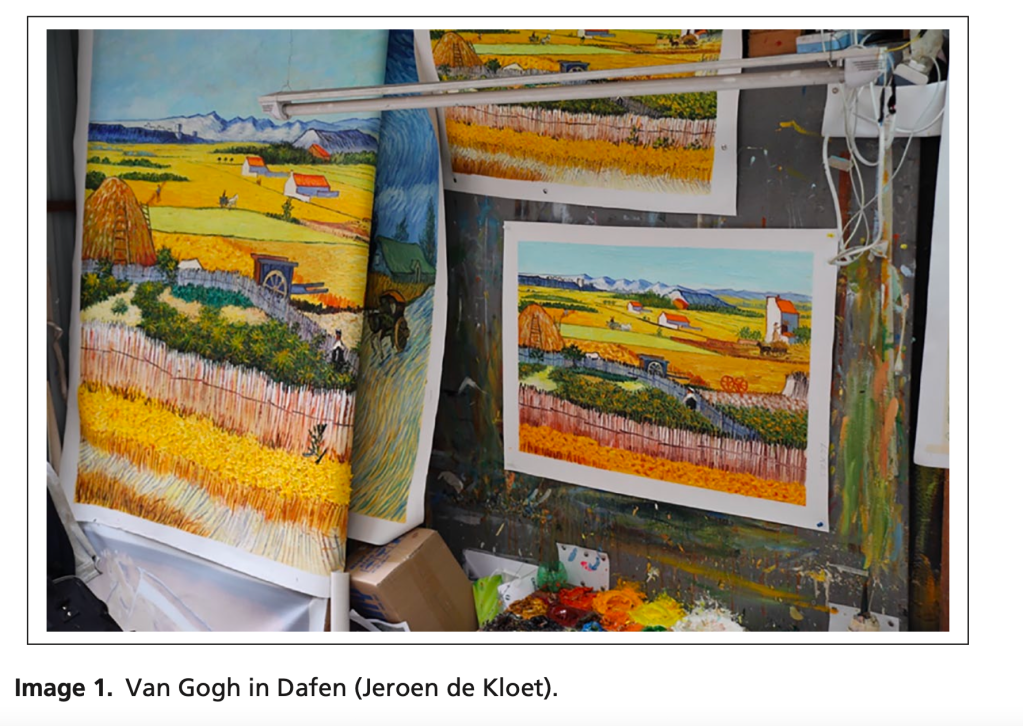
But when. . .researching shanzhai art made in Dafen village, located in Shenzhen, Southern China, and home to hundreds of painter-workers who make reproductions in every thinkable style and period, I was struck by the diversity of the artworks and their makers. The cheerfulness with which artworks were altered was liberating, for example, the ‘real’ van Gogh was considered too gloomy by customers, so the painters made a brighter version (see Image 1).
In another instance, I witnessed the face of Mona Lisa being replaced by one’s daughter to make it fit the household. When I brought an artwork home, the gallery called me later to ask if it matched my interior. Otherwise, I could change it. Such practices do turn conventional notions about art topsy-turvy. And shanzhai does not only concern art, it extends to phones, houses, cities, etc. As Lena Scheen (2019: 216) observes,
‘What makes shanzhai truly “unique” is precisely that it is not unique; that it refuses to pretend its uniqueness, its authenticity, its newness. A shanzhai resists the newness dogma dominating Euro-American cultures. Instead, it screams in our faces: “yes, I’m a copy, but I’m better and I’m proud of it”.’ https://journals.sagepub.com/doi/10.1177/13675494251371663
So what?
Any realistic attempt of ecological restoration with cloned bucardo [the Pyrenees ibex] would have to rely on hybridisation with other subspecies at some point; the genetic material from one individual could not be used to recreate a population on its own. Juan hypothesised: “we would have had to try to cross-breed in captivity, but you never know what could be possible, with new tools like CRISPR developing… and those [genome editing] technologies that come in the future, well, we don’t know, but maybe we could introduce some genetic diversity. This highlights a fundamental flaw in cloning as a means of preserving ‘pure’ bucardo—not only are ‘bucardo’ clones born with the mitochondrial DNA of domestic goats, but the hypothetical clone would also be subjected to further hybridisation. This begs the question, could such an animal ever be considered an authentic bucardo?” https://rgs-ibg.onlinelibrary.wiley.com/doi/10.1111/tran.12478
7. Colonial violence, domestic violence: an example of how genre, juxtaposition and intertext matter.
1. “The Canto of the Colonial Soldier” (sung in English with French subtitles). From the opera, Shell Shock, by Nicholas Lens (libretto by Nick Cave) from 3.25 minutes to 10.00 minutes in the following link:
2. “IT” (Scene XI) from the opera, Innocence, by Kaija Saariaho (multilingual libretto by Aleksi Barrière of the original Finnish libretto by Sofi Oksanen) from 44.25 minutes to 49.33 minutes in the following link.
This particular scene is about a mass school killing, sung by the students and in different languages. You will want to read the English translation before watching the clip.
Saariaho stipulates that the Shooter should not appear on stage at any time, while the Colonial Soldier is the first shooter to be heard in Lens’s work.
“Mitigating the risk of extinction from AI should be a global priority alongside other societal-scale risks such as pandemics and nuclear war.”
A while ago, a joint statement was issued by the Center for AI Safety. It was the one sentence quoted above. Famously, it was signed by more than 350 AI experts and public figures.
Now, of course, we cannot dismiss the actual and potential harms of artificial intelligence.
But, just as clearly, these 350 people must be among the last people on Earth you’d turn to for pandemic and nuclear war scenarios of sufficient granularity against which to appraise their AI crisis scenarios.
The conventional balance of terror and ecocide
Article 8. . .Ecocide
1. For the purpose of this Statute, “ecocide” means unlawful or wanton acts committed with knowledge that there is a substantial likelihood of severe and either widespread or long-term damage to the environment being caused by those acts. . . .
It’s common enough today to recognize the huge environmental costs of the military (e.g. https://www.securityincontext.org/posts/entropy-economics-of-military-spending). Far less recognized are those ongoing discussions and debates over military strategies as if the environmental damages were irrelevant to the merits or not of the strategies.
Take a 2025 article published in Foreign Affairs by Andrew Lim and James Fearon, “The Conventional Balance of Terror: America Needs a New Triad to Restore Its Eroding Deterrence” (https://www.foreignaffairs.com/united-states/conventional-balance-terror-lim-fearon). Here the authors argue for a US defense strategy of heightened deterrence similar to its USSR strategy in the Cold War but now with respect to the Peoples Republic of China’s military build-up in the Indo-Pacific:
[M]any of the United States’ conventional assets in the Indo-Pacific, such as its surface ships, are highly visible or heavily dependent on fixed facilities that could easily be targeted. If a crisis were to break out, the United States might have to threaten escalation to compensate for its lack of conventional response options—potentially up to the nuclear level. To remedy this problem, the United States should develop a “conventional triad” modeled on its successful nuclear strategy. Such a force structure would both increase U.S. combat credibility and decrease first-strike incentives on both sides.
Threats are mentioned, but the only occasions environment is referenced is with respect to the “threat environment” of China’s precision-strike missiles and related capabilities.
Not a scintilla–not a homeopathic whiff–of the massive environmental costs associated with this new balance of terror, let alone on the US side:
To build an effective conventional triad, the United States must invest in more submarines, bombers, and mobile launch vehicles. This would entail, for example, redoubling current efforts to increase the production of Virginia-class attack submarines; increasing the production of B-21 bombers; accelerating air force efforts to deploy a “palletized” munitions launch system, which enables transport aircraft to launch conventional cruise missiles; and expanding the range and capacity of the Marine Littoral Regiments and the U.S. Army’s Mid-Range Capability, a land-based missile launcher system that was recently deployed to the Philippines.
And so here we are, once again, in a world whose MOST BLISTERINGLY OBVIOUS FACT is that it’s no longer the 1960s and 1970s where military strategies can be debated as if ecocide were beside the point.
“So long as people meet the baseline,” or: Die, so I can be sustainable
To end, I consider the objection that my view, insofar as it sees ecological sustainability as a constraint on a people’s self-determination, could license green colonialism on the basis that new settlers could ecologically sustain a territory better than Indigenous peoples. First, according to my view, the duty of ecological sustainability is sufficientarian and tied to maintaining the material prerequisites for human life, political society, and a people’s capacities to exercise its self-determination. Thus, an outside group cannot violate a people’s self-determination on the basis that it could better ecologically sustain that territory so long as the people meet this baseline. Second, many Indigenous peoples have historically in fact met this threshold by developing effective cultural and political systems to adapt and sustain their ways of life in the ecosystems they have inhabited (Whyte, 2018b). Where Indigenous peoples struggle to ecologically sustain their territories today is generally itself due to colonialism, which would explain why colonialism is wrong and not why green colonialism is justified. [my bold]
The reference to “Whyte, 2018b” is to Kyle Whyte’s “On resilient parasitisms, or why I’m skeptical of Indigenous/settler reconciliation” in the Journal of Global Ethics (accessed online at https://doi.org/10.1080/17449626.2018.1516693).
Here, however, is another reference to Whyte with an altogether different implication for whose sustainability in the end really matters:
Indigenous ways of knowing and living have never in the history of the planet supported more than fifty million human beings at once; to envision humanity “becoming indigenous” in any real way would mean returning to primary oral societies with low global population density, lacking complex industrial technology, and relying primarily on human, animal, and plant life for energy. . . .
It means “not just our energy use . . . our modes of governance, ongoing racial injustice, and our understandings of ourselves as human”—not only the roots of plantation logic in forced literacy, centralized agriculture, and private property—not only the possibility that it may be “too late for indigenous climate justice,” in the words of Kyle Whyte. . .Thus while pre-modern indigenous social formations are doubtlessly more ecologically sound than the ones offered by progressivist capitalism, the only path to reach them lies through the end of the world. And as much as we may be obliged to accept and even embrace such an inevitability, committing ourselves to bringing it about is another question entirely.
“Underdog metaphysics,” coined by sociologist Alvin Gouldner, has been defined as:
On the assumption that truth is nothing more than the point of view of resourceful groups—imposed by these elite groups on everyone else—the conclusion ensues that powerlessness is more truthful than truth itself. That is, the absence of power becomes the new touchstone of what is true and valid. The new foundation is the group affiliation of marginalized identities. The “view-from-nowhere,” idealized by positivists, is replaced with a “view-from-the-margins.”
Let’s not forget, however, just who finds powerlessness to be an elite position:
American intellectual and literary culture may or may not abandon its deference to power and wealth and go to that necessary war against itself in order to salvage its dignity and purpose. But there is some cause for hope in the certainty that the best and brightest in the American intelligentsia won’t go looking for crumbs from the presidential table. Spurning breezy despair and jovial resignation, they might even assume the usual condition of writers elsewhere: a bitter but spiritually liberating powerlessness.
Take a peek at the track record of advisers to their leaders:
Plato and Dionysius II;
Aristotle and Alexander the Great;
Seneca and Nero;
Ibn Rushd (Averroes) and Caliph Abu Yaqub Yusuf;
Petrarch and Emperor Charles IV;
Montaigne and Henri IV;
Descartes and Sweden’s Queen Christina;
Leibnitz and the Dukes of Hanover;
Voltaire and Frederick the Great;
Diderot and Catherine the Great; and
in case you want to add to the list, Adam Smith and the Duke of Buccleuch or Goethe and Prince Carl August, and so on through the centuries. . .
Or if you really want to cringe, consider André Gide recommending against publishing Marcel Proust, Edward Garnett against publishing James Joyce, and T.S. Eliot against publishing George Orwell. . . .
I mean, get real: If these guys didn’t advise effectively, who are we to think we can do better? (And, puhleeese, don’t throw up Kissinger and Nixon as a working template!)
So what? Two things. It’s hard to imagine two words scarier in English than “designing leadership.” And we should take to heart the extensions of, “It was beyond our mental capabilities to predict Bob Dylan winning the Nobel in 2016.”
Sorry to interrupt, but is your point. . .?
. . . .Given the scope and scale of the financing (and divestment) required for mitigation and the support for adaptation, current financing gaps suggest transitions are not happening at the pace or scale they need to cope with catastrophic change. CPI find that global climate finance needs will amount to $6300 billion worldwide in 2030 (Buchner et al., 2023) and should have reached about $4200 bn in 2021. Yet in 2021, total climate finance amounted to $850 bn: a significant sum, but nowhere near what is required. This is hugely challenging, yet needs to be set against the costs of inaction. Without such interventions, warming will exceed 3°C, leading to macroeconomic losses of at least 18% of GDP by 2050 and 20% by 2100 (NFGS, 2022). . . .