A stylized recasting of the traffic mess (longer read)

I

Traffic congestion is routinely described as a mess, but rarely analyzed for the different messes that it is.

To see how, start with a simplified assumption to be problematized shortly: The net monetary value of any transportation system aggregated across all car users increases with the number of cars using that system up to the system’s carrying capacity for cars, which if exceeded leads to a decline in net value. This is shown in Figure 1’s net monetary value curve, AA’, which falls after reaching the system’s limit in carrying more automobiles (CC):
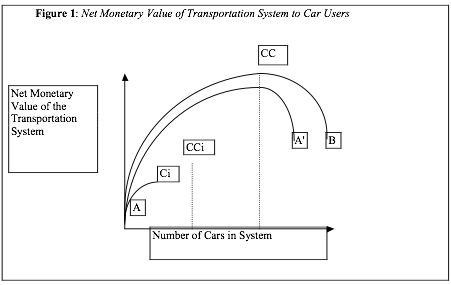
Assume the only value of interest is the value of the transportation system to car users. Assume initially that CC is fixed and that the current number of cars on system roadways exceeds that value. It may be possible to add new roads and new lanes over time, thus moving CC to the right (“supply management”). It may also be possible to reduce the number of cars to the left of CC by congestion pricing, vehicle taxing, and other tolls (“demand management”). Assume, however, that such interventions are not possible anytime soon (or if possible, their effects are not to be realized soon).

What can the transportation professional do instead in the face of car congestion?

II

Further benefits follow from other ways to increase the value of the transportation system, even when it is not possible to increase the number of cars on the roads, e.g., through reducing average car size or narrowing lanes. Value also increases, ceteris paribus, when the number of passengers in a car increases (this being, the important issue of increasing shared mobility and/or the number of uses to which the car is being put by its users).

Once other net benefits are added, the net monetary value curve rises, illustratively, to AB in Figure 1, with a gradual, delayed decline after CC being reached. More multiple-use vans on the road replacing existing vans and vehicles increase the value curve before carrying capacity is reached. Once carrying capacity is exceeded, the time lost being stuck in traffic will be offset for some period by being able to do more things in one’s vehicle than before.

Diagrammatically, the increment in value between AA’ and AB, particularly after CC, is the value car users attach to a good mess coming out of the bad mess of the formal transportation system.

This is the value car users attach to producing a mess (AB) better than the one (AA’) that would have happened instead. Other things equal, the aim of transportation professionals is to enlarge that increment. For example, not only do professionals want people “to get their best ideas” while stuck in traffic, they want more people to do so.

III

The simplified figure suggests two other ways to change net value. One is to redefine carrying capacity; the other is to redefine the “transportation system” and its services of interest. Carrying capacity has been a popular concept in modeling traffic congestion, its intuitive appeal being that there must be a limit to the number of cars that a system can accommodate, other things constant. As other factors are rarely constant, carrying capacity is necessarily a variable rather than a given.

This leads to the second way to alter net value. Just what is the “transportation system” being evaluated in terms of a good or bad mess? It need not only be the “official” system discussed so far. It is possible to redefine the transportation system of interest by changing the scope and knowledge bases for the “system” being analyzed and managed.

How to do this?

IV

Imagine you are a professional in the Regional Transportation Authority. You have just undertaken a stratified random sample survey of RTA residents as to what they perceive to be locally successful transportation interventions about which they have first-hand knowledge. Focus groups and public meetings have subsequently been held, identifying other perceived successful interventions in the region.

Assume the current list identifies interventions that include traffic calming sites in some neighborhoods, increased off-street parking in others, widening streets at different sites, adding bicycle lanes in another set, and so on. Your task is to determine an implied or de facto “transportation system(s)” that link these discrete (groups of) sites together.

The implied systems, if any, are more than street networks that connect the sites concerned. The existing availability and distribution of garages for cars, both above and below ground, connects sites as well. Yet the RTA currently does not consider the de facto, informal network of public and private garages to be a major point of intervention in improving the formal, official transportation system.

Your challenge in the constructed example is to ask, What are we missing by focusing only on the formal transportation system and in answer to see what could or does connect sites of successful interventions into a system or network that can be supported by transportation professionals.

V

One such informal system is illustrated in Figure 1. Here the transportation system is an informal one, i, implied by the connected sites, with its value curve ACi and its carrying capacity, CCi (which would now be recast in terms of local knowledge and familiarity with specific traffic patterns).

Diagrammatically, ACi is the net value car users attach to a good mess that could go bad at some point near or after CCi. If traffic professionals cannot squeeze good messes out of the bad mess that congestion has become (i.e., realize and increase a value increment between AA’ and AB), they can identify, protect and enhance different systems that are not (yet) bad messes.

What should the professionals do if there are neither informal systems to be improved nor any value increment to be realized in the formal transportation system? The “best” they can do under such circumstances is to try to keep Figure 1’s AA’ as “close” to the left of CC as possible or on the non-declining portion of AA’, should it exist, after breaching CC. Barring either, the professional is left with trying to halt or delay the further decline of AA’.

VI

Four kinds of good messes are, in other words, to be distinguished in the constructed example. They are the product of two states and transitions, namely, what start out as good or bad messes and what end up as more of a good mess or less of a bad one. Table 1 summarizes the four positions:

Table 1: Four Types of Good Messes in Traffic Congestion
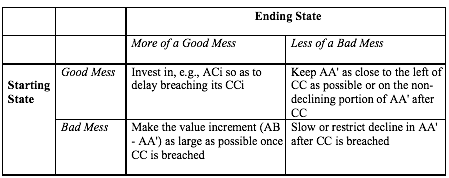
In case it needs saying, each is a good mess in its own right, though perceptions and expectations about the four cells vary considerably.

Two versions of yes, but

I

Yes,

One space spreads through all creatures equally –
inner-world-space. Birds quietly flying go
flying through us.                                                                          Rainer Maria Rilke                                                                                                                                                                                                                         

but,

They spoke to me of people, and of humanity.
But I've never seen people, or humanity.
I've seen various people, astonishingly dissimilar,
Each separated from the next by an unpeopled space.                 Fernando Pessoa

II

I in fact believe that we possess valid criteria for judging when criticism is good and when it is bad…But I also think it is a mistake to assume, and self-defeating to pretend, that these criteria are simple and obvious….To get progressively clearer to the multiple and interdependent discriminations involved requires the evolving give-and-take of dialogue…[W]hen a proponent says, ‘This is so, isn’t it?’ his interlocutor will reply, ‘Yes, but. . .’ M.H. Abrams, literary critic

The motto on his shield is a bold ‘YES BUT—.’ Dwight Macdonald, the critic writing of himself

Remember, I started out learning and appreciating literature at the time of the Black Arts Movement, when people were saying, ‘Look at what’s around you. Look at the people around you. Look at all that music around you.’ I was learning poetry at that time. So I was learning poetry when people were saying, ‘We don’t need no poems about trees. We need poems about the people.’ That was one of the things that you would hear from the people who wanted a certain kind of community poetry. But see, you’ve got a guy like me who’s listening to that, and I’ve been twelve miles out on the Bermuda reef and working in Alaska. My job was with nature. So when I picked up the Black Arts Movement, I picked it up with, ‘Yeah, yeah. But—.’ Ed Roberson, poet

An eye-drop’s worth of realism

Economists long insisted that the heroic stakes were framed around Market Competition versus State Planning, with Competition winner of the palm. Who needs Illiquid Government when you have Liquid Markets, right?

Odd then that economists began to agree that the maintenance of the storied perfect competition (all price takers and constant returns to scale) would have undermined entrepreneurial capitalism as actually practiced.

Odd that a major winner of always-late capitalism would not have been possible without imperfect competition (some price makers and increasing returns to scale) and an important role for—guess what?—government policies to foster technological change. Odd that, after all those storylines about the rising tide of market liberalization lifting all ships, it turns out that still-liberalized capital markets continue to be associated with rougher seas of financial instability.

Even odder is that implacable criticism economists levelled against price-setting by planners who couldn’t possibly process all that complexity when everyone knows that price discovery through markets does so much better. In the aftermath of 2008, however, economists told us that even core market mechanisms like auctions—Léon Walras must be turning in his grave!—can’t work because of the sheer complexity of the instruments of financial economists to be auctioned—which meant the defamed planners had to get involved anyway. Odd that economists also told us we needed dark pools and out-of-sight markets because price discovery, rather than being the raison d’être of markets, is merely a public benefit that markets may, but need not, provide.

To be fair, markets manage some risks better than government, but only those risks and certainly not the uncertainties that can come with their managing those risks through markets. The management of the latter has been placed in the hands of government and regulators.

There’s no part of the economic stories told us that even an eye-dropper’s worth of realism wouldn’t improve.

Bringing the frame into the picture

I

Stanley Cavell, the philosopher, wrote that “there is always a camera left out of the picture,” by which I take him to mean that were we able to bring it in, a very different picture would result.

A wonderful story passed on by the poet, Donald Hall, illuminates the point. Archibald MacLeish told him about the actor, Richard Burton, and a brother of his:

Then Burton and Jenkins quarreled over Coleridge’s “Kubla Khan.” Jenkins said it was a bad poem: disgusting, awful. Burton praised it: magnificent, superb. Jenkins repeated that it was nothing at all, whereupon Burton commanded silence and spoke the whole poem, perfect from first syllable to last. MacLeish told me that Burton’s recitation was a great performance, and when he ended, drawing the last syllable out, the still air shook with the memory and mystery of this speaking. Then, into the silence, brother Jenkins spoke his word of critical reason: “See?

And do you see the camera you’re holding to frame this?

II

Go look for one of those early 20th century American landscape paintings by, e.g., Redmond Granville, of wildflowers spreading across fields or Edgar Payne of a remote lake in the snowy Sierras. Then look at virtually the same painting, but this time with a young woman in her calico dress or cowboy on a horse.

In an instant, this painting dates the preceding one. What had been an idealized-now flips to a historicized-then. If you wiil, it reframes it. Public policy is full of such flips and reframing: reforms that work on paper but date immediately when real people with real problems in real time enter the picture—both as subject and as frame.

Why it matters that information overload and cognitive undercomprehension are not the same

I

Two drivers of not-knowing, inexperience and difficulty are often conflated—information overload and cognitive undercomprehension.

Think of information overload as: The “right” information is actually there but hidden in the info glut around us. Cognitive undercomprehension, in contrast, is: Our cognitive limitations undermine our ability to recognize anything like “the right information” for the matter at hand.

Overload means we would be high-performing analysts and managers if only we were to tease out the right information from all the noise obscuring it. Undercomprehension means we are held to such high-performing standards we couldn’t possibly know the right information, even if it were in front of us before our very eyes. “I could do my job if only I had the right information” is not “No one could do the job I’m tasked with, whatever the info available.”

II

Two upshots deserve emphasis.

First, at or beyond the limits of cognition, not only are prediction and forecasting difficult, so too is identifying counterfactual conditions, not least of which is what would happen if overload and undercomprehension were absent or otherwise ameliorated.

Second, arguments asserted as policy relevant because of their diamond-sharp clarity rarely get beyond the magic stage. They misdirect us from better identifying any overload and undercomprehension already present, were we only to look for them. They don’t want you to see the shadows as their flashlight is too bright.


Source

Sartori, G. (1989). Undercomprehension. Government and Opposition 24(4): 391–400.

Major Read: First, differentiate (in)equalities

Even when (especially when?) the initial conditions of a major issue are complex, the cognitive disposition is to see, really see, the issue as if in the clear light of day and around which we can walk and examine from all directions, including close-up and at a distance. Yet instead of clarity, though, we  miss much as the issues come to us perceptually as fragmented herms, partial torsos held on thin shafts, more an etiolated Giacometti than bodied Rodin.

Each issue marks what is not (no longer) there as also being present. Adam Smith’s The Wealth of Nations and J-J Rousseau’s The Social Contract have a good many implications for inequality, but their resonance for that topic is also as fragments of larger unfinished works the authors never got to write. This too is markedly the unfinished business of any complex policy issue as more can and must be said but hasn’t (again, think inequality).


The methodological imperative in better understanding debates over (in)equality is: First, differentiate. How do our fragments of understanding differ? Much debate remains at the macro-principle node, e.g., we all have equal rights. Yet from the get-go, exceptions have been read-off the macro in the form of specific contingency scenarios, i.e., people are in principle equal but people are not born with equal potentials. Contingency scenarios qualifying the reading of macro principles – “It’s always a good principle, even as it needs modifying here. . .” – litter debates over (in)equality.

Genetics is of course not everything and we find vast differences in human-by-human particularities in virtue of different life experiences, lived contexts and tacit knowledge. Equal at the macro level, the most obvious fact at the micro-level is how unequal we are in so many respects. Equal like the teeth on a comb, but, oh, the different combs!

Macro-principle, principle-based contingency scenarios and micro-experience are not the only nodes around which equality debates cluster and organize. The gap between macro-principle on paper and system behavior in practice is everywhere evident when it comes to (in)equality. Systemwide pattern recognition, this fourth node, is populated by all manner of trends and statistics that show, e.g., just how unequal income, wealth and consumption distributions are within and across countries. Indeed, the shortfall between equality as professed and equality as realized is benchmarked by this gap between macro-principle and the empirical recognition of systemwide patterns.

The upshot is that the macro-node in these debates formalizes as principle what others cannot help but seek to informalize through exceptions and contingency scenarios. The micro-node informalizes what others cannot help but seek to more formalize when they talk about systemwide patterns emerging across different cases.


Of course, nothing stops a person privileging one node over another, or some over others. In doing so, however, the person foists exaggeration on the rest of us. There is a world of difference between privileging one node from the get-go versus answering the question, “What do we do here and now for this (in)equality,” only after first assessing the four nodes with their conflicts and examples.

So what?

It just isn’t that values concerning (in)equality are socially constructed. It’s that the thick paste of macro-principles cannot stop the surfacing of all those contingent factors that differentiate inequalities for the purposes of really-existing policymaking and management–societal, political, economic, historical, cultural, legal, geographical, governmental, psychological, neurological, technological, religious, and more. Inequality and equality, like congeries, have always been plural nouns.

For example, the World Bank estimates over 1.5 billion people globally do not have bank accounts, many being the rural poor. Yet having bank accounts ties people global financialized capitalism. What, then, has more value? The rural poor with bank accounts or not? Integrated even further into global capitalisms or not?

There are, fortunately, those who insist such is not a binary value choice. Many with bank accounts also work to change the upper reaches of financial capital. But there are also those aiming for the lower-reach specifics: Surely, bank accounts work in some instances and even then differently so.

Insisting on case-by-case comparisons looks to be weak beer. That is, until you realize the self-harm inflicted when political possibilities are foreclosed by any macro-policy narrative that abstracts the world into one that is colonized or fragmented everywhere and all the time by capitalisms and only by their inequalities.


For more on inequality from this perspective, please see When Complex is as Simple as it Gets: Guide for Recasting Policy and Management in the Anthropocene

Two examples of surprise as a policy optic

I

For G.L.S. Shackle, British economist, possibility inverts surprise: The larger one’s surprise that something will happen, the less possible it is from the perspective of the person concerned. To ask what would be the biggest surprise in Global Climate Change (GCC) is to ask what would be the most counter-expected or unexpected event with respect to it. When I do ask, I’m told the most surprising eventuality would be things become far worse far faster, but in unimaginable ways.

But wouldn’t the total surprise be instead: Most everyone most everywhere benefits as a result of GCC? This would have to mean more than producing local sites of net benefit, i.e.,  some countries, regions or people benefit in aggregate from climate change, while most do not. Rather, the greatest surprise here would be that “business as usual” in intervening in climate change makes things better for far more people and the planet than currently supposed. The real surprise would be if we managed our way through GCC with no more than the counter-measures already underway or in the pipeline (business as usual of course does not mean do-nothing).

For Shackle, the more surprising, the less possible. How then could such a counter-expected event about GCC even be possible?

One answer is that of well-known philosopher of science, Roy Bhaskar: While the world is real, it is more complexly real than humans with their instruments can cognitively grasp. Should climate change be real in Bhaskar sense, its reality must as well be more differentiated than uniform, unknowable and not just unknown, more immanent or emergent than fixed, right? In this view (and again it is a possibility only) it is unrealistic to assume surprise (and so, necessarily, knowledge) is even on net, negative. Surprise is only negative if resilience cannot incorporate unpredictability, including randomness, as a resource.

II

It’s long been recognized that large complex systems are surprising even to their managers and real-time operators. The unexpected often happens. Even the most experienced operators, who say little shocks them by this point, find themselves wondering how this happened, now.

This is a very suggestive finding in my view. The financing and construction of homes and flats in the San Francisco Bay Area is a complex housing sector. All manner of politicians, regulators, investors, advocacy groups, developers, jurisdictions, localities and residents interact, and this unsettled and unsettling variety is itself often pointed to as proof-positive of the complexity. In this sector, everyone has stories to tell about the unexpected I’ve been told.

What if then we recast the stakeholder complexity in terms of the surprises experienced by those involved? Instead of housing prices going, we talk about: COVID comes, things shut down including construction, and yet the price of lumber skyrockets in ways that shock even those in the know (think supply chain interruptions).

So what? This implies unexpected ripple effects by way of inter-linked surprises, which in turn raise at least one methodological question (surprising to me, anyway): When it comes to this construction sector in the Bay Area, is it better to say we have networks or communities of surprises?

Plato is surely right if he asked, “Are we on our way to or from first principles?”

As long as the design of laws, policies and regulations are based in a priori principles (inevitable to my mind) and as long as better practices that emerge across a run of cases cannot be distilled into principles without a paralyzing loss of relevant information for policy, law and regulation (inevitable to my mind), macro-design remains a starting point for reliable behavior in a messy policy world, but never its end.

When it comes to reliability, it is important to note that there is always a gap between macro-principle and better practices, as each reflects different knowledge bases (more deductive in the former, more inductive in the latter). Plato is surely right if he asked as reported, “Are we on our way to or from first principles?”

One example is the difference between the principle of trans-substantivity in US federal civil procedures and the set of evolving common law precedents. Common law has to take the substance of the case into account (in fact, common law is characterized by substance-specific procedures). Trans-substantivity in Federal Civil Procedures, on the other hand, is the principle that a set of procedures apply equally to all cases regardless of the substance. It is not surprising that the macro-principle of trans-substantivity has remained under constant criticism for not taking into account context.

Or to put it the point here the other way around, macro-design for reliability that resists any kind of pressure to be operationally modified in light of the cases at hand is best thought of not as design but as surface pieties so void of content as to be outside any knowledge base for reliability with which humans are acquainted.


Source

D. Marcus (2010). The past, present, and future of trans-substantivity in Federal Civil Procedure. DePaul Law Review 59 371 (https://via.library.depaul.edu/law-review/vol59/iss2/6)

Three design principles that matter for high reliability management of critical infrastructures

I

Only from the position of macro-design can you argue from first principles to fixed conclusions. So, when I’m told that macro-principle also governs really-existing micro-operations (think: universal human rights applying equally to each and every individual across the planet), I’m left wondering: Just how does this work?

Such is why “design” is a trigger-word for me. Anyone who has tried to operationalize a project plan or blueprint—today’s version of clockmaker God and the echt rational—knows how contingency and context get in the way of plug-and-play implementation and any such arrow-straight causality.

Nothing, though, stops some principles being grounded explicitly in and around how things do work. In my field, policy analysis and management, I can think of three.

First—as a matter of principle—every design proposal must pass the ‘‘reliability matters’’ test. Would the proposal, when implemented, reduce the task volatility that managers face? Does it increase their options to respond to volatility? Does it increase their maneuverability in responding to different, often unpredictable or uncontrollable, performance conditions?

The test of efficacy here is not ‘‘Have we designed a system that can be controlled?,’’ but rather ‘‘Is this a system we can manage to redesign when needed?’’

Second—as a matter of principle—any macro-design that compels its professionals to work for an extended or indefinite period of time in a task environment outside their domain of competence cannot be expected to produce reliable services. A crisis of course can push real-time professionals to work beyond the limits of the known, even of the knowable—but management professionalism can’t make the coping professional as well.

Third, as a matter of principle, management alternatives exist because society and economy are complex, i.e., because problems are complex, they can be recast differently.

II

So what?

The three principles taken together insist that system designers learn about contingencies that cannot be planned for, but which must be managed in real time, and often only then case by case. This means that the responsibility and duty of real-time veto over infrastructure design and technology moves from the designers/planners to its operators/managers–when high reliability is the mandate.

What about Global Climate Sprawl?

You get them wrong before you meet them, while you’re anticipating meeting them; you get them wrong while you’re with them; and then you go home to tell somebody else about the meeting and you get them all wrong again. Since the same generally goes for them with you, the whole thing is really a dazzling illusion empty of all perception, an astonishing farce of misperception. And yet. . .It’s getting them wrong that is living, getting them wrong and wrong and wrong and then, on careful reconsideration, getting them wrong again. That’s how we know we’re alive: we’re wrong.

I want to suggest that Global Climate Change (GCC) isn’t just a bad mess; it’s a spectacularly, can’t-keep-our-eyes-off-it, awful mess of doing things wrong, again and again. It’s a hot mess–both senses of the term–now sprawled all over place and time. It is inextricably part and parcel of “living way too expansively, generously.”

GCC’s the demonstration of a stunningly profligate human nature. You see the sheer sprawl of it all in the epigraph, Philip Roth’s rant from American Pastoral. So too the elder statesman in T.S. Eliot’s eponymous play admits,

The many many mistakes I have made
My whole life through, mistake upon mistake,
The mistaken attempts to correct mistakes
By methods which proved to be equally mistaken.

That missing comma between “many many” demonstrates the excess: After a point, we no longer pause, our words and actions rushing ahead. (That the wildly different Philip Roth and T.S. Eliot are together on this point indicates the very real mess it is.)

That earlier word, sprawl, takes us to a more magnanimous view of what is going on, as in Les Murray’s “The Quality of Sprawl”:

Sprawl is the quality
of the man who cut down his Rolls-Royce
into a farm utility truck, and sprawl
is what the company lacked when it made repeated efforts
to buy the vehicle back and repair its image.
Sprawl is doing your farming by aeroplane, roughly,
or driving a hitchhiker that extra hundred miles home…

This extravagance and profligacy–the waste–are not an ornery contrarianism. For poet, Robert Frost, “waste is another name for generosity of not always being intent on our own advantage”. If I had my druthers, rename it, Global Climate Sprawl.