“Wir schaffen das” (“we can manage this”), Angele Merkel, 2015, then-Chancellor of Germany, referring to the migrant crisis in Germany and Europe.
Well, maybe in the beginning the influx was managed, but not now.
Germany initially met the increase in input variance with an expansion of process options (e.g., a major distribution and increase of migrants into towns and villages). But it’s the input variance that has increased massively since, with the pandemic lockdown, Ukraine impacts (e.g., more refugees and energy shortages), and all other disruptions up to and through the present.
So not surprisingly more of this is heard now: “We want to regain control of migration,” said Mario Voigt, CDU head in Thuringia. And yet that would mean controlling input variance, and since when have exogenous factors like war, pandemic and mass migrations been controllable in the sense this guy is talking about?
I may be wrong, but I believe these migration crises must be substantively recast and reframed, if we are to make them more tractable to policy and management (without, however, simplifying them or obscuring the complexities involved). There are a variety of policy optics to recast complex policy issues, including a focus on counternarratives, different methods, other-than-usual analogies, and key concepts around a more granular, differentiated analysis. (See my Guide https://opendocs.ids.ac.uk/opendocs/handle/20.500.12413/18008)
Below are examples for each with respect to the currently understood “migration crises”. No pretense is made that these quoted excerpts from publications are everywhere relevant for policy and management. They are offered, with little edit, in the spirit of softening up what look to be obdurate crises that can be defined in no other way than currently.
I. Counternarratives
The discourse of apocalyptic climate change-induced mass migration is now past its prime. Particularly since the early 2010s, it has been extensively critiqued (see Hartmann 2010; Bettini 2013; Piguet, Kaenzig, and Guélat 2018; Wiegel, Boas, and Warner 2019), and the majority of migration scholarship no longer expects a linear, massive and world-transforming movement of people under climate change. Indeed, an ever-rising number of studies shows the opposite is the case: that relations between climate change and human migration are often indirect, small-scale, and taking shape in context-specific ways, influenced by a host of other socio-economic and political factors. The ways in which people move in a changing climate are diverse, and typically consist of relatively local mobilities (for overviews see: Black et al. 2011a; Foresight 2011; McLeman and Gemenne 2018; Hoffmann et al. 2020; De Sherbinin 2020).
Irregular migrants need to be able to safely report labour exploitation and exercise their labour rights without fear of deportation. We therefore propose creating a special temporary work permit – call it a ‘redress work permit’ – specifically for irregular migrant workers who have come forward to claim their rights and whose employment conditions, while working illegally, were found to constitute a significant breach of their fundamental rights. Such a redress work permit could be included in European laws either by amending the current Employer Sanctions Directive, or as part of a new EU Directive on Labour Standards for Irregular Migrant Workers in the EU. . .
I argue that detained migrants become valued not only for their exploited labour, but as bedspace occupants who trigger rent payments from ICE to corrections firms.” “As detention occupants, migrants’ cash value for others is more than metaphorical. Formally and institutionally, they are made fungible, exchangeable, transformed from people with lives and stories into chargeable bed days.
Beds have been the center of urgent political struggles — be they in prisons, detention centers, hospitals, or nursing homes. Our virtual conversation series centers “bed activism,” complex forms of resistance and visionary care that emerge from the intimate spaces of sick, disabled, detained, and imprisoned peoples. It connects a long-term vision of connecting communities and movements at the nexus of abolition feminism, migrant justice, and disability justice.
Between 2010 and 2019, over 2 million people have crossed the Mediterranean to reach the shores of Europe, escaping conflicts, persecution and poverty and looking for a better chance in life (D’Angelo, 2018a; UNHCR, 2020). Since the mid-2010s, this phenomenon, widely labelled as a ‘Refugee Crisis’ (Crawley, 2016), has been at the centre of media and academic debates, with considerable attention being devoted to the humanitarian concerns over search and rescue at sea and the implementation of the European Asylum System (Crawley et al., 2017; Spijkerboer, 2016; Vassallo Paleologo, 2016). . .Specifically, the current mainstream narrative is one that looks at these people as passive components of large-scale flows, driven by conflicts, migration policies and human smuggling. Even when the personal dimension is brought to the fore, it tends to be in order to depict migrants as victims at the receiving end of external forces. Whilst there is no denying that most of those crossing the Mediterranean experience violence, exploitation and are often deprived of their freedom for considerable periods of time (Albahari, 2015; D’Angelo, 2018a), it is also important to recognize and analyse their agency as individuals, as well as the complex sets of local and transnational networks that they own, develop and use before, during and after travelling to Europe.
For migrant workers who do not have access to other means of income, the platform economy offers a viable yet exploitative alternative to the conventional labour market. Migrant workers are used as a source of cheap labour by platforms – and yet, they are not disempowered. They are at the heart of a growing platform worker movement. Across different international contexts, migrants have played a key role in leading strikes and other forms of collective action. This article traces the struggles of migrant platform workers in Berlin and London to explore how working conditions, work experiences, and strategies for collective action are shaped at the intersection of multiple precarities along lines of employment and migration status. Combining data collected through research by the Fairwork project with participant observation and ethnography, the article argues that migrant workers are more than an exploitable resource: they are harbingers of change.
The following are excerpts from Biao Xiang (2023), “Logistical power and logistical violence: lessons from China’s COVID experience,” Journal of Contemporary East Asia Studies (accessed online at DOI: 10.1080/24761028.2023.2285022).
Logistical power, be it from above or below, is defined in the article as the “capacity to initiate, coordinate, and stop mobility”:
A state gains infrastructural power by building roads, but does not acquire significant logistical power unless it can collect real-time traffic data, monitor all vehicles, and communicate with individual drivers on the move. More importantly, the concepts of infrastructural power and logistical power point to different analytical questions. Infrastructural power is by definition state power, and the concept is meant to explain how and why modern states, wielding much less despotic power than traditional rulers, can effectively govern societies of tremendous scale and complexity; and why the state and civil society have both become more powerful in the modern times. Infrastructural power enables modern states to govern through society instead of over society. Logistical power, in comparison, has its origin in social life. In most parts of human history, it is the marginal groups – nomads, migrants, hill tribes, petty traders, vagabonds and many others – which are most capable of exercising logistical power. The critical question associated with the concept of logistical power is not how state and society gain more power at the same time, but rather how state concentrate logistical power at the cost of people’s logistical power, in which process society becomes fragmented and loses its capacity of coordinating mobility.
Logistical power is the ability to coordinate mobility, and can be possessed by state and non-state actors. Logistical violence is state coercion through forced (im)mobility. Logistical power from below, namely citizen’s capacity to move and to form networks beyond government control, was a driving force behind economic reforms in the 1980s. By the 2010s, logistical power from above – the coordination of mobility by larger corporations and the state in particular – had become the dominant means of organizing the mobility of people, goods, money, and information.
II
So what?
While appearing inescapable due to its infrastructural and logistical power, the state has profound difficulty in controlling people’s thoughts, emotions, or communications. When talking to each other, citizens can construct a lifeworld of common sense, interpersonal trust, and mutual assistance. Such a lifeworld may provide a base for the capacity to refuse and resist forces like logistical violence.
State-sponsored sedentarization is logistical violence, the chief resistance to which is and remains the logistical power of pastoralists who move their herds and/or household members outside these settlements.
As regards analysis, I have been much influenced by Bob Goodin’s dictum: ‘Distinctions = arguments’. That formula cannot be quite right: distinction is often the basis for argument rather than the argument itself. For example, philosophers may distinguish different aspects of equality before using this for a normative argument. But Goodin’s essential insight is correct: we often benefit when we see that what we thought of as one thing is actually two or more things, and that our answers depend on which of these things we examine.
Thinking infrastructurally about migrants typically short-cuts to the stresses and strains they bode for a site’s infrastructures, i.e., the added demands they impose on water supplies, transportation, energy, healthcare and the social protection systems, be that site a city, region or nation.
Attempts at itemizing the benefit side of having migrants–by virtue of added economic growth and increased tax revenues–look more and more feeble these days in the face of calls for degrowth and populist pressures against more government.
Shift this frame of reference, however, and matters start to look very different.
II
Historically, diasporic immigration worldwide has had its irreversible impacts. (Think: the transoceanic slave trades.) One such irreversibility has been that immigrants and infrastructures have developed together, with worldwide as the level and unit of analysis.
Rather than a priori stressors on existing infrastructures, a better point of departure is the evolution of: water supplies with respect to immigrants, energy supplies with respect to immigrants, telecommunications with respect to immigrants, and so on. Indeed, infrastructures and immigrants render each other visible and tangible–unavoidably really-existing for themselves and the rest of us–in ways that the noticeably immaterial labor of speechifying anti-immigrant politicians and pro-immigrant advocates does not.
III
So what? In reality, pro- and anti-immigration policies have rarely been articulated in practical terms when it comes to shifts in the many different configurations of interconnected critical infrastructures, again worldwide.
The idealized concatenation of sequential and reciprocal interconnectivity–migrants leave home and arrive at their destination, and once there, interact with others–has been (if it weren’t always) much more complicated. Mediated interconnectivities of traffickers and remittances along with pooled interconnectivities (think: EU directives on border management) have complicated matters even more.
For example, the focus on shifting interconnectivities takes on increasing importance in the digitalization of border management, not least of which in the operation of Frontex, the EU’s primary agency in this area. It is argued that, via digital technologies (including AI), national borders are being securitized and militarized. Surveillance is broadened and changing dramatically. “Europe has long been implementing border and migratory policies that focus on externalising European borders as far south as Senegal or as far east as Azerbaijan” records the same report (https://datajusticeproject.net/wp-content/uploads/sites/30/2023/08/Risking-Lives-report.pdf). Another report finds:
The removal of rescue boats and the increase of the utilization of drones is used by Frontex to detect and prevent migratory flows at an early stage, as migrant vessels are recognized in pre-frontier areas. In fact, the Frontex Situation Centre is a unit in charge of monitoring the external borders and the pre-frontier areas of the EU (European Parliament, 2018). The investment in drones has increased considerably in parallel with the deterrence of external rescue operations and the withdrawal of some naval missions in the Mediterranean, as it happened in the case of the Operation Sophia. Therefore, vessels that are capable of helping migrants and asylum seekers are replaced by drones that can only observe. In consequence, the agency has not the obligation to intervene neither rescue them.
And yet, the complexity remains when the focus is on digital interconnectivites. A third report concludes:
Overall, the wide range of applications for new technologies implies that each one should be investigated independently, taking into consideration its development context and the unique requirements of the stakeholders who develop and use them. This report, therefore, debunks a totalising, black-and-white perception of the uses of new technologies. New technologies can be used for various purposes ranging from including migrants’ and refugees’ preferences in their settlement processes (as in the case of some preference matching tools) to profiling them through risk assessments or monitoring them through invasive tools such as electronic monitoring. While the former can benefit migrants by having a say in their migration and settlement trajectory, the latter can have extremely harmful impacts on them. It is, therefore, crucial to examine each use of new technology in its own right, considering its design and implementation processes and their legal and social impacts.
Yes, these cases of shifts in interconnectivity can themselves be inter-related, but by definition they cannot be reduced to one and the same case (there are, after all, separate nodes in even the most tightly coupled network.)
IV
So too when it comes to thinking infrastructurally about the diasporic communities of immigrants worldwide. Undertake a thought experiment. Assume today was able to send a macro-message to world’s diasporic communities of half a century ago. What would we say to them? At best, it would be about what not to do by way of their infrastructures, right? No more building this and that; but instead not losing more of those and these.
And when those of 50 years ago understandably shoot back and ask, “Just how is that to be implemented when it comes, say, to the digitalization you are talking about?,” is there any doubt whatsoever our replies would center around what’s taken to be ideal today with respect to the interconnectivity shifts, albeit in no way detailed enough for their cases?
If worldwide is your unit and level of analysis, then complex, thankfully, is as simple as it gets.
Begin with the strategic orientations many have with respect to resilience and anticipation as distinct from each other. Resilience is said to be optimizing the ability to absorb or rebound from shocks, while minimizing the need to anticipate these shocks ahead of time. Anticipation, in contrast, is to optimize the ability to plan ahead and deal with shocks before they happen, while minimizing having to cope with shocks when they do occur. Consider the resulting Table 1:
System designers would like managers to be both optimally anticipatory and resilient at the same time—indeed that managers maximize their “readiness” for whatever arises, whenever. These all-embracing demands can, however, reduce the managers’ much-needed capacity to balance anticipation and resilience case by case.
More, the ideal of stabilizing the task environment so as to minimize the need for both anticipation and resilience—a common enough premise (promise) of macro-designers—is as impossible to realize as it is irresponsible to promote, when the aim is high reliability in real-time operations.
Who wouldn’t be right in avoiding or resisting burn-out, if told repeatedly they haven’t “taken control” of climate change, species extinction and biodiversity loss?
It would be good to know if we are nine missed meals away from civil unrest, or only four such meals as others say.
Isn’t everything-connected-to-everything-else an odd form of stasis?
To say endemic crises have many causes and are overdetermined is like saying there’s too much wind-up for the pitch thrown.
Since when has inequality been best described as a crisis? Inequality is much more the norm before it is a crisis. Norms are accepted or not; crises are to be managed or coped with. Shaming, humiliating and ostracizing those profiting from the scandal of the status quo is a more policy-relevant response to norms of inequality.
–Conflation of the physical system managed with the area of system impacts should the system fail is common. The spatial area managed by a water supply or electric grid is not the spatial area affected by indefinite loss of water or electricity. Large critical infrastructures may be operated within regions, but regions are not systems managed on their own in the same way critical infrastructures with central control rooms are.
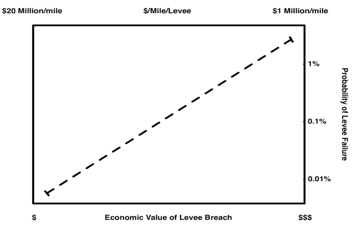
To see how this matters, picture a stylized relationship between the probability of levee failure (Pf, e.g., 1%, 0.1%, 0.01% per annum), the estimated cost per mile of levee stretch to bring it to high safety standard, and the estimated loss in economic value (including foregone earnings due to loss of life), should levee failure occur at a given Pf. One relationship is the diagonal read from the upper right to the lower left (my thanks for Robert Pyke for the figure):
The dotted line assumes that the losses in economic value of a levee breach decline as levees are brought to a higher, more costly standard with reductions in the probability of levee failure, Pf. What is managed directly is maintenance at a levee standard and the associated Pf; only indirectly is the “economic value of levee breach” managed..
–If you counter that this impact-shed is “the system to be managed,” then you beg the larger question: What infrastructure manages the impact-shed in terms of the consequences of levee breach (Cf), including economic losses?
Answer: Cf is most pertinent to the emergency management infrastructure, and not the flood and levee infrastructure, as in the illustration. The time period for the former involvement may well be limited (say, six weeks to three months after the disaster), leaving the bulk of the recovery to those infrastructures that manage systems–roads, waterways–and not the respective impact-sheds.
From the viewpoint of narrative policy analysis, the most obvious feature of the climate emergency is this narrative discrepancy: On one hand, all of us on this planet are in the terra incognita of the Anthropocene’s uncharted waters, and on the other hand, we know this because of those who stand on the terra firma of best-available science, technology and climate activism.
I do not mean that point to be a criticism nor do I see it as some kind of contradiction or inconsistency. In narrative policy analysis, the role of a narrative discrepancy is to point to a metanarrative (or metanarratives), that is: a wider narrative, if any, that explains holding both positions at the same time without inconsistency, contradiction or self-refutation. A readily-available metanarrative is the social psychological one about how persons experience the present. Even those feeling shipwrecked grasp at the prospect of life-saving wreckage and being tossed onshore as a castaway.
Where there is one metanarrative, there are often more, and my aim here is to illustrate four, among many, metanarratives that are more directly policy-relevant.
It should not surprise the reader that my strategy to identify these wider policy narratives is to differentiate both sides of the first-paragraph statement. On the one hand, how are we differently at sea and in uncharted waters? On the other, are there more specific shorelines than just science, technology and activism associated with those differences in unchartered waters and being at sea?
The following four metanarratives come into a view when and because we are operating more granularly in the climate emergency. New narratives emerge because at these levels the discrepancies that mislead analyses become clearer as do how to address them, particularly:
1. How to respond better to the climate emergency when viewed asymmetrically as failures and their costs
2. How to respond better to the climate emergency when viewed asymmetrically as having to stop this or save that
3. How to respond better to the climate emergency when viewed asymmetrically as US-style emergency management
4. How to respond better to the climate emergency when viewed asymmetrically with respect to the still much-needed reduction of global GHG emissions
————————
1. How to respond better to the climate emergency when viewed asymmetrically as failures and their costs
I recently attended a very informative conference on sea-level rise, storm surges and flooding in the greater San Francisco Bay Area, now and projected into the near decades.
Most of the day was spent on projects and interventions for climate change mitigation and adaptation about which I knew nothing, including: a Lake Mendocino water storage innovation, several dredging and sediment projects geared to beneficial uses, several wetlands restoration projects, and a great many planning and feasibility efforts funded with respect to not just sea-level rise, increased storm surges and inland flooding, but also for rising groundwater levels and changing air temperatures affecting major infrastructures differently.
In addition to these specifics, I was told:
that Bay Area would need some 477 million cubic yards of sediment–the vast majority of which can’t be sourced locally–to restore area wetlands and mudflats;
It would require an estimated US$110 billion dollars locally to adapt to higher sea levels by 2050, this being based on existing plans in place or used as placeholders for entities that have yet to plan; and
To expect much more sea level rise locally because of the newly accelerated melting of the ice cap melting in Antarctica and Greenland.
Millions of cubic yards equivalent to over 420 Salesforce Tower high-rises? Some $110 billion which has no possibility whatsoever of being funded, locally let alone regionally? And those massive new requirements posed even locally by the melting ice caps? How are these unprecedented high requirements to be met?
It’s not surprising that the individual interventions presented that day and all the hard work they already required paled into insignificance against the funding and work challenges posed by the bulleted challenges.
What to do? How to respond?
II
Such massively large sums are meant to underscore the urgency of the matter, to stir us to action that matches the unparalleled magnitude of the climate emergency. Such numbers do that for some people, but others respond by becoming instead even more uncertain than they already are. Part of that increased uncertainty is translated into dread over how to proceed (as seen with respect to nuclear weapons in the Cold War), and dread can also be instrumental in generating action.
More often though, I’ve found that the increased uncertainty generated by category-five sums ends up reinforcing the focus on and approach to narratives, projects and interventions already underway. At least we know and can see hard work achieves this!
III
And in that hard work is one answer to why such large numbers, even when they measure requirements, fall short of the needed analysis.
The problem lies in the asymmetrical estimates of losses (economic, physical, lives, and more) incurred if we don’t take action now. None of these estimated losses take into account the other losses prevented by infrastructure operators and emergency managers who avoid systemwide and regional system failures from happening that would have happened had they not intervened beforehand, sometimes at the last moment.
Why are these uncalculated billions and billions of saved dollars important when it comes to responding to sea level rise, increased storm surges, more inland flooding, rising groundwater levels and other sequelae?
Because it from this pool of real-time talent and skills and practices that society will be drawing for operationally redesigning the inevitable shortfalls in new technologies, macro-plans and regulations for climate restoration and recovery.
IV
Now deepen that wider perspective. You’d think that with the catastrophic disaster scenarios the planet faces, we’d see more investigations of how large critical infrastructures actually do avoid or avert massive system failures. You’d also think that the costs to society of confronting limitless disaster scenarios is set by the dangers of ignoring disasters, like earthquakes, floods and fires, easier to identify and assess.
So what?
Appeals to processes or state conditions such as “globalization,” “financialization,” “disaster capitalism,” and the like leave us assuming these processes are in fact the peoples’ chronic crises. The latter, though, is the case only if the with-respect-to scenarios detail how these broad processes are chronic because people have failed to avert all their own dreaded events.
————————
2. How to respond better to the climate emergency when viewed asymmetrically as having to stop this or save that
As in: Stop fossil fuels; stop cutting down trees; stop using plastics; stop defense spending; stop being imperialist; stop techno-solutionism; save biodiversity; save open spaces; save the coastlines; and in all of this never ever forget class, gender, race, inequality, identity and the rest. . .
I
An article starts with: “The climate crisis calls for a massive and rapid dismantling and retooling of our economy and society.” Yes, surely that and more; but what do we do now, right now, by way of existing options and procedures?
In the US setting, this means, among other things, decisions over activating a city or county emergency operations center and/or incident management teams at the department level to coordinate immediate response efforts. States also do the same with respect to their own EOCs, IMTs or equivalent.
This activation is done all the time, when high winds, ice storms, wildfires, heat dome effects, flooding and their combinations take down essential services, particularly backbone infrastructures of water, electricity, roads and telecoms.
II
Now the thought experiment: Activate the EOCs and IMTs, or at least the ones which know we are the climate emergency. Who then are the distressed peoples and sites? Well, that’s not something you can answer a priori or universally. It’s up to the EOCs and IMTs, who recognize the climate emergency is leaving local people hungry, making local spaces uninhabitable, taking away local employment. . .
In having to think about these things, one seemingly counter-intuitive implication becomes clearer.
Those oft-mentioned “stop-this-and-save-that” immediately hit a major obstacle. In really-existing emergency response, fossil fuel is needed to evacuate people, ship goods and services to distressed areas, keep the generators running when electricity fails, and so on. Cutting down trees, distribution of water in plastic bottles, and wide use of readily available gas-guzzling vehicles, in case it needs saying, are not uncommon.
III
Indeed and now necessarily more globally, years and years of R&D have gone into studying, prototyping and distributing more sustainable options, like eco-friendly stoves, toilet facilities, renewable-energy generators, and other alternatives.
Shouldn’t we then expect and want their increased use in immediate emergency response, especially when (not: “even if”) expediting them to the distressed sites and peoples means, e.g., using petrol to get them there? Isn’t the latter the wider narrative in which we operate in a world needing far more EOCs?
————————
3. How to respond better to the climate emergency when viewed asymmetrically as US-style emergency management
I
If your world is the world, you will quickly come across the literature on Shock-Responsive Social Protection that also addresses massive multiple shocks. But here you’d find almost an entirely different set of terms, namely, how social protection programs work with humanitarian response and disaster risk management for what is called here in the US emergency preparedness, immediate response and initial service restoration.
II
A social protection program might focus on how to transfer and get cash into the hands of the victims asap; the emergency management efforts we looked at worried about how ATMs and cellphone transactions would work once the infrastructures failed.
Humanitarian programs readily admit the need for international assistance; we interviewed no one in our recent research on disaster management in Oregon and Washington State who described “humanitarian aid” as a key emergency response, let alone from anywhere outside the US.
For its part, disaster risk management, while close to what we mean by emergency management in the States, might also include insurance mechanisms (e.g., assisting in paying premiums before the disaster) and contingency credit programs not just for recovery but also during immediate response
III
How does this wider perspective reframe US emergency management? One example will have to suffice.
Managed retreat is increasingly recommended as a response to rising sea levels confronting coastal communities, cities and major ports in the US (including the Bay Area mentioned in #1 above). We already have climate migrants in coastal Louisiana and like places, and the proposals are to manage this out-migration more systematically.
What’s missing, however, are assessments of the track records in the various managed retreat strategies out there already. Relocating capitols, for example, has not been without its major problems. Relocation of large numbers of people is even more notoriously difficult in humanitarian work.
What then might this mean in practice? One point of departure already suggested in thinking about managed retreat on the West Coast is captured in following:
Every time I visit South Sudan, the angels’ response to my criticisms never varies. “What would you have us do?” asked one exasperated aid worker as we sat drinking cold beers one night by the bank of the Nile. “If we leave, people will die.” He was right. A decade of government withdrawal from the provision of services, enabled by the humanitarian presence, and campaigns of government violence, partly paid for from humanitarian resources, had created a situation in which some people in the camps in Maban would probably starve if it were not for the aid agencies. The only solution the humanitarians can envision is to continue with this dystopic system.
Imagine, that is, not a massive withdrawal and resettlement of peoples from the West Coast (or any other major coastline for that matter), but rather masses of people who stay behind having nowhere else to go practically and who need indefinite humanitarian aid in order to survive.
Stay or not stay–either way means disaster preparedness as the wider frame of operations.
————————
4. How to respond better to the climate emergency when viewed asymmetrically with respect to the still much-needed reduction of global GHG emissions
I
One of the most famous typologies in organization theory in that of James D. Thompson:
The entry in Wikipedia explains the typology this way:
Where both preferences and cause/effect relations are clear, decision making is “computational”. These decisions are often short term and information about the decision is fairly unambiguous.
Where outcome preferences are clear, but cause/effect relations are uncertain, Thompson suggest that “judgment” takes over and you make your best educated guess. These decisions are based on prior experience and are often qualitative in nature.
When the situation is reversed, and preferences are uncertain, then you rely on compromise between different groups. Political coalitions may be built which rely on negotiating and bargaining.
When neither preferences nor cause/effect relations are clear, then you rely on “inspirational” leadership. This is where the charismatic leader may step in and this type of decision often takes place in times of crisis. (https://en.wikipedia.org/wiki/James_D._Thompson)
I want you to keep Thompson’s typology in mind when you read the following article on the case for better emissions reductions by Dr. Hannah Ritchie in the Guardian.
It’s quoted at length, in large part because I agree with every word of it. The virtue of Thompson’s typology is that it unlocks reasons why her points need to be extended, and when doing so, the important policy and management implications that follow for the climate emergency.
II
The big idea: why climate tribalism only helps the deniers
Hannah Ritchie
One of the most effective ways to be a climate sceptic is to say nothing at all. Why expend the effort slapping down climate solutions when you can rely on feuding climate activists to tear each other’s ideas apart? We tend to fight with those we are closest to. This is true of family. But it’s also true of our peers, which for me, are those obsessed with trying to fix climate change. Step into the murky waters of Twitter and you’ll often find activists spending more time going after one another than battling climate falsehoods.
These might seem like small squabbles, but they have a real impact. They slow our progress and play into the hands of the deniers, the oil companies, the anti-climate lobbyists. These groups push on while our heads are turned.
What we want to achieve is the same: to reduce carbon emissions. The problem is that we are stubborn about how we get there. We often have strong opinions about what the evils are, and how to fix them. The nuclear zealots want to go all-in on building new power stations. The renewable zealots want no nuclear at all. Some promote electric cars; their opponents want car-less roads. Vegans advocate for cutting out animal products; flexitarians feel judged when they eat their weekly roast chicken. . . .
. . .But the reality is that we can’t afford to be choosy. The answer to almost every climate dilemma is “We need both”. We need renewables and nuclear energy (even if that means just keeping our existing nuclear plants online). We need to tackle fossil fuels and our food system; fossil fuels are the biggest emitter, but emissions from food alone would take us well past a temperature rise of 1.5C and close to 2C. Not everyone can commute without a car, so we need electric vehicles and cycle-friendly cities and public transport networks. We can’t decarbonise without technological change, but we need to rethink our economic, political and social systems to make sure they flourish. . . .
So how can we make these debates work better? First, we need to become less fixated on the ideal pathway. None of us will get precisely what we want; we need to compromise and take a route that reduces emissions effectively and quickly, using a combination of solutions.
Second, we need to be more generous when dealing with our rivals. Intellectual disagreements can quickly descend into name-calling. Real conversation stops and we talk past one another instead. We become more focused on winning the argument than understanding the other side. This makes the climate solution space hostile, which is counterproductive considering we want the world’s best minds to be there.
Third, we need to be honest about what is and isn’t true about the solutions we don’t like. “EVs emit just as much CO2 as petrol cars” is simply wrong. They emit significantly less, even if they emit more than the subway or a bike (and yes, this is still true when we account for the emissions needed to produce the battery). “Nuclear energy is unsafe” is wrong – it’s thousands of times safer than the coal we’re trying to replace, and just as safe as renewables. It’s fine to advocate for your preferred solutions, but it’s not OK to lie about the alternatives to make your point. . .
For me, Dr. Ritchie speaks the truth; better yet, truth to power. But if you’ve kept in mind the Thompson typology, you’ll see what she’s doing a bit differently.
In Thompson terms, the article posits a low uncertainty over preferences—we do want to reduce carbon emissions—even if there are among us people more uncertain as to what best achieves our preferred outcome. Where so, the decisionmaking process is primarily a matter of judgment, and involving the drive to consensus not just among experts but also among more and more people who have come to the same judgment about the priority of reducing emissions.
Fair enough, but now return to that part of her text about “the need to compromise,” a term that for Thompson means something quite different. For him, yes of course there are occasions when negotiating and bargaining are the primary decision processes, but these are more the cases of greater uncertainty or disagreement over preferred outcomes than over the available means to achieve them. But for Dr. Ritchie the ends remain clear(er). That is also why her article reads at points almost computational in Thompson terminology: “’Nuclear energy is unsafe’ is wrong – it’s thousands of times safer than the coal we’re trying to replace, and just as safe as renewables”.
IV
So what? The wider policy and management challenge is now more one of documenting those really-existing cases, where computation, judgment, compromise and inspiration are achieving lower emissions.
This means that the wider policy narrative includes cases of actually-existing compromises, whose ends while not being explicitly emission reductions, nevertheless prove to have means that lead to reductions even greater than those promoted as doing so directly and explicitly. Yet have we even begun to measure that, regionally let alone globally?
On Shock-Responsive Social Protection, see: O’Brien, C., Scott, Z., Smith, G., Barca V., Kardan, A., Holmes, R., Watson, C. and Congrave, J. (2018), Shock-Responsive Social Protection Systems Research: Synthesis Report, Oxford Policy Management, Oxford, UK
The statement above establishes time/space between at one end, “When one dog takes a leak, all dogs around take a leak,” and at the other, “It’s not as wet as the forecast predicted,” something the Irish say to others on their routine walks.
It’s easy to cook up disaster scenarios. Film producer, Sam Goldwyn, who, when asked about staging the Last Supper, exclaimed: “Why only twelve? Go out and get thousands!” Such is the low-skill toehold of many disaster scenarios.
It’s not just that we’re wrong about some disaster scenarios.
The point is that we are back to a key narrative discrepancy in crisis scenarios—between the stated urgency to do something even if it includes massive experiments, and on the other side the requirement that the planet is to be made reliably safe—yet both claims underwritten by demands of unpredictability at the same scale of analysis, the system level.
“If you want stability, you have to change,” but also: “Since you have nothing to lose, why not change?” This is said without full appreciation of that discrepant “you”—singular or plural, personal or impersonal?—in each statement. Such narrative discrepancies can’t be written off or talked out of. They are to be managed as the messes we are in.
II
So what?
You’d think that the costs to society of confronting limitless disaster scenarios is set by the dangers of ignoring disasters, like earthquakes, floods and fires, easier to identify and assess. More, claims about “globalization,” “financialization,” “disaster capitalism,” and the like as causes of disasters run the risk of diminishing the centrality of those disasters averted by and for real people in real time with real problems.
Such displacement leaves us assuming macro-causes or macro-unknowns are indeed the peoples’ chronic crises. The latter, though, is the case only if the with-respect-to scenarios detail how these are chronic because people have failed to avert all their own dreaded events.


 WHEN COMPLEX IS AS SIMPLE AS IT GETS