Rethinking emergency management: 12 examples
1. Profession(s) of emergency management
2. A different optic for recasting US emergency management: the literature on Shock-Responsive Social Protection (SRSP)
3. Rethinking pre-disaster mitigations for critical infrastructures
4. Improvisation as interconnectivity
5. “Why aren’t you all running away like mad!“
6. How the only thing between you and death is you
7. “It’ll be unimaginably catastrophic” as a limitation of the interview genre
8. Error avoidance is NOT risk management: an example from China
9. Silos, duties and responsibilities: implications for emergency management
10. Rethinking “trade-offs” in emergency management through an interconnectivity framework: the examples of evacuations and mitigations
11. That “communications gap” in emergency management
12. More on managing ahead for latent vulnerabilities in emergency management (newly added)

1. Profession(s) of emergency management
I
I think we’re all familiar with advocacy pieces that call for more adaptive, collaborative, comprehensive, integrated, holistic, and resilient approaches to hard issues, without however providing details for that implementation.
Notice a positive but under-acknowledged implication for policy and management: Those who do know (some of) the details have much to say about their respective abstractions.
We know that real-time operators and managers of infrastructures coordinate, adapt, improvise, and redesign all the time in the face of system surprises and shocks, big and small. They also practice different types of resilience (i.e., adjusting to surprises in normal operations differs from restoring back to normal after a systemwide disruption). When it comes “comprehensive and holistic,” these professionals seek to maintain team situational awareness and a common operating picture of the system, again in real time.
Note two inter-related assumptions in the preceding. First, they are professionals, whether officially certified or not. Second, because they are professionals, their operational definitions of adaptation, resilience and coordination, among other abstractions, matter for and in practice.
II
Yet what do we hear in our interviews of emergency managers and infrastructure operations? Answer: the attempt of some to separate the goats from the sheep, namely, those who understand the centrality of the state and federal incident command systems to emergency management, and those who operate outside these structures when collaborating and improvising directly.
It’s accepted, of course, that in some emergencies, horizontal and lateral micro-coordination may well be required. But those are exceptions and do not determine emergency management from the perspective of the incident command systems. That said, a magnitude 9.0 or greater earthquake in the Pacific Northwest will destroy infrastructures, including those for government emergency management, leaving behind the rest to self-organize and self-provision for the duration.
In our view, self-organization and self-provisioning have always been part and parcel of professional emergency management in major disasters
There is no place in this view for the credentialed to see the uncredentialed as amateurs for want of something better. The reliability professionals we write about are not Neanderthals, as one interviewee with engineering certification put it to us. Emergency management today is in the 21st century; it should have no time or place for the likes of 19th century canine veterinarians asserting their professionalism by deriding 18th century dog-doctors.
2. A different optic for recasting US emergency management: the literature on Shock-Responsive Social Protection (SRSP)
I
I’m about to finish my part of a study of state and federal emergency management efforts in two US states, Oregon and Washington, were a magnitude 9.0 earthquake to occur offshore as predicted. Suffice it to say, there is great worry that not enough is being done by way of preparing for, responding to, and recovery from such an event.
More formally, the counterfactual to get more resources is: Were infrastructures and governments there spending more on automatic shut-off valves, retrofitting bridges, mobile generators and telecommunication towers, 2-week readiness kits for individual households, etc etc, they would be in a better position for immediate emergency response and recovery.
No guarantees of course, but still fair enough. Yet the preceding is not the only counterfactual about what would or could happen instead.
II
If your world is the world, you will come across the literature on Shock-Responsive Social Protection that also addresses massive multiple shocks. But here you’d find almost an entirely different set of terms, namely, how social protection programs work with humanitarian response and disaster risk management for what is called here in the US emergency preparedness, immediate emergency response and initial service restoration.
III
A social protection program might focus on how to transfer and get cash into the hands of the victims asap; the emergency management efforts we looked at worried about how ATMs and cellphone transactions would work once the infrastructures failed.
Humanitarian programs readily admit the need for international assistance; we interviewed no one in Oregon and Washington State who described “humanitarian aid” as a key emergency response, let alone from anywhere outside the US.
For its part, disaster risk management, while close to what we mean by emergency management in the States, might also include insurance mechanisms (e.g., assisting in paying premiums before the disaster) and contingency credit programs not just for recovery but also during immediate response
IV
So what?
We are a rich country that knows emergency management inside out. SRSP, if we were to get that literature, is for poor countries, from which we wouldn’t learn anyway. We have real infrastructures, they don’t. That western Oregon and Washington State won’t have them either after a magnitude 9.0 earthquake is what other literatures call collective denial.
Source
O’Brien, C., Scott, Z., Smith, G., Barca V., Kardan, A., Holmes, R., Watson, C. and Congrave, J. (2018), Shock-Responsive Social Protection Systems Research: Synthesis Report, Oxford Policy Management, Oxford, UK.
The Oregon and Washington State interviews and research were funded by National Science Foundation grants BCS-2121528 and BCS-2121616.
3. Rethinking pre-disaster mitigations for critical infrastructures
I
How do you choose which bridges to retrofit, when so many major ones could fail in the next big earthquake?
That question is misformulated and its answers accordingly misleading.
II
Retrofitting a bridge pre-disaster isn’t a chancy wager on what might or might not happen to the bridge later. Retrofitting is managing latent interconnectivities between bridges and related infrastructures that become manifest during and immediately after the disaster. That inter-infrastructural connections will shift and these shifts will involve bridges is far more predictable than this or that bridge will fail, unless retrofitted.
This means attention is crucial to the track record in retrofitting bridges before and after disasters, here and elsewhere. Note the upshot: Retrofitting has to occur in order to have a track record to monitor and from which to learn.
Since there are material and cognitive limits on controlling inter-infrastructural connectivity at any point in time, doing more by way of managing the pre-disaster latency of interconnectivities is elemental. An interviewee with engineering and management experience told us their city water infrastructure was behind the electricity utility in the adoption of automatic shut-off valves. Bringing water systems up to power’s better practices is a way of managing latent interconnectivity in advance of disaster.
III
In other words, the question we should be asking is more akin to: “What have we learned, here or under like conditions elsewhere, that actually works in better managing latent interconnectivity for post-disaster response and recovery?”
4. Improvisation as interconnectivity
I
“I can’t say enough good things about planning and how important it is,” a state emergency manager in the Pacific Northwest told us:
But you realize the gaps in plans when you’re dealing with such catastrophic events that we’ve dealt with in the past 18 months to two years…There’s a lot that needs to be decided on the fly because it hasn’t been planned for or it’s not going to work, the plan didn’t consider all the factors because every emergency is different.
The preceding will seem obvious to many, but the implications aren’t as readily recognized.
For one thing, it implies that there is not a “life cycle” of a critical infrastructure, if by that is meant one stage follows another until it–the single now-mature infrastructure–is superseded by something better. In open-systems theory, infrastructures are like other complex organizations in that they shift in response to changes in their wider task environments. That they shift in and out of stability again implies the centrality of improvisation, not steady evolution.
II
“What does success look like?” a senior state emergency manager asked rhetorically, and answered from his experience: “Success in every disaster is that you didn’t have to get improvisational immediately. You can rely on prior relationships and set up a framework for improvisation and creativity.”
Success, in other words, is when pre-existing interconnectivity does not altogether disappear, however reconfigured. Indeed, interconnectivity can be improvised in trying to match just-now demands with just-now capabilities. Stability takes many shapes, and so too the pathways followed by infrastructures.
5. “Why aren’t you all running away like mad!“
I
For reasons that become clear, no names are given in what follows. The numbers, though, remain roughly as identified.
Researchers estimated the annual probability of a major stretch of an island’s levees failing ranged between 4% to 24% due to a slope failure. (Slope instability in this scenario would be caused by flooding behind the levee as well as high water levels on its water side.)
Our estimates were considerably higher than the official one, in large part because the research project relied on methodologies validated against benchmark studies.
We presented the findings to the island’s management board. Their first and really only question was whether our estimates would be revealed to the island’s insurers.
II
We undertook a hotwash afterwards to figure out their–how to put it?–lukewarm response:
- Didn’t they understand the upper range, 24% per annum, implied a levee breach nigh inevitable with respect to our failure scenario? Or to put the question to our side, in what ways did the 24% per annum estimate fall short of being a failure probability of 1.0?
- But if as high as 24% per annum, why hadn’t there been a levee breach over the many decades since the last major one on the island?
- And what about the islands nearby? Assuming even a few of these had a similar upper range, why weren’t levee failures happening more often?
- The 4% – 24% range was with respect to annual levee failure due to slope instability only. If you add in all the levee failure modes possible (e.g., due to seepage rather than overtopping and flooding), the combined probability of levee failure would have to be higher. (But then again, what are the conditions under which the more ways there are to fail, the more likely failure is?)
- You could say one reason why levee failure there hadn’t happened–yet–was because it had been long enough. That is: a long enough period to observe levee breaches so as to form the distribution from which the 24% could be established empirically. But these levees had been in place for decades and decades. The burden of proof was on us, the team of levee experts, to explain why this wasn’t “long enough” or what that long-enough might actually look like.
- The levee stretch in question could be “failing to fail.” It might be that this stretch had not undergone events that loaded it to capacity and worse. (But then again: How much worse would the conditions have to be in our expert view? Just what is “a probability of failing to fail”?)
- To put all this differently, was this levee stretch on that island more diverse and more resilient (say, in the way biodiverse ecosystems are said to be more resilient) than current methods capture but which islanders better understood and perhaps even managed?
III
But our most significant point from the hotwash was the one none of us saw need to voice: How could we accuse the management board and islanders of being short-sighted or worse, with so much else going on challenging us, the team, to make sense of our own estimates for the purposes of island emergency preparedness and management?
6. How the only thing between you and death is you
I
Say you are residents of Oregon, a US state facing a magnitude 9.0 earthquake just off its shoreline, in the Pacific Northwest. Aftershocks will likely be around magnitude 8.0 with a 60’ft tsunami hitting the shore first thing.
Nothing has every happened like that to Oregon. People there began thinking seriously about this earthquake and its aftermath only about a decade or so ago. Thinking about the infrastructure interconnectivities within a regional focus has been even more recent. People talk about the recent spate of ice storms, fires, flooding and heat dome effects more as “eye-openers and wake-up calls” than as sources of lessons to be learned for the M9 events. According to interviewees, emergency management is itself a relatively new profession and organizational priority in the state.
The good news, if you can call it that, is that key resources, like electricity generation and regional transmission is on the eastern side of the state. But that too is at jeopardy if instead of a Cascadia subduction zone earthquake off the coast, we are talking about, say, a repeat of the massive geomagnetic storm like the Carrington Event of 1859. That too can happen and take out a much wider swathe of electric and telecom assets.
II
What to do in response to the prospect of the earthquake or worse? One thing is: “get out of Dodge.” But then do you know what’s in store when you arrive somewhere you’ve never resided? That the state’s infrastructure operators aren’t fleeing like mad indicates people’s preferences for known unknowns over unknown unknowns.
Known unknowns after all can be cast in the form of scenarios, and scenarios can be more or less detailed. Restoring water, electricity, telecoms and roads will be an immediate priority once saving lives is underway and plans are (being) made for this. That is, people imagine the known unknown called the unimaginable all the time.
In other words, the second we try to anticipate the unimaginable–that is, prepare for it–the preparedness scenarios become more or less granularized as well. These scenarios are what separate you from unstudied/unstudiable conditions. “Humans can only really know that which they create,” as the older philosophical insight has it.
7. “It’ll be unimaginably catastrophic” as a limitation of the interview genre
I
Our interviewees were insistent: A magnitude 9.0 Cascadia earthquake will be unimaginably catastrophic. But the M9 earthquake isn’t totally incomprehensible, like unknown-unknowns, as we just saw. Scenarios of varying details are to be expected. Still, I think something else is also going on in these interviewee comments. It has to do with the interview as its own genre with its own limitations and their implications.
II
The American author, Joyce Carol Oates, recently summed up its limitations to one of her interviewers:
David, there are some questions that arise when one is being interviewed that would never otherwise have arisen. . .I focus so much on my work; then, when I’m asked to make some abstract comment, I kind of reach for a clue from the interviewer. I don’t want to suggest that there’s anything artificial about it, but I don’t know what I’m supposed to say, in a way, because I wouldn’t otherwise be saying it. . .Much of what I’m doing is, I’m backed into a corner and the way out is desperation. . .I don’t think about these things unless somebody asks me. . .There is an element of being put on the spot. . .It is actually quite a fascinating genre. It’s very American: “The interview.”
https://www.nytimes.com/interactive/2023/07/16/magazine/joyce-carol-oates-interview.html?smid=nytcore-ios-share&referringSource=articleShare&utm_source=Sailthru&utm_medium=email&utm_campaign=Lit%20Hub%20Daily:%20July%2019%2C%202023&utm_term=lithub_master_list
Elsewhere Oates adds about interviewees left “trying to think of reasonably plausible replies that are not untrue.” I suspect such remarks are familiar to many who have interviewed and been interviewed.
III
I believe our interviewee statements to the effect that “The M9 earthquake will be unimaginably catastrophic” also reflect the interview genre within which this observation was and is made. The interviewees probably felt put on the spot sometimes while answering about other important work matters. They wanted to be just as plausible as in their earlier knowledgeable answers.
So what? “Anyway, this is not to say that there was anything wrong about my statement to you,” adds Oates. “It’s that there’s almost nothing I can say that isn’t simply an expression of a person trying desperately to say something”–this here being something that is not untrue about a catastrophe desperate indeed.
8. Error avoidance is NOT risk management: an example from China
I
To talk about known errors and vulnerabilities to avoid seems incongruous in the context of the pervasive uncertainties found in the midst of major disasters. Real-time surprises and shocks are frequent in flooding, wildfires, earthquakes, and disease outbreaks, among other major disruptions and failures.
Also well-documented, however, is the urgency, clarity and logic about what to do by way of just-in-time interventions in some cases. Despite surprises, sequences of action can be clear, urgent and known to front-line staff; and with them, certain errors to be avoided are also evident as well as the vulnerabilities posed if not avoided beforehand. This is especially true when it comes to known sequences with respect to restoring electricity, water, telecoms and roads after, say, an earthquake.
II
Vulnerabilities arise because the interconnectivities between and among infrastructures, when shifting from latent before an emergency to manifest during and afterwards, invalidate existing response planning and preparedness. The emergency changes or multiplies the range of contacts, communications and negotiations required to produce new and unforeseen options to respond. Where and when so, infrastructures are by definition under-prepared and under-resourced to match their capabilities to the now-dynamic demands.
More specifically with respect to known errors:
- Under conditions of such changed interconnectivity, it would be an error for infrastructure operators and emergency managers not to establish lateral communications with one another and undertake improvisational and shared restoration activities where needed, even if no official arrangement exists to do so in the time required.
- In addition to these front-line errors, there are also errors of anticipation and planning. In particular, it would be a management error not to provide robust and contingent inter-infrastructure communication capabilities, including phone connections between the control rooms of interconnected infrastructures. This communication, it has been demonstrated, is greatly facilitated by establishing lateral inter-infrastructure personnel contacts prior to emergencies
- It would also be an error not to have some contingent resources for restoration and initial recovery activities such as lorries, portable generators and movable cell towers in differing locations that would be made available across infrastructures if needed, particularly where chokepoints of interconnected infrastructures are adjacent to each other.
III
While there are other known errors, the above three bullets are sufficient to draw important implications with regard to inter-infrastructural vulnerabilities to be anticipated before, during and after a disaster:
1. Avoiding these known errors are not to be equated to “risk management.” Indeed, they should have their very own, different funding sources and programs.
2. That earmarked funding should be allocated to already existing units and organizations focused on interconnectivities between and among infrastructures. In our experience, this means focusing beyond the official emergency management structures at the local, regional and national levels. Instead, you are looking for existing initiatives that have already “seen the light” by focusing on interconnectivities in their own right and right from the start.
3. Typical discussions of infrastructure vulnerabilities focus on physical components, like corrosion in gas pipelines. The vulnerabilities of interest here, however, begin when the interconnected infrastructures fail to anticipate the need for these special capacities in those cases of shifting or shifted interconnectivities, like the need for lateral communications beyond official channels as a known error to avoid.
4. Without prior contacts, communication channels and contingent resources already in place beforehand, the infrastructures will by necessity focus on their own intra-infrastructure priorities, tasks and responsibilities in the emergency. Where inter-infrastructural connectivities turn out to be a priority, real-time corrections are then hampered by lack of prior error avoidance and attention.
(My thanks to Paul Schulman in thinking through and formulating these points. The original research interviews were funded by National Science Foundation grants BCS-2121528 and BCS-2121616.)
IV
So what? Take China and its disaster management with respect to, say, its massive High Speed Rail (HSR) system. Against the above background, four follow-on questions, for which I don’t pretend to have any kind of answer, are:
–Do existing institutions facilitate lateral communications and horizontal micro-coordination even if (especially if) they occur outside official emergency management systems, be they in rural or urban areas?
–Are formal and informal communications systems robust even when baseline telecoms are down, be they in rural or urban areas?
–Are repositories of key infrastructure back-ups readily available, particularly where chokepoints of two or more infrastructures are co-located in urban or rural areas?
–Are existing initiatives focused on vulnerabilities of interconnected infrastructures in the face of urban or rural disasters supported not only by funds and staff, but also by new information and findings?
Note, in case it needs saying, that in none of this am I suggesting the answers start, let alone end, with the HSR system.
9. Silos, duties and responsibilities: implications for emergency management (newly added)
I
The admonition, “We need to get out of our organizational silos!,” is a familiar one. It is also said of immediate response and service restoration by the feds and state emergency management agencies. The causes and the consequences of human-made disasters are inter-sectoral and so too, the argument runs, should be emergency management.
That may be demonstrably true as far as it goes, but differences in contexts require going further by imposing all manner of caveats and qualifications. I focus here on one because of its surprising implications for policy and management.
II
Oregon and Washington State have separate and separately staffed Emergency Support Functions, e.g., in Oregon ESF-1 is responsible for transportation, ESF-2 responsible for communications, ESF-3 for public works and so on. The separate functions seem to be a welcomed way for inter-function coordination apart from but complementary to the formal federal and state Incident Command System.
One reason for this seems to be each ESF unit is small, a single staff-person with or without some support, who recognizes that the formal duties with respect to his or her function need to be supplemented by informal responsibilities to coordinate with other units and field staff. This is especially so when it comes to infrastructural interconnectivities emerging before, during and just after a major disaster.
In formal terms, you can think of each ESF undertaking their respective duties and responsibilities as a focal unit mediating between those on the ground and those in the Incident Command Structure (ICS) chain of command. Where so helps make sense of one conundrum we encountered in our research in both states on the huge and awful impacts of a Magnitude 9 earthquake there.
III
“If the earthquake’s going to be that bad, why plan for it at all?” Answer: Because it someone’s job–in terms of their duties and responsibilities–to do that.
We were told that it’s better to build a resilient cell-tower now, as long as you have done a detailed study showing on that cell-tower is instrumental to your post-disaster response/recovery. Why? A resilient tower is built to last, long after people and disasters come and go, we were told. But we were also told the M9 events would test any “built to last” assumption.
Yet even if the latter remains true, building more resilient cell-towers is still the job of someone or organization. This is true in the same sense that the question–“Whose ESF is responsible for ensuring mobile generate are provided?”–has an answer, including “Well, no one is doing this right now., so it’s our job. . .”
IV
This focus on whose job we are talking about means that the position holder (if there) carries an authority and expertise others don’t have. When he or she says, “That ain’t gonna happen,” that message conveys a level of certainty in the midst of uncertainties. “What percentage of electricity can we expect to be restored within 2 days after M9?” “Well, about zero,” has the ring of truth if it’s the responsible ESF or ICS person saying it. So too if these professionals say, “We won’t know where to start until we see what actually left to work with.”
Note another implication of whose job is it. It is also common to hear, and not just in emergency management: “Everything is connected to everything else.” If so, then the other side of “everything’s connected” is “nothing can be completely reduced to something else.” As in: “It would be crazy for the regulator to do the work of the utilities, when the latter are the experts.” (For example, “we can’t tell them where to de-energize lines,” a regulator told us.)
A last implication. It is one thing is to insist on unimaginable M9 impacts, but quite another to leave out those whose job it is think about those impacts with respect to other infrastructures. We were told that wastewater wasn’t at the planning and emergency preparedness table as often as other infrastructures like electricity, roads and potable water. “If there’s an earthquake and water is restored, here we’ll be calling for no flushing of toilets,” said a wastewater manager responsible for making this call. He didn’t need to add: Now, how would that look?
Source: Interviews and research were funded by National Science Foundation grants BCS-2121528 and BCS-2121616. See also E. Roe and P.R. Schulman (2023). “An Interconnectivity Framework for Analyzing and Demarcating Real-Time Operations Across Critical Infrastructures and Over Time.” Safety Science.
10. Rethinking “trade-offs” in emergency management through an interconnectivity framework: the examples of evacuations and mitigations (newly added)
From our framework’s perspective (Roe and Schulman 2023), the key feature of a “trade-off” is that it is an inter-relationship between parties, more precisely: an interconnectivity between them.
Now economists tell us more guns mean less butter, other things equal. Say this produces X amount of guns and Y amount of butter. But “change one causes the other to change” is only one type of interconnectivity, in this case sequential. Assuming both guns and butter require infrastructures to produce and distribute means that other types of interconnectivity could as well explain the values, X and Y. For example, the parties reciprocated and so ended up with those amounts; or someone from the outside mediated the interchange between the parties, leading to that joint consensus, well, at least for the time being.
We and the economist still see X guns and Y butter, but from our interconnectivity framework perspective, it matters greatly what type of interconnection that trade-off is (i.e., sequential, reciprocal, mediated). Two examples of key concepts in emergency management help illustrate why these differences matter:
1. Post-Disaster Evacuations. From our framework’s view, evacuations of people from a disaster area are efforts to shift the demands for major infrastructural interconnectivities out and away from that area to sites where those demands can be met through interconnections involving electricity, water supplies, telecoms and other lifeline infrastructures.
In other words, not only are the trade-offs–even with respect to guns and butter–different between the origin and the destination areas, the trade-offs also vary within each area to the extent their interconnectivity types differ.
This means that there is difference relevant for policy and management between a disaster area now without water, electricity or telecoms and a disaster area still with levels of electricity, water and telecoms but insufficient for the population demands. Even with evacuation eventuating in the latter case, the trade-offs in its origin area differ from the former case where the infrastructures and their critical services have been eliminated. That is to say, evacuation also means those remaining behind.
So what? Recourse to “trade-off” terminology can be too coarse for management purposes if it is without the granularity differences in interconnectivity impose on the analysis.
2. Pre-Disaster Mitigations. From our framework’s perspective, pre-disaster mitigations are efforts to manage latent interconnections before they become manifest by virtue of a triggering disaster. This challenge is compounded by the fact that not only are some latent interconnections extremely difficult to see or predict beforehand, they and others may also only become visible during the disaster or afterwards.
So what? Any vacuum produced by difficulties in prediction matters because the professional(s) whose job it is to make these predictions and calls for pre-disaster mitigation will always be confronted by politicians, whose politics also ground and justify making such calls anyway. How is this relevant for policy and management?
One answer is to shift the issue to a different question: Who is better at improvising solutions once the latent become manifest in the disaster: Those politicians, those professionals, both depending on the circumstances, others? In other words, whose improvisation learning carries more weight when it comes thereafter to offering pre-disaster mitigations? Now that’s the trade-off–interconnection–of interest!
Source:
E. Roe and P.R. Schulman (2023). “An Interconnectivity Framework for Analyzing and Demarcating Real-Time Operations Across Critical Infrastructures and Over Time.” Safety Science. Interviews and research were funded by National Science Foundation grants BCS-2121528 and BCS-2121616.
11. That “communications gap” in emergency management (newly added)
I
Interviewees frequently mention “classic examples” of communication gaps that emerge or recur in emergency response and recovery. Issues of interoperability across communication technologies is one. As for others, I don’t need to spell out all the acronyms for you to still get that déjà vu when reading the following passage from a recent draft after-action report for a Cascadia earthquake exercise:
Numerous resource requests in OpsCenter were marked as “Unable to Fulfill” without any follow-up communication from the ECC Operations Section. This lack of communication resulted in stalled requests, even though federal resources were available to address them. The FEMA Liaison Officer identified, submitted to the RRCC, and resolved this issue, but only after delays had occurred. ESF staff reported being overwhelmed with incoming requests, leaving little capacity for follow-up or escalation, while ECC Operations did not proactively monitor or coordinate these unresolved requests. Highlighting a siloed approach to resource management, where the absence of centralized oversight contributed to gaps in communication and missed opportunities for resolution.
Well yes, but there is a more subtle persisting problem here.
II
In terms of our framework, a communication gap is the absence of interconnections established when task demands and response capabilities match (in this case, with respect to the broad tent called communications). The problem is the backdrop against which the communication gaps emerge, namely: All manner of other gaps and matches come and go in the emergency. What is the relationship between persisting gaps and the more fleeting ones?
Here part of the answer lies in other interconnectivities. Part of the definition of a major disaster is that task demands and resource capabilities are highly unlikely to be isolated to the purview and authority of one agency. The disaster is too big for that.
The state and federal infrastructures for emergency management could never undertake the tasks of preparedness, response, restoration and recovery on their own without the major and active participation of the key lifeline infrastructures under threat. Task environment demands are so varied, numerous and unpredictable when it comes to immediate response and initial service restoration that requisite variety in options requires multiple sites (organizational, locational) of response capabilities—and even then there are no guarantees.
III
In fact, we were told, “Emergency management coordinates with anyone who can help.” For example, bringing community members into emergency preparedness, response and recovery isn’t just because members could well make infrastructure response and restoration more effective. It can also bring in different interconnectivity, i.e. restoring social and cultural relationships before or in parallel to immediate response. Either way, the emergency management priority, while saving lives and property, is to restore power and water for those remaining.
So now we have an answer to the Big Question: Why isn’t an Magnitude 9 earthquake in Oregon and Washington State a critique of economic system that leads to the earthquake being such a catastrophic failure with such catastrophic consequences there and beyond?
Because critical service restoration–from the Latin restaurare, to repair, rebuild, or renew–is such a high priority, now and not just ahead, for the communities, lifeline infrastructures and emergency managers combined. Plus, they want to get back to where they were before, if only to plan the next steps ahead. Let others critique the end of the world through capitalism or the climate emergency or the polycrisis. Now that’s what I call a persisting gap in communications.
12. More on managing ahead for latent vulnerabilities in emergency management (newly added)
I
The admonition to manage ahead latent interconnectivities before they are triggered into manifest ones by a disaster is easier said than done. What are the practices to do so? Mitigations like retrofitting a bridge, installing automatic shut-off valves, 2 week readiness supplies in advance of an earthquake are common examples. So too are table-top exercises, increasing one’s contact list for emergencies, and contingency planning.
Each of these comes with no guarantee that they will actually mitigate once the disaster hits. It might be useful, then, to start with what is guaranteed to happen and see if that offers insights in what to do beforehand and afterwards.
II
One guarantee when major disaster hits: Latent interconnections unmanaged beforehand, particularly those that are invisible or dormant, necessitate improvisations in immediate emergency response afterwards. That is, disaster is the only way these vulnerabilities become visible for management, if any.
Obviously, not all latent interconnectivities are invisible beforehand. To bring to light what can be made visible and manage ahead for them is the function of contingency planning, table-tops, joint drills and other mitigations, like retrofitting. The only thing I have to offer here based in our Oregon and Washington State research on a Magnitude 9 earthquake is that a number of interviewees did not have specific response scenarios for their own departments or units.
This lack of granularity is understandable (i.e., the more specific the scenario the more likely it is wrong about actual events unfold), but it makes some M9 discussions, in the words of one state infrastructure coordinator, “theoretical”. To avoid that, increased granularity in what-if scenarios seems necessary in managing for vulnerabilities that are not hidden out of view. Think again of table-tops, but this time around multiple what-if scenarios and interconnections.
III
But what to do beforehand for those cases where latent vulnerabilities are altogether unknown until disaster makes them manifest?
One answer follows from the guarantee that, when it comes to major disaster, prior latencies are joined at the hip with subsequent improvisations. Managing ahead means the latter are to be more doable and effective. I think immediately of cross-desk or cross-position training, e.g., control room dispatchers have also trained on the scheduler’s desk or water department staff can clear a major road even if the roads department staff have priorities elsewhere.
But it must also be recognized that some improvisations would not happen, cross-training or not, without the disaster. One state coordinator involved in communications management during emergencies told us about convening an online group of competing companies and infrastructure providers:
During a winter storm we had a utility or provider say we’ve got fiber cuts in this area, we don’t have the fiber to replace it in that area, our resources are in this other area—that allowed us to look at the group and say now is the time for some teamwork: Can anyone else solve that problem and be a good team member? And we’ve seen a lot of that sort of problem-solving manifest among the agencies with very little input from us. Another example might be a cellular carrier who is a competitor of another carrier going “Hey, we’re going to fill our generator, can we top off your fuel tank while we’re up there?. . .But I don’t think [those kinds of cooperation] would occur if we didn’t coordinate it and get everybody on the same call and provide a platform for them to kind of air those sorts of things.
Disaster shifts the interconnectivity configurations of staff and infrastructures not only in ways that open up opportunities to improvise but also in ways that make any such missed opportunities mitigable errors to be avoided.
IV
So what, practically?
Many interviewees reiterated they have no idea who or how many of their staff will be able to resume work immediately after the M9 earthquake. “The first 72 hours and you’re still trying to figure out who’s alive out there and those who can communicate,” said a state emergency manager. In other words, referring to “the M9 event” is misleading if it’s taken to imply one event and not thousands or more of them unfolding unpredictably.
One major implication is that it’s better to assume infrastructure cascades are part of the unfolding nature of the M9 earthquake, where just-in-time joint improvisations play an important role in addressing those cascades. Far too often “inter-infrastructure cascades” are assumed–and not just by modelers–to be instantaneous and unmanageable when in fact they are delayed and open to human intervention.
When pastoralists are more like occupiers than residents only
I
I couldn’t help thinking of Kristin Ross’s The Commune Form when reading Navigating Violence and Negotiating Order in the Somalia–Kenya Borderlands by Patta Scott-Villiers, Alastair Scott-Villiers and others.
At first reading, though, these are two very different books about very different sites. Here is how Ross’s publisher, Verso, describes her essay:
When the state recedes, the commune-form flourishes. This was as true in Paris in 1871 as it is now whenever ordinary people begin to manage their daily lives collectively. Contemporary struggles over land–from the ZAD at Notre-Dame-des-Landes to Cop City in Atlanta, from the pipeline battles in Canada to Soulèvements de la terre–have reinvented practices of appropriating lived space and time. This transforms dramatically our perception of the recent past.
Rural struggles of the 1960s and 70s, like the “Nantes Commune,” the Larzac, and Sanrizuka in Japan, appear now as the defining battles of our era. In the defense of threatened territories against all manners of privatization, hoarding, and infrastructures of disaster, new ways of producing and inhabiting are devised that side-step the state and that give rise to unprecedented kinds of solidarity built on pleasurable, fruitful collaborations. These are the crucial elements in the present-day reworking of an archaic form: the commune-form that Marx once called “the political form of social emancipation,” and that Kropotkin deemed “the necessary setting for revolution and the means of bringing it about.”
Here in contrast is the Summary from Scott-Villiers et al:
This working paper examines how communities along the Somalia–Kenya border navigate a landscape of war. Over decades of conflict–including civil war, insurgency, and counterinsurgency–local people have relied on their own means of governance and mutual support to repair the damage and maintain life and livelihood. The study draws on people’s reflections on their ‘middle way’, a system rooted in tradition by which they both govern themselves and do their best to avoid the dangers of the war. The informal order blends customary institutions, negotiated agreements, and far-reaching social networks to provide basic public goods and maintain the common good.
So indeed, the two publications have very important differences.
II
Yet what connects them for me is Ross’s point about the protracted occupy-movements that interest her:
Occupations that endure for so long require of the occupants a ceaseless ingenuity to come up with new and creative ways of inhabiting the conflict. Fighting about a place is not the same as fighting for an idea. Place-specific struggles create a political situation that really calls for a clear-cut existential choice. . .The Weelaunee Forest outside Atlanta will continue to be a forest, or it will become a militarized training ground for police. . .
This notion that people have now come to occupy a territory indefinitely strikes me as what some of those in the borderlands of Kenya and Somalia are also undergoing.
It might be useful to think of some pastoralists there less as residents only of drylands in which they and their families have long lived. Rather, think of them more as inhabiting conflicts which render them, like others also now there, as occupants of what are best understood as shifting borderlands. Yes, you still see them as residents, but they also act as occupiers of a territory now claimed by others as well.
For example, according to one interviewee in Scott-Villiers et al:
My name is Burhaan. I’m a pastoralist. It is the zakat season [when “charitable contributions” are made]. There is a lot of push from Al-Shabaab around the villages collecting the tax. You know this zakat has stayed for some time now, and we know what it is. I used to pay to my relatives who are poor, but now I pay to Al-Shabaab. The first time they took the tax, a few years ago, I was herding on the Kenya side and Al-Shabaab came to collect the zakat. They have people who do the counting for them. They know how many are in each herd. They tied two camels of mine. I went to the local police boss, the Officer in Charge of Security (OCS), and told him – my camels are taken by Al-Shabaab. The OCS asked me: ‘How many camels did you have, 30? And then they tied how many, two?’ Then he asked, what will they do next? I said, they will go with them and then they will come back after one year. And then the OCS asked: ‘Between now and then, what will happen to you?’ Nothing will happen to me, I replied. If I have paid my tax, my camels can graze anywhere. I’m not faced by any threat from them. That is when the OCS said: ‘If my unit goes after Al-Shabaab, I may lose soldiers. If two camels can guarantee your safety and the security for a year, it is a good deal!’ I went straight to those who took away my camels and negotiated – these animals are not all mine, I said. This is a herd that is pooled together by many people. Then they told me: ‘If you have issues to raise, you can go to a place called Busar and lodge a complaint. We have mechanisms for addressing grievances.’ I pleaded with them: ‘I don’t know that place, I’ve never been there, I’m from this Kenya side of the border.’ And then they released one camel back to me. It was a waiver. And then after from that day I have complied with paying zakat to Al-Shabaab.
III
So what? So what if pastoralists are occupants of borderlands along with others, notably the Kenya military and Islamic insurgents?
The answer that Ross’s work implies is more than interesting: Alliances by pastoralists with other very different occupiers that shift over time and sites can be ways to defend that occupied territory and appropriate it for uses and practices of each.
And why is that important? Because, as Ross also points out, defence and appropriation are not the same as resistance: “Resistance, quite simply, means letting the state set the agenda. Defence, on the other hand, is grounded in a temporality [namely, protracted conflict] and a set of priorities by the local community in the making.” Note: “in the making.”
Sources
Ross, K. (2024). The Commune Form: The Transformation of Everyday Life. London: Verso.
Scott-Villiers, P.; Scott-Villiers, A. and the team from Action for Social and Economic Progress, Somalia (2025) Navigating Violence and Negotiating Order in the Somalia– Kenya Borderlands, IDS Working Paper 618, Brighton, UK: Institute of Development Studies. (Accessed online at https://opendocs.ids.ac.uk/articles/report/Navigating_Violence_and_Negotiating_Order_in_the_Somalia_Kenya_Borderlands/28715012?file=53375021)
Rethinking catastrophes and emergencies: 5 brief examples
1. What people don’t appreciate about the Trump budget and staff cuts: Catastrophe averted is no longer the gold standard for government performance
It is recognized that the Trump budget and staff cuts will have catastrophic effects. But most people don’t understand that their chief effect will be jettisoning catastrophe itself as an evaluative standard for government performance. Catastrophe is the risk we have to take, or so we are now told.
Yet millions of real-time professionals have been trained and acculturated to avoid or prevent outright failure in providing critical services. People die when catastrophes happen. In contrast, our national leaders believe “If we don’t risk system failure by cutting costs and staff we’ll never get our global market share”–now both in dollars and in global politics.
What they–and the rest of us–don’t see is the billions of dollars saved each day by professionals who are now being fired from real-time operations in our critical infrastructures, like water, energy and telecommunications. For our national CEO’s, the jettisoned standard was all about playing it safe, and playing it safe is not good enough.
The expression, “playing it safe,” is often used pejoratively in the U.S. Safety-first, Teddy Roosevelt said, will kill America. The problem is that our CEO leaders haven’t told us: Under what conditions is not playing it safe the equivalent to running headlong into fire?
2. A different optic for recasting US emergency management: the literature on Shock-Responsive Social Protection (SRSP)
I
I’m about to finish my part of a study of state and federal emergency management efforts in two US states, Oregon and Washington, were a magnitude 9.0 earthquake to occur offshore as predicted. Suffice it to say, there is great worry that not enough is being done by way of preparing for, responding to, and recovery from such an event.
More formally, the counterfactual to get more resources is: Were infrastructures and governments there spending more on automatic shut-off valves, retrofitting bridges, mobile generators and telecommunication towers, 2-week readiness kits for individual households, etc etc, they would be in a better position for immediate emergency response and recovery.
No guarantees of course, but still fair enough. Yet the preceding is not the only counterfactual about what would or could happen instead.
II
If your world is the world, you will come across the literature on Shock-Responsive Social Protection that also addresses massive multiple shocks. But here you’d find almost an entirely different set of terms, namely, how social protection programs work with humanitarian response and disaster risk management for what is called here in the US emergency preparedness, immediate emergency response and initial service restoration.
III
A social protection program might focus on how to transfer and get cash into the hands of the victims asap; the emergency management efforts we looked at worried about how ATMs and cellphone transactions would work once the infrastructures failed.
Humanitarian programs readily admit the need for international assistance; we interviewed no one in Oregon and Washington State who described “humanitarian aid” as a key emergency response, let alone from anywhere outside the US.
For its part, disaster risk management, while close to what we mean by emergency management in the States, might also include insurance mechanisms (e.g., assisting in paying premiums before the disaster) and contingency credit programs not just for recovery but also during immediate response
IV
So what?
We are a rich country that knows emergency management inside out. SRSP, if we were to get that literature, is for poor countries, from which we wouldn’t learn anyway. We have real infrastructures, they don’t. That western Oregon and Washington State won’t have them either after a magnitude 9.0 earthquake is what other literatures call collective denial.
Source: O’Brien, C., Scott, Z., Smith, G., Barca V., Kardan, A., Holmes, R., Watson, C. and Congrave, J. (2018), Shock-Responsive Social Protection Systems Research: Synthesis Report, Oxford Policy Management, Oxford, UK.
3. Rethinking “trade-offs” in emergency management through an interconnectivity framework: the examples of evacuations and mitigations
The key feature of a “trade-off” is that it is an inter-relationship between parties, more precisely: an interconnectivity between them.
Economists tell us more guns mean less butter, other caveats aside. Say this produces X guns and Y butter. But “change one causes the other to change” is only one type of interconnectivity, in this case sequential. Assuming both guns and butter require infrastructures to produce and distribute means that other types of interconnectivity could as well explain arriving at X and Y. For example, the parties reciprocated and so ended up there; or someone from the outside mediated the interchange between the parties, leading to those joint values for the time being.
We and the economist still see X guns and Y butter, but from our interconnectivity framework, it matters greatly what type of interconnection that trade-off is (i.e., sequential, reciprocal, mediated). Two examples of key concepts in emergency management help illustrate why the differences matter:
1. Post-Disaster Evacuations. From our framework’s view, evacuations of people from a disaster area are efforts to shift the demands for major infrastructural interconnectivities from that area to sites where those demands can be met through interconnections involving electricity, water supplies, telecoms and other lifeline infrastructures.
This means that there is a difference relevant for policy and management between a disaster area now without water, electricity or telecoms and a disaster area still with levels of electricity, water and telecoms but insufficient for population demands. Even with evacuation eventuating in the latter case, the trade-offs in its origin area differ from the former case where the infrastructures and their critical services have been eliminated. If, as they say, a thing is also defined by what it is not, then evacuation also means those remaining behind.
So what? Recourse to “trade-off” terminology can be too coarse for management purposes if it is without the granularity differences in interconnectivity impose on the analysis.
2. Pre-Disaster Mitigations. From our framework’s perspective, pre-disaster mitigations are efforts to manage latent interconnections before they become manifest by virtue of a triggering disaster. This challenge is compounded by the fact that not only are some latent interconnections extremely difficult to see or predict beforehand, they and others may also only become visible during the disaster or afterwards.
So what? Any vacuum produced by difficulties in prediction matters because the professional(s) whose job it is to make these predictions and calls for pre-disaster mitigation will always be confronted by politicians, whose politics ground and justify making such calls anyway. How is this relevant for policy and management?
One answer is to shift the issue to a different question: Who is better at improvising solutions once the latent become manifest in the disaster: Those politicians, those professionals, both depending on the circumstances, others? In other words, whose improvisation learning carries more weight when it comes thereafter to offering pre-disaster mitigations? Now that’s the trade-off–interconnection–of interest!
4. Managing ahead for latent vulnerabilities in emergencies
I
The admonition to manage ahead latent interconnectivities before they are triggered into manifest ones by a disaster is easier said than done. What are the practices to do so? Mitigations like retrofitting a bridge, installing automatic shut-off valves, 2 week readiness supplies in advance of an earthquake are common examples. So too are table-top exercises, increasing one’s contact list for emergencies, and contingency planning.
Each of these comes with no guarantee that they will actually mitigate once the disaster hits. It might be useful, then, to start with what is guaranteed to happen and see if that offers insights in what to do beforehand and afterwards.
II
One guarantee when major disaster hits: Latent interconnections unmanaged beforehand, particularly those that are invisible or dormant, necessitate improvisations in immediate emergency response afterwards. That is, disaster is the only way these vulnerabilities become visible for management, if any.
Obviously, not all latent interconnectivities are invisible beforehand. To bring to light what can be made visible and manage ahead for them is the function of contingency planning, table-tops, joint drills and other mitigations, like retrofitting. The only thing I have to offer here based in our Oregon and Washington State research on a Magnitude 9 earthquake is that a number of interviewees did not have specific response scenarios for their own departments or units.
This lack of granularity is understandable (i.e., the more specific the scenario the more likely it is wrong about actual events unfold), but it makes some M9 discussions, in the words of one state infrastructure coordinator, “theoretical”. To avoid that, increased granularity in what-if scenarios seems necessary in managing for vulnerabilities that are not hidden out of view. Think again of table-tops, but this time around multiple what-if scenarios and interconnections.
III
But what to do beforehand for those cases where latent vulnerabilities are altogether unknown until disaster makes them manifest?
One answer follows from the guarantee that, when it comes to major disaster, prior latencies are joined at the hip with subsequent improvisations. Managing ahead means the latter are to be more doable and effective. I think immediately of cross-desk or cross-position training, e.g., control room dispatchers have also trained on the scheduler’s desk or water department staff can clear a major road even if the roads department staff have priorities elsewhere.
But it must also be recognized that some improvisations would not happen, cross-training or not, without the disaster. One state coordinator involved in communications management during emergencies told us about convening an online group of competing companies and infrastructure providers:
During a winter storm we had a utility or provider say we’ve got fiber cuts in this area, we don’t have the fiber to replace it in that area, our resources are in this other area—that allowed us to look at the group and say now is the time for some teamwork: Can anyone else solve that problem and be a good team member? And we’ve seen a lot of that sort of problem-solving manifest among the agencies with very little input from us. Another example might be a cellular carrier who is a competitor of another carrier going “Hey, we’re going to fill our generator, can we top off your fuel tank while we’re up there?. . .But I don’t think [those kinds of cooperation] would occur if we didn’t coordinate it and get everybody on the same call and provide a platform for them to kind of air those sorts of things.
Disaster shifts the interconnectivity configurations of staff and infrastructures not only in ways that open up opportunities to improvise but also in ways that make any such missed opportunities mitigable errors to be avoided.
IV
So what, practically?
Many interviewees reiterated they have no idea who or how many of their staff will be able to resume work immediately after the M9 earthquake. “The first 72 hours and you’re still trying to figure out who’s alive out there and those who can communicate,” said a state emergency manager. In other words, referring to “the M9 event” is misleading if it’s taken to imply one event and not thousands or more of them unfolding unpredictably.
One major implication is that it’s better to assume infrastructure cascades are part of the unfolding nature of the M9 earthquake, where just-in-time joint improvisations play an important role in addressing those cascades. Far too often “inter-infrastructure cascades” are assumed–and not just by modelers–to be instantaneous and unmanageable when in fact they are delayed and open to human intervention.
5. Breaking into a snatch of dialogue from the play of our time
. . . .SPIEGEL: Surely you would include here the communist movement?
Heidegger: Yes, unquestionably — insofar as that, too is a form of planetary technicity.
SPIEGEL: Americanism also?
Heidegger: Yes, I would say so. Meantime, the last 30 years have made it clearer that the planet-wide movement of modern technicity is a power whose magnitude in determining [our] history can hardly be overestimated. For me today it is a decisive question as to how any political system — and which one — can be adapted to an epoch of technicity. I know of no answer to this question.
SPIEGEL: But someone might object very naively: what must be mastered in this case? Everything is functioning. More and more electric power companies are being built. Production is up. In highly technologized parts of the earth, people are well cared for. We are living in a state of prosperity. What really is lacking to us?
Heidegger: Everything is functioning. That is precisely what is awesome, that everything functions, that the functioning propels everything more and more toward further functioning, and that technicity increasingly dislodges man and uproots him from the earth. I don’t know if you were shocked, but [certainly] I was shocked when a short time ago I saw the pictures of the earth taken from the moon. We do not need atomic bombs at all [to uproot us] — the uprooting of man is already here. All our relationships have become merely technical ones. It is no longer upon an earth that man lives today.
SPIEGEL: . . .Now the question naturally arises: Can the individual man in any way still influence this web of fateful circumstance? Or, indeed, can philosophy influence it?
Heidegger: If I may answer briefly, and perhaps clumsily, but after long reflection: philosophy will be unable to effect any immediate change in the current state of the world. This is true not only of philosophy but of all purely human reflection and endeavor. Only a god can save us.
SPIEGEL: . . .The question, then, is this: isn’t it possible, after all, that suggestions come from the thinkers (if only as a by-product) either as to how this system may be replaced by a new one and what a new one would look like, or that reform must be possible — together with some indication as to how this reform could be possible.
Heidegger: As far as I can see, an individual [thinker] is not in a position by reason of his thought to see through the world as a whole in such fashion as to be able to offer practical advice, and this, indeed, in view of the fact that his first task is to find a basis for thinking itself. For as long as thought takes itself seriously in terms of the great tradition, it is asking too much of thought for it to be committed to offering advice in this way. By what authority could this come about? In the domain of thinking there are no authoritative statements. . .
BUT WHAT THEN IS THE STATEMENT, “ONLY A GOD CAN SAVE US”?
Source: excerpted and assembled from https://www.ditext.com/heidegger/interview.html
Reflection and sensibility
I
During her last years, artist Joan Eardley (1921-1963) painted seascapes at Catterline, a fishing village on Scotland’s coast. I especially like her The Wave (1961), Seascape (Foam and Sky, 1962), and Summer Sea (1962). What intrigues are the recurring smudges of light and cloud—center or just off center, at or above the horizon. (In other paintings, her glimmers are recognizably moon, sun, blue sky, or sea-spray.)
Four examples give an idea of what I’m talking about (mindful here of the variable quality of digital reproductions):

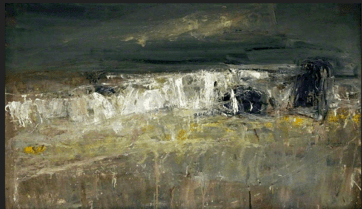


My eye locks on the rush and scatter of waves, but I’m distracted by those lit clouds above.
I end up thinking about the smudges and glimmers, where this thinking is itself a distraction—here the distraction of leaving the painting too early. I return and the clouds are luminous and I wonder, what kinds of reflections do they cast on the seascape below, or on me, out of sight?
II
This version of a sensibility is more like the matrix of conscious connections that would not have otherwise been made were it not for the distraction and an attentiveness to that distraction.
III
Let’s see if we agree and can push the point further.
Below are links to three brief performances. The clips show performers and music taking place on stages of sort and sorts of instruments. I wager you’ve not seen the clips before or imagined something like them in this sequence.
I’ve chosen them because the individual pieces seem to reflect–and reflect on–one another, e.g,, Kyung Namchul’s fingers moving across the strings parallel the hands and feet of Denis Matvienko and Leonid Sarafanov moving across the floor parallel Lin Yi’s fan and body flicking together.
(I claim no copyright privilege over the below.)
The sequence serves as one intertext: Sarafanov plucks floor and air, Kyung flicks the strings, Lin Yi dances the fan. Each is inscribed onto the music. Each illuminates the other, and each-together reflects back onto me, its out-of-sight viewer.
That sensitivity feels very much like a sensibility to me, while cognitively the resonance is very much like reflection. Refracted through the brain-prism, it is difficult to tell if what’s written is “live” or “love,” “hype” or “hope,” “could” or “would.”
A politics of complexity
I believe in a politics of complexity. One which you cannot homogenize or leave undifferentiated. A politics reminding us that what works is often at the smaller scale, where the gatherers of information are its users. A politics that starts with cases in their own right. A politics that resists getting lost when scaled up but compels asking at each scale, What am I missing right in front me?
A politics where no matter how tightly-coupled other things are, people’s stories are not as connected. A politics that insists if you believe everything is connected to everything else, then nothing is reducible to anything else, and if you believe both, then the starting point is not interdependence or irreducibility, but the kaleidoscopic granularity in between. If everything is connected, not everything adds up.
A question about Bt cotton in India
As I remember the too-ing and fro-ing over the introduction of Bt cotton in India, saving on insecticides was the putative plus and runaway GM crops its negative. I know nothing about the subsequent record but suspect that the findings must be mixed and differentiated by region and other demographics.
All this came back to me when I read the following passage describing a recent conference paper on Bt cotton:
Ambarish Karamchedu presented on Dried up Bt cotton narratives: climate, debt and distressed livelihoods in semi-arid smallholder India. Proponents of this ‘technical fix’ position GMO crops as a triple win. India has semi-arid and arid areas where rural poverty is concentrated, with an intense monsoon season (3-4 months), making farming a challenge. BT cotton introduced around 1995, thrives here. India is the biggest cotton cultivator and Bt cotton is grown by 7 million smallholder farmers, 66 percent in semi-arid areas with poor soils and low rainfall prone to monsoon. In Telangana, 65% of farmers across all classes produce BT cotton, with good harvests for 5 years, after which they decline. Failure of farmers who face increased input prices have to resort to non-farm incomes. The triple win technological fix narrative perpetuates and exacerbates the problems it seeks to solve, and benefits farmer institutions rather than enriching farmer knowledge and practice.
https://drive.google.com/drive/folders/1VfvjJlxB9VPKQj55dNbZ_VH6oPi2IEVd
It’s that “with good harvests for 5 years, after which they decline” that grabbed my attention.
Did anyone predict that, be they proponents or opponents of Bt cotton?
This matters, because in the absence of any such prediction, why not also conclude: “Well, five years is five years more than expected, right?”
Four reconsiderations
–Many, including myself, argue that, when it come to contemporary critical infrastructures, there is need to manage latent vulnerabilities before they become manifest. The example is a set of cross-infrastructure interconnectivities that are invisible to those responsible until a disaster makes them all too evident.
There are however two other features associated with latency than require their own attention: dormancy and delay. The latent vulnerabilities, while inactive, may be gestating or altering. In addition, the length of delay in managing latency ahead must also be important to the identifying and achieving, or not, error avoidance.
–While it is common to use “control” and “manage” interchangeably, I’ve tried to make a point about that infrastructure operators seek to manage precisely because they can’t control. That is, they increase their process options as away of keeping output variance low and stable, given they can’t control a widening input variability.
But it also seems important to distinguish “manage because you can’t control” from “control that is ever about to slip away or disappear.” How so?
The more you have to lose, the less you can take for granted. That leaves us somewhere between “Though to/hold on in any case means taking less and less/for granted…” and “to lose/again and again is to have more/and more to lose…” (Amy Clampitt from her “A Hermit Thrush” and Mark Strand from his “To Begin”). What to do? Elizabeth Bishop suggests in “One Art”: “Then practice losing farther, losing faster”.
–“Why don’t some things scale easily? Scaling up our collective response to climate change has been notoriously difficult because people neither agree on problem definitions nor solutions; because the effects of climate change and mitigation efforts translate into different real-world experiments depending on location; and because different constituencies in the global political economy don’t agree on how to value what. Any site where scaling is made to look easy should thus raise red flags about a likely lack of comprehension or inclusiveness of perspectives.” (https://journals.sagepub.com/doi/full/10.1177/03063127211048945)
–Globalization, marketization and commodification have indeed become lay path dependencies. But the answer to What-Happens-Next in path dependencies can only be, well, more path dependence. The more helpful point here is that different path dependencies when cast as scenarios are also represented via different and more-or-less granularity.
More on managing ahead for latent vulnerabilities in emergency management
I
The admonition to manage ahead latent interconnectivities before they are triggered into manifest ones by a disaster is easier said than done. What are the practices to do so? Mitigations like retrofitting a bridge, installing automatic shut-off valves, 2 week readiness supplies in advance of an earthquake are examples. So too are table-top exercises, increasing one’s contact list for emergencies, and advanced contingency planning.
Each of these comes with no guarantee that they will actually mitigate once the disaster hits. It might be useful, then, to start with what is guaranteed to happen and see if that offers insights in what to do beforehand and afterwards.
II
One guarantee when major disaster hits: Latent interconnections unmanaged beforehand, particularly those that are invisible or dormant, necessitate improvisations in immediate emergency response afterwards. That is, disaster is the only way these vulnerabilities become visible for management, if any.
Obviously, not all latent interconnectivities are invisible beforehand. To bring to light what can be made visible and manage ahead for them is the function of contingency planning, table-tops, joint drills and other mitigations, like retrofitting. The only thing I have to offer here based in our Oregon and Washington State research on a Magnitude 9 earthquake is that a number of interviewees did not have specific response scenarios for their own departments or units.
This lack of granularity is understandable (i.e., the more specific the scenario the more likely it is wrong about actual events unfold), but it makes some M9 discussions, in the words of one state infrastructure coordinator, “theoretical”. To avoid that, increased granularity in what-if scenarios seems necessary in managing for vulnerabilities that are not hidden out of view. Think again of table-tops, but this time around multiple what-if scenarios and interconnections.
III
But what to do beforehand for those cases where latent vulnerabilities are altogether unknown until disaster makes them manifest?
One answer follows from the guarantee that, when it comes to major disaster, prior latencies are joined at the hip with subsequent improvisations. Managing ahead means the latter are to be more doable and effective. I think immediately of cross-desk or cross-position training, e.g., control room dispatchers have also trained on the scheduler’s desk or water department staff can clear a major road even if the roads department staff have priorities elsewhere.
But it must also be recognized that some improvisations would not happen, cross-training or not, without the disaster. One state coordinator involved in communications management during emergencies told us about convening an online group of competing companies and infrastructure providers:
During a winter storm we had a utility or provider say we’ve got fiber cuts in this area, we don’t have the fiber to replace it in that area, our resources are in this other area—that allowed us to look at the group and say now is the time for some teamwork: Can anyone else solve that problem and be a good team member? And we’ve seen a lot of that sort of problem-solving manifest among the agencies with very little input from us. Another example might be a cellular carrier who is a competitor of another carrier going “Hey, we’re going to fill our generator, can we top off your fuel tank while we’re up there?. . .But I don’t think [those kinds of cooperation] would occur if we didn’t coordinate it and get everybody on the same call and provide a platform for them to kind of air those sorts of things.
Disaster shifts the interconnectivity configurations of staff and infrastructures not only in ways that open up opportunities to improvise but also in ways that make any such missed opportunities mitigable errors to be avoided.
IV
So what, practically?
Many interviewees reiterated they have no idea who or how many of their staff will be able to resume work immediately after the M9 earthquake. “The first 72 hours and you’re still trying to figure out who’s alive out there and those who can communicate,” said a state emergency manager. In other words, referring to “the M9 event” is misleading if it’s taken to imply one event and not thousands or more of them unfolding unpredictably.
One major implication is that it’s better to assume infrastructure cascades are part of the unfolding nature of the M9 earthquake, where just-in-time joint improvisations play an important role in addressing those cascades. Far too often “inter-infrastructure cascades” are assumed–and not just by modelers–to be instantaneous and unmanageable when in fact they are delayed and open to human intervention.
For managing latencies ahead, please also see https://mess-and-reliability.blog/2024/06/03/managing-ahead-for-latent-risks-and-latent-interconnectivity-2/
Rethinking “trade-offs” in emergency management through an interconnectivity framework: the examples of evacuations and mitigations (revised)
From our framework’s perspective (Roe and Schulman 2023), the key feature of a “trade-off” is that it is an inter-relationship between parties, more precisely: an interconnectivity between them.
Economists tell us more guns mean less butter, other things equal. Say this produces X amount of guns and Y amount of butter. But “change one causes the other to change” is only one type of interconnectivity, in this case sequential. Assuming both guns and butter require infrastructures to produce and distribute means that other types of interconnectivity could as well explain arriving at X and Y. For example, the parties reciprocated and so ended up there; or someone from the outside mediated the interchange between the parties, leading to those joint values for the time being.
We and the economist still see X guns and Y butter, but from our interconnectivity framework perspective, it matters greatly what type of interconnection that trade-off is (i.e., sequential, reciprocal, mediated). Two examples of key concepts in emergency management help illustrate why thedifferences matter:
1. Post-Disaster Evacuations. From our framework’s view, evacuations of people from a disaster area are efforts to shift the demands for major infrastructural interconnectivities from that area to sites where those demands can be met through interconnections involving electricity, water supplies, telecoms and other lifeline infrastructures.
This means that there is difference relevant for policy and management between a disaster area now without water, electricity or telecoms and a disaster area still with levels of electricity, water and telecoms but insufficient for population demands. Even with evacuation eventuating in the latter case, the trade-offs in its origin area differ from the former case where the infrastructures and their critical services have been eliminated. If, as they say, a thing is also defined by what it is not, then evacuation also means those remaining behind.
So what? Recourse to “trade-off” terminology can be too coarse for management purposes if it is without the granularity differences in interconnectivity impose on the analysis.
2. Pre-Disaster Mitigations. From our framework’s perspective, pre-disaster mitigations are efforts to manage latent interconnections before they become manifest by virtue of a triggering disaster. This challenge is compounded by the fact that not only are some latent interconnections extremely difficult to see or predict beforehand, they and others may also only become visible during the disaster or afterwards.
So what? Any vacuum produced by difficulties in prediction matters because the professional(s) whose job it is to make these predictions and calls for pre-disaster mitigation will always be confronted by politicians, whose politics ground and justify making such calls anyway. How is this relevant for policy and management?
One answer is to shift the issue to a different question: Who is better at improvising solutions once the latent become manifest in the disaster: Those politicians, those professionals, both depending on the circumstances, others? In other words, whose improvisation learning carries more weight when it comes thereafter to offering pre-disaster mitigations? Now that’s the trade-off–interconnection–of interest!
Source:
E. Roe and P.R. Schulman (2023). “An Interconnectivity Framework for Analyzing and Demarcating Real-Time Operations Across Critical Infrastructures and Over Time.” Safety Science. Interviews and research were funded by National Science Foundation grants BCS-2121528 and BCS-2121616.
 WHEN COMPLEX IS AS SIMPLE AS IT GETS