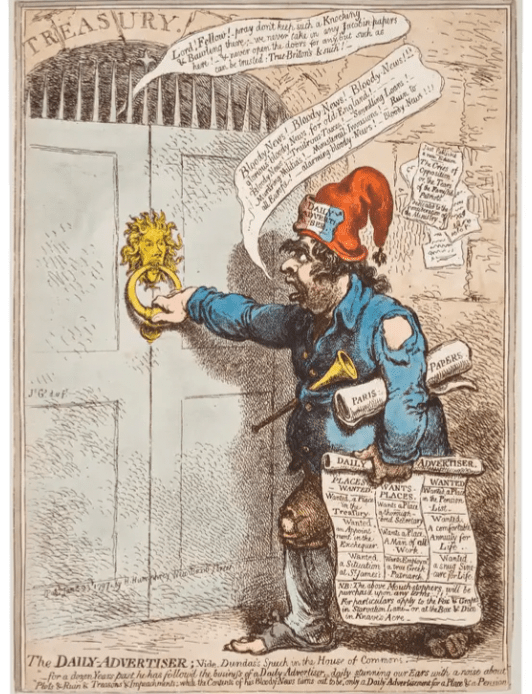
Not really a monarch but rather a long-seeking prime minister, “with a notorious and colourful private life,” advertising himself all over the place, always wanting more money.
Source: James Gillray, The Daily-Advertiser, 1797 (caricature of Charles James Fox).
My bête noire is the dentist’s assistant–“hygienist”–and what they call teeth-cleaning. “Our gums still don’t look good, do they, Mr. Roe?”
I’ve been doing this leeching for over 50 years and the onlything to change in that time is my having to do more and more of the work myself. What, they ask, surely you brush at least twice a day? You don’t floss! You’re shoving wood and plastic splinters between every one of your teeth, right? You’re now using a water pick, correct?
Where—I ask them when able—is that innovative tooth paste with it quantum leap in plaque/tartar reduction? That truly restorative mouthwash and its dramatic protection? Those easy teeth caps or permanent enamelization or something to stop the need for further blood-letting?
One. Half. Century of zero, nada, zilch. “We’d have to sterilize mouths, Mr. Roe, and we can’t do, can we?” I suppose I’ve not helped by calling them Butcher Bobs.
1. We must fight for the expansion of pastoralism as a universal public infrastructure, just as is now being done for universally available electricity!
2. Government agencies and donors working in pastoralism ask to be overhauled so as to meet pastoralist needs faster and more effectively. (“The C.D.C. director, Rochelle Walensky,. . .called for her agency to be overhauled after an external review found it had failed to respond quickly and clearly to Covid.”)
3. Pastoralists explain their responses to government and donor initiatives this way: “We corrected a few things on the ground. Our job, after all, is to protect you.”
4. Researchers on pastoralism agree that the people and areas they study are usefully marginal and marginalized. In point of fact, pastoralisms provide the only valid commentary on the center where many researchers, among others, are also routinely to be found.
5. We refuse to play the game conjured up by analyses that start with tables and numbers of livestock. The follow-on question, almost immediate, is who owns the livestock and, sooner than a blink of the eye, we are down to: “But what about the old woman with 5 goats or fewer?”
As if to ask: “What are you going to do about these inequalities?” Thus leaving us hardly any time to reply that, well, the most ethical thing in response is to see if there are more effective ways to think about this problem than one starting with livestock owned and held.
Google the phrase “environmental criticisms of pastoralism because of the climate emergency” and you get the AI-generated response (January 15 2025):
Environmental criticisms of pastoralism in the context of climate change primarily center around the potential for overgrazing, leading to land degradation, reduced biodiversity, and increased greenhouse gas emissions from livestock, especially when faced with changing weather patterns that can limit access to grazing land and water sources, making pastoralists more vulnerable to climate change impacts.
It is easy to find empirical evidence to counter this narrative. The AI-generated sweep itself goes on to support the well-known finding, e.g.: “Strong community-based management systems can help regulate grazing practices and protect fragile ecosystems.”
I draw attention, however, to what is missing, at least in my reading, from the crisis narrative and its versions but more clearly seen in the counternarratives: technologies.
I
Climate change–more correctly, climate emergency–is a set of threat scenarios increasingly important to the evolving genre variously called “useful fiction” or FICINT (fictional intelligence). While the terms are recent, much has been written about them and their deep roots in past literary developments.
The central idea is to combine very different media–visual as well as written (and written not only in the form of fictional passages with characters and plot, but also incorporating current statistical trends and scholarly findings)–so as to persuade readers that the scenarios portrayed are in fact existential threats and must be acted upon. Much of this genre has been developed in the areas of national security and extreme climate (see Sources below from which points have been extracted here).
For our thought experiment below, what is of special interest is that FICINT
has developed a framework of guidelines that center around the ‘no vaporware’ rule. Vaporware is technology that has been imagined, but is not yet created. To ensure that FicInt remains feasible and grounded in legitimate technology, all technology included in the story must be developed or in development. In addition, FicInt character behavior should be based on past real-world situations. Finally, FicInt should use appropriate facts and research to justify the narrative.
II
So, let’s say that important parts of pastoralist development are full of useful fictions. While some of the associated narratives are orthogonal to others (e.g., models of open-access grazing versus models of the managed commons), others appeal to varieties of different evidence and different trends to support their versions of realistic, near-term threat scenarios.
Focus on those cases where empirical uncertainties are high with respect pastoralist development in the midst of abrupt, extreme climate. For those cases, which narrative(s) to believe?
One answer is to focus on the curious asymmetry between the aforementioned dominant narrative and counternarratives when it comes to the role and presence of technologies in each. The primary technology in the dominant narrative and its versions is the cow, and here negatively as a methane producer and not positively as possessor of that rumen also able to make use of that lignin content in dryland grasses. This technology–and so too for other primary livestock–also move across grasslands and water points that however are, technologically speaking, either there or not.
In contrast and again in my reading, the counternarratives are much more populated by technologies and different socio-technical systems for their operation and management. Even the model of the managed commons can have fences. Cattle boreholes have to be operated and maintained. Livestock are transported by lorries, even airlifted for mountain pastures. Supply chains going out drylands and coming in are important. Agro-pastoralism adds even more technologies. Once again, add context and contingency, and counternarratives about socio-technical systems are inevitable.
So what, though?
III
Now take a hypothetically context-less technology called “rotational grazing” and insert it in each narrative, dominant or counter. Ask yourself: How can this insertion be rendered into a useful fiction?
Well, in some cases “rotational grazing” is already going on, even if the actual practice (e.g., use of a drift fence to separate grazing from crops, but open to grazing of the stubble after harvest) doesn’t look like the textbook ranch. In other cases, even if it doesn’t reduce overgrazing, the fiction of “rotational grazing” is kept so as to ensure claim to the land and its water point(s). Or in different instances, livestock are transported by lorry for fattening or supplemental feeding, even if it’s still useful to liken this to the “mobility” of old-time rotations between wet and dry season grazing in earlier or less extreme climate periods.
Which pastoralist development narratives, then, are likely to be found more credible by more people when it comes to (still arguably) realistic or near-term threat scenarios: those that center around a few technologies–cattle, water points and fences–or those narratives far more differentiated technologically for management purposes?
Di Feo, M. (2021) “Overcoming Complexity of (Cyber)War: The Logic of Useful Fiction in Cyber Exercises Scenarios.” Accessed online at https://ceur-ws.org/Vol-2940/paper32.pdf
Engberg-Pedersen, A. (2025). “The National Security Novel: ‘Useful Fiction,’ Persuasive Emotions, and the Securitization of Literature.” Critical Inquiry, 51(2) Winter.
Imagine that you’re in a room with four very tall walls, and they’re totally smooth. There are no footholds, and there’s no way out, and you’re in there with nothing, and there’s water pouring in from the top in all directions. What do you do? We were stumped, proposing one solution after another, and none of them worked. And then, the answer to his riddle was: Stop imagining.
Not, “stop imagining” because what’s imagined is already here. But rather, “stop imagining because it’s getting us nowhere.”
As in: “Imagination: Always ‘lively.’ Be on guard against it. When lacking in oneself, attack it in others. To write a novel, all you need is imagination” (Gustave Flaubert, novelist).
And yet: “What we have here is a failure of imagination,” intone the critics of this or that policy failure. Yet they are just as likely to demand we take seriously any of their crisis scenarios, even when they are unable to specify what it takes to disprove the scenarios or prevent their recurrence or come up with details about the response structure to be in place after the losses incurred by said crises.
To do the latter requires deep knowledge and realism—that is, far far far far more than the touted imagination. Having the former may even cure us of some crises.
. . .and had to conclude, with some others, that it was about increasing human opportunities to respond to unpredictable change without killing ourselves in the process. No mention of the priority of unpredictable change in the then-reigning Brundtland Report definition of “development that meets the needs of the present without compromising the ability of future generations to meet their own needs.” Plus, one very major way to increase human opportunities to respond to unpredictability remains increasing economic growth in ways that, again, don’t destroy us now, let alone later.
How to undertake the latter remains an open question precisely because of the unpredictable change taking place in the Anthropocene.
What to do?
I
In answer, I want to start with a thought experiment. Assume current levels of above-average consumption, production and pollution are halved and then halved again. High rates of population growth are halved and then halved again. The mass extinction of biodiversity stops, fossil fuel extraction stops; industrial fishing, farming and forestry stop; and all manner of government stupidity in the form of subsidies, incentives and distortions cease.
Now ask yourself: What if these interventions also prove unsustainable? What we thought was true sustainability proves to be unsustainable as things change (remember: irrigated agriculture was once promoted because it sustained year-round production). Conditions remain complex, even if different from before.
In this thought experiment, it turns out that degrowth reduces the resources to prevent stronger nations from invading and taking over. Changes in diets as now recommended lead to unexpected maladies or recurrence of older diseases. Getting rid of fossil fuels doesn’t eradicate the need for plastics and other petroleum based products. The growing middle classes, once considered essential to the advancement of democracy and states, continue to undermine the global biosphere.
And yet, while all this is going on, the demand remains that whatever critical infrastructures are in place–even (especially?) ecologically sensitive ones–must be highly reliable and safe. (Hunting and gathering societies may be the most sustainable, but I do not remember any hunter-gatherer in Botswana in the early 1970s who didn’t want to quit that that way of life for something safer and more reliable. Their lives were exciting enough, thank you very much.) It turns out that realizing sustainability, in this thought experiment, didn’t make any of this less complex for management purposes when it comes to the Anthropocene.
At best, socio-technical systems–even the more sustainable and environmentally-friendly ones we need–are reliable only until the next failure ahead. That indeed is the lesson of unpredictablity. This means that preventing that next failure in today’s energy-intensive infrastructures is the track record we want in place when the more sustainable infrastructures are to be managed just as, or even more reliably. The upshot of so many infrastructure studies is that, when operating in situations of high unpredictability, systems must be managed reliably and safely beyond the in-built limits of design, technology and regulation. A track record in managing the unexpected now and just ahead, especially in conditions of Anthropocene, is an affordance–opportunity and constraint–not be thrown aside.
In short, Infrastructure mandates for managing and innovating reliably and safely are not going away. Nor can they, even when systems are necessarily smaller, more decentralized, less interconnected, and more sustainable. Those systems too will be managed as if peoples’ lives and livelihoods depend on it—because they do.
III
Still the question remains: “What are more sustainable ways to anticipate future environmental crises while coping with the ongoing ones, now and just ahead?”
As I see it, the benefit of this question is thinking in terms of path dependencies (plural)–not only that their durations differ, but the with-respect-to’s are also highly variable. Path dependencies in the Anthropocene already are commercial or institutional or legal or technological or behavioral or climatic–and hybrid and more.
This means management attention is directed to the specific failure scenarios of interest and the levels of granularity at which the scenarios are said to be actionable. Specifying action-levels of granularity is important because the answer to the “What happens next?” question so central to on-the-ground crisis management MUST be more than “What happens is, well, more path dependence. . .”
So what?
If the question is–“What are reasonable and feasible ways to anticipate future sustainability crises while coping with the ongoing ones, now and ahead?”, then my answer in light of the preceding is another question:
If we can’t differentiate path dependencies by better focusing on case-level, variably granular failure scenarios actionable in and for environmental crisis management, how are we ever to better anticipate future sustainability crises while coping with the ongoing ones?
Or another way to put it: The most important part of the expression, “sustainable livelihoods,” is that final “s.”
I can’t quote them because Heidegger was a Nazi, Pound a Fascist, Sartre a Maoist, Eliot an anti-Semite. I don’t read Foucault because he didn’t care if he infected guys and I don’t read that mystery writer because she was a convicted killer. I don’t go to baseball games because of the players’ strike way back when and I refuse to watch that man’s films because he’s said to have messed with his own kid.
I don’t buy Nike because of the sweatshops, listen to Wagner because he was a Jew-hater, or have a TV because it makes children violent. I can’t eat tofu because of genetically modified soybeans or cheese because of genetically modified bacteria. I don’t listen to Sinatra because he was a nasty little man or Swarzkopf because she was a collaborator. The U.S. government’s been screwed since Johnson and the Great Society (no, since FDR and the welfare state (no, since Lincoln and the Civil War (no, since Jackson and the Trail of Tears (no, since Jefferson and the Louisiana Purchase (no, since Washington and his plantation slaves…)))).
I don’t trust Freud because he didn’t understand women, Klein because she couldn’t get along with her daughter, Bettelheim because he’s suppose to have hit kids, or Laing because he also wasn’t nice. I think we were never further away from nuclear war than during the Cuban Missile Crisis (only afterwards did Brezhnev insist on nuclear parity). Plus it’s a good thing Japan has lost decades of economic growth or they’d’ve been re-armed by now.
I’ve wondered from time to time if Socrates could go to heaven. Speaking of which, why is Adam painted with a belly button, where in the Bible is the turkey that keeps showing up in those tapestries of Eden and Noah’s Ark, and for that matter why do shadows show up in early Western art first? And, let’s get this clear: Do you actually think historical Jesus worried about who licks what body part where?
Dying means my total annihilation, and I say, Too bad for eternity: It doesn’t know what it’s missing. It’s when I’m dead that I become “will always have been.” Whatever, little gives me quite the pleasure as knowing my secrets die with me.
Which makes me also wonder: Other than the streets, where do squirrels go to die? And whatever happened to pineapple upside-down cake and Saturday drives? Did Wittgenstein read Rabelais: “Utterances are meaningful not by their nature, but by choice”? Can there be anything more mind-numbing than beginning, “In hunting-and-gathering societies. . .”? And just who did say, Freedom is the recognition of necessity (Hegel, Engels, Lenin, who)? E Pluribus Unum: Isn’t that Latin for “Follow the dollar”?
Still, every morning I wake up and thank heaven I wasn’t born a minority in this country. If I had a magic wand, I’d solve America’s race problem by giving everybody a master’s degree. I’d make sure they’d all be white, married, professionally employed, and own homes. (BTW, every adult in China should have a car. With all that ingenuity they’d have to come up with a solution to vehicle pollution.)
But then again, I’m quite willing to say that the entire point of human evolution is “there hasn’t been one.” As for the rest, I suppurate with unease. It’s probably—possibly, plausibly?—wise not to think too much about these things.
I found my following food-for-thought on January 29, 2024:
Several years ago, some colleagues and I conducted a taxonomy study to understand how AI is depicted in contemporary science fiction. We were hoping to learn whether the speculative side of our cultural imaginary on AI has better answers for what kinds of stories we should be telling, as policymakers try to understand and regulate these rapidly evolving tools. The answer? Nobody knows what AI is—even in fiction, where the author can make all the decisions about how the world works. The AI systems we studied in fiction were ambiguous in terms of their agency, their boundaries or extent of operations, the question of who owned or controlled them, etc. Little wonder that we collectively have such a poor grasp of what AI means in the real world, much less how to manage it.
To lay all my cards out, for me it’s no longer “global cIimate change” but the Climate Emergency (and one deserving capitalization). I’m not, however, here to convince you that terminology matters. What matters more is demonstrating how the urgencies entailed in the Climate Emergency are open to rethinking and recasting, with very different policy and management implications for those, like me, who agree urgent climate action is required.
My take-home message is this: If I understand recent discussions, we must deal substantively and structurally with issues of inequality, poverty, fossil fuel, and rising authoritarianism, to name four only. If I understand the Climate Emergency, we also don’t have time for anything except radical action to prevent global climate disaster. In other words, this means the former narratives must be able to recast the urgencies commonly attributed to the Climate Emergency in order for both sets of requirements to hold. Three examples of how this can be done follow. I conclude with an answer to the “So what?” question.
1. Recasting delay and deferral in the Climate Emergency
Narrative. To repeat, we don’t have time for more delays in dealing with the Climate Emergency. Vulnerable people, especially in but also all over the rest of the planet, are at risk and in hazard. Some are already dying because of this. We must act now to prevent the already bad from turning into the worst.
Implications for policy and action. If so, the narrative’s first implication is to acknowledge and understand why policy and action are shot through with delays, deferrals and their narratives. Policy and action are full of interruptions, with delays initially said to be temporary and deferrals indefinite, where not permanent. The mess is no less when the temporary turns out to be permanent, while some indefinites prove to be temporary after all
What can’t and mustn’t be ignored is that we have evolved a very rich literature to describe decisionmaking full of delays and deferrals: wicked policy problems, muddling through, incrementalism, groping along, bounded rationality, garbage can processes, second-best solutions, fatal remedies, rotten compromises, managing the unexpected, coping agencies, groupthink, adhocracy, and that deep wellspring of miserabilism, “the implementation gap,” to name just a few.
Nor do counter-exhortations of “Failure is not an option!” get us out of the messy decisonmaking that is part and parcel of responding to the Climate Emergency. Even if we were to end up with a techno-managerial elite able to control the Earth’s atmosphere to 1.5 degrees or something like it, we would still see learning and adaptation–aka, delays and deferrals–having to take place. Who doubts, for that matter, that the obviously necessary replacement of our energy intensive infrastructures with more sustainable ones won’t have their own learning curves–ditto delays and deferrals–even when (especially when) urgency is high?
What then is to be done? Am I saying nothing can be done? No. What I am saying is that we need to know more about those (implied) narratives of delays and deferrals under different scenarios of urgency.
“But we don’t have time for more research!” You’d then think that the costs to society of confronting these new disaster scenarios is set by the dangers of ignoring disasters, like hurricanes, floods and fires, that we are currently know more about. You’d also think that with the catastrophic disaster scenarios the planet is said to face, we’d see more investigations of how large critical infrastructures actually do avoid or avert massive climate induced flooding and fires.
In other words, what’s needs to be done is searching for more and different granularity that is actionable in varied Climate Emergency scenarios. Consider a timely example where urgency is already high and will be so for the rest of the Anthropocene: humanitarian aid.
A recent working paper, Understanding the role of narratives in humanitarian policy change and published by the London-based Overseas Development Institute (Saez & Bryant 2023), highlights the many and various factors leading to what they call delay narratives and discourses that infuse and transform contemporary humanitarian aid:
Not only does Figure 1 underscore that policy narratives can be better understood by focusing on delaying rather than supporting this or that policy and management. It also underscores the vast importance of context and contingencies in differentiating what factors are salient where, when and how.
That is, what the urgency of the Climate Emergency does is not erase or solve interruptions, but instead makes (1) the vastly different delay and deferral scenarios far clearer and (2) why no global techno-managerial elite could hope to address and monitor this high differentiation adequately, let alone “holistically.”
Or to put the point positively, some regional climate change modeling is of such a high resolution today that climate model results can be and are disaggregated in ways of use to key critical infrastructures. It is now possible to project estimates for rising sea-levels, storm surges, and inland flooding in, say, 20-year increments to better reflect already existing near- and longer-term cycles for infrastructure depreciation and forward investments, among others. More of this needs to be done, and importantly, we need to take the time do it.
2. What is to be done immediately in the Climate Emergency? Activate your EOCs!
Anyone who studies government emergency management in large disasters and catastrophes, at least in the US setting, knows longer-term recovery is the second part of emergency management. The first, very formidable phase is immediate emergency response. Which raises the issue: Yes, the climate crisis calls for a massive and rapid remaking of economy and society. Yes, surely that and more; but what do we also do immediately?
I
In the US setting, a disaster, like massive storms, wildfires or flooding, entails the activation of a city or county emergency operations center (EOC) and/or incident management teams (IMTs) to coordinate immediate response efforts. States also have their own EOCs or equivalent.
This activation is done all the time, when high winds, ice storms, wildfires, heat dome effects, flooding and their combinations take down essential services, particularly backbone infrastructures of water, electricity, roads and telecoms.
Now the thought experiment: Activate the EOCs and IMTs, or at least the ones which acknowledge and accept we are the Climate Emergency. And who, you ask, are the distressed peoples and sites?
Well, that’s not something you, the reader, can answer a priori. It’s up to those really-existing EOCs and IMTs, who recognize the Climate Emergency is making local spaces uninhabitable, taking away local employment. . .
II
The stakes thereby become clearer for both recovery and for immediate response when it comes to the Climate Emergency.
First, much of what outsiders recommend for now-now clearly belongs more under “long-term recovery” than immediate response, e.g., those net-zero emissions promises or those for more resilient or sustainable infrastructures. Nor is it news that this longer-term is invariably political with many stakeholders and does not have the same logic, clarity and urgency that immediate response has, e.g., disaster declarations that trigger immediate release of funds.
That said and second, those current appeals to “Stop oil!” and such immediately hit a major obstacle. In really-existing emergency response, fossil fuel is needed to evacuate people, transport goods and services to distressed areas, keep the generators running when electricity fails, and so on. Cutting down trees, distribution of water in plastic bottles, and wide use of readily available gas-guzzling vehicles, in case it needs saying, are also common because they are necessary..
III
As such, rather than focusing objections on the greater reliance in an emergency on petrol or like, we might instead want to think more productively about two empirically prior issues.
First, who are those EOCs and IMTs activated for the Climate Emergency? Their activation for wildfires, flooding and abrupt seasonal events have been increasing and increasingly responded to by all manner of city, county, state and agency EOCs and IMTs. That implies a learning curve, i.e., learning from past mistakes and delays.
Second, where EOCs and IMTs have been or will be activated, are they responding in ways that are climate-friendly? Or to put response challenge correctly: Where are the logic, clarity and urgency of the Climate Emergency requiring immediate eco-friendly response even before longer-term environmental recovery?
I ask the latter question, because I don’t think some of us who treat the Climate Emergency seriously have thought the answers through. It seems to me much more thought has been given by many more people to the use of eco-friendly stoves, toilet facilities, renewable-energy generators, and like alternatives. Years and years of R&D have gone into studying, prototyping and distributing more sustainable options.
Shouldn’t we then expect and want their increased use in immediate emergency response as well, especially when (not: “even if”) expediting them to the distressed sites and peoples means using petrol and cutting down trees in the way? Do the activated EOCs and IMT’S really need new benefit-cost analyses over such matters to take that decision—right now?
3. Not thinking radically enough about the Climate Emergency
I recently attended a conference on sea-level rise, storm surges and flooding in the greater San Francisco Bay Area, now and projected into the near decades. Most of the day was spent on projects and interventions for climate mitigation and adaptation that I knew nothing about, including: a Lake Mendocino water storage innovation, several dredging and sediment projects geared to beneficial uses, wetlands restoration projects, and a great many planning and feasibility efforts funded with respect to not just sea-level rise, increased storm surges and inland flooding, but also for rising groundwater levels and changing air temperatures affecting major infrastructures differently.
In addition to these specifics, I was told that:
The Bay Area would need some 477 million cubic yards of sediment–the vast majority of which can’t be sourced locally–to restore area wetlands and mudflats;
It would require an estimated US$110 billion dollars locally to adapt to higher sea levels by 2050, this being based on existing plans in place or used as placeholders for entities that have yet to plan; and
To expect much more sea level rise locally because of the newly accelerated melting of the ice cap melting in Antarctica and Greenland.
Millions of cubic yards equivalent to over 420 Salesforce Tower high-rises? Some $110 billion which has no possibility whatsoever of being funded, locally let alone regionally? And those massive new requirements posed by the melting ice caps? How are these unprecedented high requirements to be met, let alone the really urgent ones?
It’s not surprising that the individual interventions presented that day and all the hard work they already required paled into insignificance against the funding and work challenges posed by the bulleted challenges.
What to do then? How to respond now?
I
These massively large sums (and like figures) are meant to stir us to urgent action. Such numbers do that for some people, but others respond by becoming even more uncertain than they already are in the Anthropocene. Some of that increased uncertainty is translated into dread over how to proceed (like we saw with respect to nuclear weapons in the Cold War), and dread can also be instrumental in generating immediate action.
More often though, I’ve found that the increased uncertainty generated by category-five sums and figures ends up reinforcing the focus on and approach to projects and interventions already underway. At least here we can see what hard work achieves.
And in that hard work is one answer to why such large numbers, even when they measure true requirements, fall short of the needed analysis.
II
The problem lies in the estimates of losses (economic, physical, lives, and more) incurred if we don’t take action now, right now. It’s been my experience that none of these estimated losses take into account the other losses already prevented from occurring by infrastructure operators and emergency managers who avoid systemwide and regional system failures from happening that would have happened had they not intervened beforehand, sometimes at the last moment.
Why are these uncalculated billions and billions of saved dollars important when it comes to responding to sea level rise, increased storm surges, more inland flooding, rising groundwater levels and other sequelae?
Because it from this pool of real-time talent and skills and practices that society will be drawing for operationally redesigning the inevitable shortfalls in new technologies, macro-plans and regulations for climate restoration and recovery.
We already have a pool of such professionals who make this radical recalculating possible. They are not being consulted nor is their professionalism adequately recognized for the Anthropocene challenges ahead. Those in infrastructures who are already making billion-dollar saves by preventing worse fires and flooding are going to be needed even if the impossible sums were funded, and most assuredly because they won’t be.
So what?
Return by way of concluding, to our starting narrative about the Climate Emergency, expressed in such statements as.: “Based on climate science, there is not enough time to first overhaul a critical mass of economies simultaneously according to socialist democratic planning and then to realise emission reductions” (https://www.tandfonline.com/doi/full/10.1080/13563467.2024.2434469 ).
It should not be a surprise, however, that context-dependent factors relating to differences in inequality, poverty and the such interrupt the preceding conclusion, as when making the following statement.: “We emphasize the importance of taking political time and maintain that collective social responses to major climate impacts must center actually existing material and symbolic inequalities and place procedural and distributive justice at the heart of transformative action. This is so even where climate change will have devastating physical and social consequences” (https://doi.org/10.1215/00382876-10242756; my italics).
All of which means that without first differentiating the impacts of the Climate Emergency by location and time, it is next to impossible to identify, let alone differentiate, the consequences with respect to the disparate and different practices of acting democratically here versus there–or otherwise heedlessly instead.
That said, such considerations are beside the point for those who insist the Climate Emergency calls for global climate security. But you see security is what militaries do—and a well-funded military is one of the few government organizations that routinely does long-term planning and often takes that planning seriously.
It’s one thing to call for radical resistance against the major polluting nations. It’s another thing to lay out how the next wave of environmental activism includes cadres of digital hackers ready to take on, say, Xi Jinping and the CCP. China is responsible for an estimated one-quarter of annual global GHG emissions, largely due to its massive fleet of coal-fired power stations. Where is the hacktivism ready and able to disable these plants? Or disable the real-time operations of, say, the “Big 3” credit rating agencies (S&P Global, Moody’s and Fitch) for their insanely positive ratings of the economies fueling the Climate Emergency?
In what world is an unprecedented global techno-managerial elite managing climate for nearly 8 billion people easier than, say, mobilizing the Chinese proletariat of some 220 million or disrupting the operations of the Big 3 CRAs, both for the planet’s survival?
So, again: What’s to be done?
As I hope my above examples illustrate and underscore, the Climate Emergency exhibits already a large array of local coping and managing responses. We know from this evidence that the Emergency is complex, precisely because local activities and responses are so heterogenous and diverse. We also know the large array of local cases form a distribution across which practices could emerge for local transformations, if not for scaling up.
What I am saying is that the agenda for better addressing the Climate Emergency would establish as its benchmark the really-existing diversity of climate responses and related practices already underway (including militant practices and those, say, reducing inequalities and poverty). Now, that would be radical! Yes, more is needed by way of other-level policy and management, but the “more” would be evaluated against this benchmark and not some other far more imperfect one of stop this! and stop that!

 WHEN COMPLEX IS AS SIMPLE AS IT GETS