Major Read: The expanding terrain of methods in the professions of policy analysis and management, now and ahead

Because I’ve had a career as a practicing policy analyst, I’ve also had a healthy respect for the utility of different methods of problem-solving. What I wasn’t prepared for were all the “vs”: quantitative versus qualitative, positivist versus post-positivist, reductionist versus holistic, and such. The complexity of the policy issues meant that all and more could be required–and anyway these “versus’s” weren’t granular enough to identify which specific methods were being compared or not.

Once the analyst starts thinking in terms of different specific methods, the horizon of candidates broadens considerably. In my practice, methods came to include applications and modifications of middle-range frameworks from one area to another in order to reframe more tractably difficult problems in the latter. New ways to recast the benchmarks and metrics for managing risk, uncertainty and unknowns have been of interest (for other examples, see my Guide).

Below are twelve examples to add to that earlier discussion for a methodologically expanded policy analysis and public management. These map out for the analyst-as-a-professional additional working space not in graduate school training. As always, your comments are welcome.


1. Key method questions in complex policy and management

2. Methodological implications of using triangulation in complex policy and management.

3. Methodologically, analogies without counter-cases are empty signifiers

4. The methodological challenge of empty and floating signifiers to analyzing policy (newly added)

5. Peer review: another area where error avoidance is the method for reliability management

6. Not all the “can’s, might’s, may’s, or could’s” in the worlds of policy and management add up to one single “must”

7. To paraphrase Wittgenstein, an infinite regress explains nothing for the purposes of policy and management

8. The Achilles heel of conventional risk management is the counterfactual

9. What “calling for increased granularity” means

10. Seven differences in method that matter for reliable policy and management

11. The methodological importance of “and-yet” counternarratives

12. Etcetera’s are the crisis kitsch of policy analysis (newly added)


1. Key method questions in complex policy and management

–A young researcher had just written up a case study on traditional irrigation in one of the districts that fell under the Government of Kenya’s Arid and Semi-Arid Lands (ASAL) Programme. (We’re in the early 1980s.) I remember reading the report and getting excited. Here was detailed information about really-existing irrigation practices and constraints sufficient to pinpoint opportunities for improvement there.

That was, until I turned the page to the conclusions: What was really needed, the author stated, was a country-wide land reform. Huh? Where did that come from? Not from the details and findings in the report!

This was my introduction to “solutions” in search of problems they should “solve.” Only later did I realize I should have asked him, “What kind of land reform for whom and under what conditions at your research site?”

–Someone asserts that this policy or approach holds broadly, and that triggers your having to ask:

  • Under what conditions?
  • With respect to what?
  • As opposed to what?
  • What is this a case of?
  • What are you–and we–missing right here?

Under what conditions does what you’re saying actually hold? Risk or uncertainty with respect to what failure scenario? Settler colonialism as opposed to what? Just what is this you are talking about a case of? What are you and I missing that’s right in front us?

2. Methodological implications of using triangulation in complex policy and management

I

Triangulation is the use of multiple methods, databases, theories, disciplines and/or analysts to converge on what to do about the complex issue. The goal is for analysts to increase their confidence–and that of their policy audiences–that no matter what position they take, they are led to the same problem definition, alternative, recommendation, or other desideratum. Familiar examples are the importance in the development literature of women and of the middle classes.

In triangulating, the analyst accommodates unexpected changes in positions later on. If your analysis leads you to the same conclusion regardless of initial positions that are already orthogonal, then the fact you must adjust that position later on matters less because you have sought to take into account utterly different views from the get-go.

Everyone triangulates, ranging from cross-checking of sources to formal use of different methods, strategies and theories for convergence on a shared point of departure or conclusion. Triangulation is thought to be especially helpful in identifying and compensating for biases and limitations of any single approach. Obtaining a second (and third. . .) opinion or soliciting the input of divergent stakeholders or ensuring you interview key informants with divergent backgrounds are common examples.

Detecting bias is fundamental, because reducing, or correcting and adjusting for bias is one thing analysts can do. To the extent that bias remains an open question for the case at hand, it must not be assumed that increasing one’s confidence automatically or always increases certainty, reduces complexity, and/or gets one closer to the truth of the matter.

II

Return now to our starting point: The approaches in triangulation are chosen because they are, in a formal sense, orthogonal. This has another methodological implication: The aim is not to select the “best” from each approach and then combine these elements into a composite that you think better fits or explains the case at hand.

Why? Because the arguments, policies and narratives for complex policy and management already come to us as composites. Current issue understandings have been overwritten, obscured, effaced and reassembled over time by myriad interventions. To my mind, a great virtue of triangulation is to make their “composite/palimpsest” nature clearer from the outset.

Indeed, failure to triangulate can provide very useful information. When findings do not converge across multiple and widely diverse metrics or measures (populations, landscapes, times and scales…), the search by the analysts becomes one of identifying specific, localized or idiographic factors at work. What you are studying may be non-generalizable–that is, it may be a case in its own right–and failing to triangulate is one way to help confirm that.

3. Methodologically, analogies without counter-cases are empty signifiers

The relentless rise of modern inequality is widely appreciated to have taken on crisis dimensions, and in moments of crisis, the public, politicians and academics alike look to historical analogies for guidance.

Trevor Jackson (2023). “The new history of old inequality.” Past & Present, 259(1): 262–289 (https://doi.org/10.1093/pastj/gtac009)

–I bolded the preceding because its insight is major: The search for analogies from the past for the present is especially acute in turbulent times.

The methodological problem–which is also a matter of historical record–is any misleading analogy. Jackson, by way of illustrating this point, provides ample evidence to question the commonplace that the US is presently in “the Second (New) Gilded Age,” with rising inequality, populism and corruption last seen in the final quarter of our 19th century.

–Even here, we are still stuck with the fallacy of composition: Just because a tree is shady does not mean each leaf provides shade. Not all of the country was going through the Gilded Age, even when underway. And doubtless parts of the country are now going through a Second Gilded Age, even if not nationally.

The upshot is that we must press the advocates of this or that analogy to go further. The burden of proof is on the advocates to demonstrate their generalizations hold regardless of the more granular exceptions, including those reframed by other analogies.

Why would they concede exceptions? Because we, their interlocutors, know empirically that micro and macro can be loosely-coupled, and most certainly not as tightly coupled as theory and ideology often would have it. Broad analogies that do not admit granular counter-cases are unhelpfully empty for policy and management.

–A fairly uncontroversial upshot, I should have thought, but let’s make the matter harder for us.

The same day I read Jackson’s article, I came across the following analogy for current events. Asked if there were any parallels to the Roman Empire, Edward Luttwak, a scholar on international, military and grand strategy, offered this:

Well, here is one parallel: after 378 years of success, Rome, which was surrounded by barbarians, slowly started admitting them until it completely changed society and the whole thing collapsed. I am sure you know that the so-called barbarian invasions were, in fact, illegal migrations. These barbarians were pressing against the border. They wanted to come into the Empire because the Romans had facilities like roads and waterworks. They knew that life in the Roman Empire was great. Some of these barbarians were “asylum seekers,” like the Goths who crossed the Danube while fleeing the Huns. 

https://im1776.com/2023/10/04/edward-luttwak-interview/?ref=thebrowser.com&utm_source=substack&utm_medium=email

Of course, some read this as inflammatory and go no further. Others, of course, dismiss this outright as racist, adding the ad hominem “Just look at who is writing and publishes this stuff!”

But the method to adopt would be to press Luttwak for definitions and, most importantly, counter-examples.

4. The methodological challenge of empty and floating signifiers to analyzing policy (newly added)

I

The usual way floating and empty signifiers are distinguished is that the former are terms or concepts with (too) many meanings, while the latter have none. The ready example of a floating signifier in today’s policy discussions is “capitalism,” since it’s

laissez-faire capitalism, monopoly capitalism, oligarchic capitalism, state-guided capitalism, party-state capitalism, corporate capitalism, corporate-consumerist capitalism, bourgeois capitalism, patrimonial capitalism, digital capitalism, financialized capitalism, political capitalism, social (democratic) capitalism, neoliberal capitalism, crony capitalism, cannibal capitalism, wellness capitalism, petty capitalism, platform capitalism, cloud capitalism, infrastructural capitalism, algorithmic capitalism, aspirational capitalism, welfare capitalism, compliance capitalism, authoritarian capitalism, imperialistic capitalism, turbo-capitalism, post-IP capitalism, green (also red and brown) capitalism, climate capitalism, extractive capitalism, libidinal capitalism, regulatory capitalism, clickbait capitalism, emotional (affective) capitalism, tech capitalism, American capitalism, British capitalism, European capitalism, Western capitalism, transnational capitalism, agrarian capitalism, disaster capitalism, rentier capitalism, industrial capitalism, post-industrial capitalism, fossil capitalism, settler-colonial capitalism, supply chain capitalism, asset manager capitalism, information (data) capitalism, cyber-capitalism, cybernetic capitalism, necro-capitalism, bio-capitalism, war capitalism, crisis capitalism, managerial capitalism, stakeholder capitalism, techno(scientific)-capitalism, pandemic capitalism, caring capitalism, zombie capitalism. . .

Nothing would seem more policy relevant than capitalism, but even a cursory study of the list identifies no shared or central focus on, importantly, markets and prices. The cumulative implication for policy analysis, my profession, is obvious: Just what is the–or even “an”–anti-capitalist alternative?

II

If capitalism as a floating signifier makes a hash of what it is to be “anti-capitalist,” the opposite is the case for the empty signifier of that equally policy relevant neoliberalism. Neoliberalism is almost always a term used by those whose position is anti-neoliberalism. “Recent scholarship has suggested that ‘neoliberalism’ functions almost exclusively a term used by its critics,” where

An empty signifier, in Laclau’s vocabulary, is a name progressively emptied of specific content so
that it can stand for an entire chain of heterogeneous demands: the poorer its intension, the wider the
coalition it can represent (Laclau, 1996, 2005). . . .Laclau was entirely lucid about the epistemic price and entirely explicit that it was worth paying, because the point of such signifiers is not to describe but to assemble [and articulate]. . . .

Defenders of the concept argue that neoliberalism names a real macro-phenomenon and that the term’s breadth reflects the breadth of the thing (Peck, 2013; Laruffa, 2024). Our argument does not require denying this: real processes of marketisation, privatisation and financialisation occurred. The question is why they came to be gathered under this name, in this form, on this timeline. . .

A concept that functions as an articulating signifier is unlikely to be disciplined by demonstrations of its descriptive failure, because description was never its principal function, and the productive question may therefore be less ‘what is the correct definition of neoliberalism?’ than ‘what work is the concept doing, for whom, and at what analytical cost?’

Paniagua, Pablo and Vergara, Álvaro (2026). “Neoliberalism As Adversary: The Latin American Construction of an Empty Signifier”. My underlining. https://ssrn.com/abstract=7316099)

The upshot: The analytic costs in relying on and using “neoliberalism”–and by implication other empty signifiers–understandably trouble the policy analyst more than the policy advocate intent on articulating who the adversary is and assembling coalitions to oppose it.

III

Floating and empty signifiers are problematic for policy analysts when these terms, capitalism, neoliberalism and the like (e.g., “cooperative global governance”), are exiled from their specifics and particularities as events, situations and contexts. More, the identification of systemwide patterns (if any) over a range of different events, situations, and contexts–including but not limited to those self-identified as neoliberal or anti-capitalist–is also unavoidable for the analyst.

Why? Because practices surface in pattern recognition and become the signifier of interest–the center of analytic gravity–for the analyst. It’s the practice of protesters waving or holding blank sheets of paper that is significant. Practices for managing assets (A) differ from the older practices of commodification (C), which in turn has changed Marx’s classic formulation for making more money (M’) from M–C–M’ to M–A–M’.

IV

So what? Two implications follow from this reshifted focus to practices.

(1) First, centering the analysis of policy on existing practices helps explain why human values and beliefs are more often the floating and empty signifiers of choice in policy advocacy. Policy analysts are, in my experience, keener at describing the formal and informal routines, procedures, mechanisms and improvisations key critical infrastructures undertake in order that real-time market exchange and transactions take place. In contrast, the policy advocates with whom I’m familiar are more comfortable in focusing on, say, “human greed” and “belief in markets” to explain that which takes place.

The latter quotation marks are not meant to be pejorative, but rather to mark that both signifiers need to be recognized as socially constructed before taking further action (rather than calling for greater detail tout court).

(2) Second, the response of policy analysts to policy advocates’ reliance on empty and floating signifiers isn’t to insist advocates provide these details. Policy advocacy is an entirely different genre than policy analysis. Rather, the burden of proof is on the advocates to demonstrate their signifiers hold regardless of the more granular qualifications or exceptions provided by analysts. (See the point made with respect to the Luttwak quote in the preceding #3.)

5. Peer review: another area where error avoidance is the method for reliability management

Below is part of an interchange in the Comments section of a recent Financial Times article on scientific fraud:

Comment: I am a scientist. I spend all my time trying not to be wrong in print. Even then, occasionally I am. It is the same for all of us. Furthermore, some scientists are very poor at dealing with statistics and are thus wrong more than others. Our common incompetence is different from actual fraud. The proportion of frauds has probably held steady since the time science became a profession and has grown as the number of scientists has grown. I find it unlikely that the proportion of scientists with this character flaw has increased recently. Possibly much more common than fraud is ripping off your collaborators, or stealing ideas during reviews of manuscripts and grant applications. That is quite hard to prove and so it seems to be popular among certain character types but again, there is no reason to think their proportion has increased.

Reply: It actually doesn’t matter if the proportion is remaining steady – even though it almost certainly is growing, with so much more financial, career and political pressure on academics these days, and a for-profit publishing system that reduces public oversight and is massively biased towards positive outcomes.

The goal should remain zero.

It’s unacceptable for scientists to publish errors due to being ‘poor at statistics’. Huge amounts of money is being wasted, lives are being lost – the least people can do is get training, or work with someone else who IS good at them.

https://www.ft.com/content/c88634cd-ea99-41ec-8422-b47ed2ffc45a

Upshot: If peer review isn’t solely or primarily about error avoidance, how can it aspire to be reliable?

6. Not all the “can’s, might’s, may’s, or could’s” in the worlds of policy and management add up to one single “must”

Consider the following example (my bolding):

Our expert-interview exercise with leading thinkers on the topic revealed how climate technologies can potentially propagate very different types of conflict at different scales and among diverse political actors. Conflict and war could be pursued intentionally (direct targeted deployment, especially weather-modification efforts targeting key resources such as fishing, agriculture, or forests) or result accidently (unintended collateral damage during existing conflicts or even owing to miscalculation). Conflict could be over material resources (mines or technology supply chains) or even immaterial resources (patents, soft- ware, control systems prone to hacking). The protagonists of conflict could be unilateral (a state, a populist leader, a billionaire) or multi- lateral in nature (via cartels and clubs, a new “Green OPEC”). Research and deployment could exacerbate ongoing instability and conflict, or cause and contribute to entirely new conflicts. Militarization could be over perceptions of unauthorized or destabilizing deployment (India worrying that China has utilized it to affect the monsoon cycle), or to enforce deployment or deter noncompliance (militaries sent in to protect carbon reservoirs or large-scale afforestation or ecosystem projects). Conflict potential could involve a catastrophic, one-off event such as a great power war or nuclear war, or instead a more chronic and recurring series of events, such as heightening tensions in the global political system to the point of miscalculation, counter-geoengineering, permissive tolerance and brinksmanship. . . .

States and actors will need to proceed even more cautiously in the future if they are to avoid making these predictions into reality, and more effective governance architectures may be warranted to constrain rather than enable deployment, particularly in cases that might lead to spiralling, retaliatory developments toward greater conflict. After all, to address the wicked problem of climate change while creating more pernicious political problems that damage our collective security is a future we must avoid.

https://www.sciencedirect.com/science/article/pii/S2211467X22002255 (my bolds)

Let’s be clear: All such “could’s-as-possibilities” do not add up to one single “must-as-necessity.”

The only way in this particular passage that “could” and “can” link to one or more “must” would mean that the article (and like ones) actually began with “We must avoid this or that” and then proceeded to demonstrate how to undertake really-existing error avoidance with respect to those (could- and might-be) events.

7. To paraphrase Wittgenstein, methodologically an infinite regress explains nothing for the purposes of policy and management

Stop fossil fuels; stop cutting down trees; stop using plastics; stop this defense spending; stop being imperialist; stop techno-solutionism; start being small-d democratic and small-p participatory; dismantle capitalism, racism and the rest; transform cities; save biodiversity; never forget class, gender, race, inequality, religions, bad faith, identity. . .and. . .and. . .

8. The Achilles heel of conventional risk management methods is the counterfactual

–For me, the crux of counterfactual history is a present always not one way only. You want a counterfactual, but for which current interpretation or set of historical interpretations?

What is at work are the two blades of a scissors. One devotes time and attention to “what is happening,” a state of affairs that can be interpreted in multiple different ways. The other devotes time and attention to “what has happened,” a state of affairs that could have turned out differently and so too the allied interpretations. Where the blades slice, they open up not only the contingent nature of events past and present, but also the recasting of what is and has been.

–For example, consider a city’s building code. Viewed one way, it is sequential interconnectivity (do this-now followed by that-then). But if cities also view their respective building codes as the means to bring structures up to or better than current seismic standards, then the code becomes a focal mechanism for pooled interconnectivity among developers and builders.

That neither is guaranteed should be obvious. That you in no way need recourse to the language of conventional risk management to conclude so should also be obvious.

9. What “calling for increased granularity” means

I

When I say concepts like regulation, inequality, and poverty are too abstract, I am not criticizing abstraction altogether. I am saying (1) that these concepts are not differentiated enough for actionable policy or management and (2) that this actionable granularity requires a particular kind of abstraction from the get-go.

What then does “actionable granularity” mean?

II

I have in mind the range of policy analysis and management that exists between, on the one side, the adaptation of policy and management designs and principles to local circumstances and, on the other side, the recognition that systemwide patterns emerging across a diverse set of existing cases inevitably contrast with official and context-specific policy and management designs.

Think here of adapting your systemwide definition of poverty to local contingencies and having to accommodate the fact that patterns that emerge across how really-existing people identify poverty differ from not only system definitions but also from localized poverty scenarios based in these definitions.

III

One implication is that cases that are not framed by emerging patterns and, on the other side, by localized design scenarios are rightfully called “unique.” Unique cases of poverty cannot be abstracted, just as some concepts of poverty are, in my view, too abstract. Unique cases stand outside the actionable granularity of interest here for policy and management.

Where so, there is the methodological problem of cases that are assumed to be unique or stand-alone, when in fact no prior effort has been made to ascertain (1) systemwide patterns and local contingency scenarios in which the case might be embedded along with (2) the practices, if any, of adaptation and modification that emerge as a result.

From a policy and management perspective, such cases have been prematurely rendered unique: They have been, if you will, over-complexified so as to permit no abstraction. Unique cases are not themselves something we can even abstract as sui generis or “a case in its own right.”

I stress this point because of the exceptionalism assigned to “wicked policy problems”. Where the methodological problem of premature complexification isn’t addressed beforehand, then by definition the so-called wicked policy problem is prematurely “wickedly unique.” Or, more ironically, uniquely wicked problems are abstracted insufficiently for the purposes of systemwide pattern recognition and design scenario modification.

10. Seven differences in method that matter for reliable policy and management

When I and others call for better recognition and accommodation of complexity, we mean the complex as well as the uncertain, unfinished and conflicted must be particularized and contextualized so that we can analyze and manage, if only case-by-granular case.

When I and others say we need more findings that can be replicated across a range of cases, we are calling for identifying not only emerging better practices across cases, but also greater equifinality: finding multiple but different pathways to achieve similar objectives, given case diversity.

What I and others mean by calling for greater collaboration is not just more teamwork or working with more and different stakeholders, but that team members and stakeholders “bring the system into the room” for the purposes of making the services in question reliable and safe.

When I and others call for more system integration, we mean the need to recouple the decoupled activities in ways that better mimic but can never fully reproduce the coupled nature of the wider task environment.

When I and others call for more flexibility, we mean the need for greater maneuverability across different performance modes in the face of changing system volatility and options to respond to those changes. (“Only the middle road does not lead to Rome,” according to composer Arnold Schoenberg.)

Where we need more experimentation, we do not mean more trial-and-error learning, when the systemwide error ends up being the last systemwide trial by destroying the limits of survival.

While others talk about risks in a system’s hazardous components, we point to different systemwide reliability standards and then, to the different risks and uncertainties that follow from different standards.

11. The methodological importance of “and-yet” counternarratives

The statement that I will be discussing is immediately book-ended by two quotes:

Just before the missing statement: “Therefore, rather than being schools of democracy, ACs [associative councils] may be spaces where associative and political elites interact and, therefore, just reproduce existing political inequities (Navarro, 2000). Furthermore, these institutions may have limited impact in growing and diversifying the body of citizens making contributions to public debate (Fraser, 1990).”

Just after the missing statement: “The professionalised model results from a complex combination of inequalities in associationism and a specific type of participation labour. Analysing the qualitative interviews, regulations and documents was fundamental to understanding the underlying logic of selecting professionals as the main components.”

Now try to guess the gist of the paragraph in between. More of the same? Well, no. Six paragraphs from the article’s end emerges an “and-yet” that had been there from the beginning:

Nevertheless, an alternative interpretation of professionalisation should be considered. The fact that ACs perform so poorly in inclusiveness does not mean that they are not valuable for other purposes, such as voicing a plurality of interests in policymaking (Cohen, 2009). In this respect, participants can act as representatives of associations that, in many cases, promote the needs of oppressed and exploited groups (De Graaf et al., 2015; Wampler, 2007). Suffice it to say, for example, that labour unions or migrants’ associations frequently send lawyers or social workers to ACs to defend their needs and positions. Problems with inclusion should not take away from other purposes, that is, struggles to introduce critical issues and redistribution demands to the state agenda. Other studies have already shown that groups make strategic decisions to achieve better negotiation outcomes in the context of technical debates (Grillos, 2022). Thus, the choice of selecting professionals can be a strategy to improve the capacity of pressure in institutional spaces dominated by experts. (my bold; accessed online at https://journals.sagepub.com/doi/10.1177/00323217251319065)

Methodological upshot: What the counterfactual is to economic analysis, the “and-yet” counternarratives are to policy analysis. What would have happened in the former is contrasted to what else is happening during the latter.

12. Etcetera’s are the crisis kitsch of policy analysis (newly added)

Start here: “Policymakers also need to worry about those other factors—societal, political, economic, historical, cultural, geographical, governmental, psychological, technological, ethical, religious etc—that are so undeniably part of policy analysis and management.” Or: The very same people who question the use of GDP as a measure of human health and the environment end up being among the first to urge “Increase government budgets by x% of GDP for health and the environment and social protection and this and that, etc. . .”

That pincushion of etcetera’s indicates things are just critical enough to get a nod, but not that critical to actually have to name. So too Samuel Taylor Coleridge argued “matter” was treated like a pincushion whose surface was hidden by all the sensations, thoughts and properties stabbed helter-skelter into it.

You ask today, “But just what are the important factors?,” and you still get a pincushion of “etc’s” Methodologically, they are the crisis kitsch of policy analysis. But in reality, as Wittgenstein writes: “Again and again, my ‘etc’ has a limit.
Etcetera’s are the crisis kitsch of policy analysis

Start here: “Policymakers also need to worry about those other factors—societal, political, economic, historical, cultural, geographical, governmental, psychological, technological, ethical, religious etc—that are so undeniably part of policy analysis and management.” Or: The very same people who question the use of GDP as a measure of human health and the environment end up being among the first to urge “Increase government budgets by x% of GDP for health and the environment and social protection and this and that, etc. . .”

That pincushion of etcetera’s indicates things are just critical enough to get a nod, but not that critical to actually have to name. So too Samuel Taylor Coleridge argued “matter” was treated like a pincushion whose surface was hidden by all the sensations, thoughts and properties stabbed helter-skelter into it.

You ask today, “But just what are the important factors?,” and you still get a pincushion of “etc’s”. Woe to us. They’re the crisis kitsch of policy analysis. But in reality, as Wittgenstein writes: “Again and again, my ‘etc’ has a limit.”

What a delicious moment!

Remember all those STEM types who criticized the humanities because “you can offer any interpretation you want without having to prove any of it!”

Now pull that inside out: STEMS types face the AI prospect of being proved surplus to requirements because of algorithms they could never interpret on their own. I just love it, this Schadenfreude!

The humanities & fine arts offer more for the analysis of public policy and management: eleven examples from this policy analyst

1. Climate emergency parsed through a poem by Jorie Graham

–I liken one of our complexity challenges to that of reading Hardy’s “Convergence of the Twain” as if it were still part of the news (it had been written less than two weeks after the sinking of the Titanic).

So too the challenge of reading the first sequence of poems in Jorie Graham’s Fast (2017, Ecco HarperCollinsPublishers). The 17 pages are extraordinary, not just because of pulse driving her lines, but also for what she evokes. In her unfamiliar words, “we are in systemcide”.

–To read the sequence—“Ashes,” “Honeycomb,” “Deep Water Trawling,” and five others—is to experience all manner of starts—“I spent a lifetime entering”—and conjoined ends (“I say too early too late”) with nary a middle in between (“Quick. You must make up your/answer as you made up your//question.”)

Because hers is no single story, she sees no need to explain or explicate. By not narrativizing the systemicide into the architecture of beginning, middle and end, she prefers, I think, evoking the experience of now-time as end-time:

action unfolded in no temporality--->anticipation floods us but we/never were able--->not for one instant--->to inhabit time… 

She achieves the elision with long dashes or —>; also series of nouns without commas between; and questions-as-assertions no longer needing question marks (“I know you can/see the purchases, but who is it is purchasing me—>can you please track that…”). Enjambment and lines sliced off by wide spaces also remind us things are not running.

–Her lines push and pull across the small bridges of those dashes and arrows. To read this way is to feel, for me, what French poet and essayist, Paul Valery, described in a 1939 lecture:

Each word, each one of the words that allow us to cross the space of a thought so quickly, and follow the impetus of an idea which rates its own expression, seems like one of those light boards thrown across a ditch or over a mountain crevasse to support the passage of a man in quick motion. But may he pass lightly, without stopping—and especially may he not loiter to dance on the thin board to try its resistance! The frail bridge at once breaks or falls, and all goes down into the depths.

The swiftness with which I cross her bridges is my experience of the rush of crisis. I even feel pulled forward to phrases and lines that I haven’t read yet. Since this is my experience of systems going wrong, it doesn’t matter to me whether Graham is a catastrophizer or not. She takes the certainties and makes something still new.

–I disagree about the crisis—for me, it has middles with more mess than beginnings and ends—but that in no way diminishes or circumscribes my sense she’s right when it comes to systemcide: “You have to make it not become/waiting…”

2. Finding value through different genres

Capitalism, imperialism, militarism, racism, nationalism, atavism: with that line-up and more, who’s got a chance? Isn’t it better, then, to start at the other end and answer: “What really-existing political conditions and cultural practices allow for the expression of fallibility?”

No wonder poems matter, since poems favor words many people don’t know and new words can be new worlds–including worlds uncolonized by our very own historically-contingent “ism’s.”


cratered bromides, pockmarked and punched through by carve-outs and concessions; we seeking some sort of no-miracles settlement amidst the commotion; so true to its date and so false to its subject; a bit like the corpse having to drive the hearse;

only happiest with the work he’s defaced; jumping in with berserk ideas before fading out; on the edge of the burn pit;

so proficient are our pundits at describing the water we’re drowning in; a touch more panic-room chic, shall we?; the answer is in today’s omnipresent binary of Oppressor/Oppressed?; rather,grandiose proclamations followed by appalled second looks;

otherwise, sofa realism instead of the general strike

3. Global Climate Sprawl

You get them wrong before you meet them, while you’re anticipating meeting them; you get them wrong while you’re with them; and then you go home to tell somebody else about the meeting and you get them all wrong again. Since the same generally goes for them with you, the whole thing is really a dazzling illusion empty of all perception, an astonishing farce of misperception. And yet. . .It’s getting them wrong that is living, getting them wrong and wrong and wrong and then, on careful reconsideration, getting them wrong again. That’s how we know we’re alive: we’re wrong.

I suggest that Global Climate Change isn’t just a bad mess; it’s a spectacularly, can’t-keep-our-eyes-off-it, awful mess of getting it wrong, again and again. To my mind, GCC is a hot mess–both senses of the term–now sprawled all over place and time. It is inextricably, remorselessly part and parcel of “living way too expansively, generously.”

GCC’s the demonstration of a stunningly profligate human nature. You see the sheer sprawl of it all in the epigraph, Philip Roth’s rant from American Pastoral. So too the elder statesman in T.S. Eliot’s eponymous play admits,

The many many mistakes I have made
My whole life through, mistake upon mistake,
The mistaken attempts to correct mistakes
By methods which proved to be equally mistaken.

That missing comma between “many many” demonstrates the excess: After a point, we no longer can pause, with words and thoughts rushing ahead. (That the wildly different Philip Roth and T.S. Eliot are together on this point indicates the very real mess it is.)

That earlier word, sprawl, takes us to a more magnanimous view of what is going on, as in Les Murray’s “The Quality of Sprawl”:

Sprawl is the quality
of the man who cut down his Rolls-Royce
into a farm utility truck, and sprawl
is what the company lacked when it made repeated efforts
to buy the vehicle back and repair its image.
Sprawl is doing your farming by aeroplane, roughly,
or driving a hitchhiker that extra hundred miles home…

This extravagance and profligacy–the waste–are not ornery contrarianism. For poet, Robert Frost, “waste is another name for generosity of not always being intent on our own advantage”. If I had my druthers, rename it, “GCS:” Global Climate Sprawl.

4. War

–I finish reading the Collected Critical Writings of Geoffrey Hill, which discussed a poet I don’t remember reading before, Ivor Gurney. Which in turn sends me to his poems, which leads me to his “War Books” from World War I and the following lines:

What did they expect of our toil and extreme
Hunger - the perfect drawing of a heart's dream?
Did they look for a book of wrought art's perfection,
Who promised no reading, nor praise, nor publication?
Out of the heart's sickness the spirit wrote
For delight, or to escape hunger, or of war's worst anger,
When the guns died to silence and men would gather sense
Somehow together, and find this was life indeed….

The lines, “What did they expect of our toil and extreme/Hunger—the perfect drawing of a heart’s dream?”, reminded me of an anecdote from John Ashbery, the poet, in one of his essays:

Among Chuang-tzu’s many skills, he was an expert draftsman. The king asked him to draw a crab. Chuang-tzu replied that he needed five years, a country house, and twelve servants. Five years later the drawing was still not begun. ‘I need another five years,’ said Chuang-tzu. The king granted them. At the end of these ten years, Chuang-tzu took up his brush and, in an instant, with a single stroke, he drew a crab, the most perfect crab ever seen.

It’s as if Chuang-tzu’s decade—his form of hunger—did indeed produce the perfect drawing. Gurney’s next two lines, “Did they look for a book of wrought art’s perfection,/Who promised no reading, no praise, nor publication?” reminds me, however, of very different story, seemingly making the opposite point (I quote from Peter Jones’ Reading Virgil: Aeneid I and II):

Cicero said that, if anyone asked him what god is or what he is like, he would take the Greek poet Simonides as his authority. Simonides was asked by Hiero, tyrant of Syracuse, the same question, and requested a day to think about it. Next day Hiero demanded the answer, and Simonides begged two more days. Still no answer. Continuing to double up the days, Simonides was eventually asked by Hiero what the matter was. He replied, ‘The longer I think about the question, the more obscure than answer seems to be.’

I think Hiero’s question was perfect in its own right by virtue of being unquestionably unanswerable. In the case of Chuang-tzu, what can be more perfect than the image that emerges, infallibly and unstoppably, from a single stroke? In the case of Simonides, what can be more insurmountable than the perfect question without answer?

–Yet here is Gurney providing the same answer to each question. War ensures the unstoppable and insurmountable are never perfect opposites—war, rather, patches them together as living: Somehow together, and find this too was life indeed.

Ashbery records poet, David Schubert, saying of the great Robert Frost: “Frost once said to me that – a poet – his arms can go out – like this – or in to himself; in either case he will cover a good deal of the world.”

5. Intertext as the Anthropocene’s long run

I’m first asking you to look and listen to one of my favorites, a short video clip of Anna Caterina Antonacci and Andreas Scholl singing the duet, “I embrace you,” from Handel (the English translation can be found at the end of the clip’s Comments):

Antonacci’s performance may resonate for some with the final scene in Sunset Boulevard, where Gloria Swanson, as the actress Norma Desmond, walks down the staircase toward the camera. But intertextuality–that two-way semi-permeability across genres–is also at work. Antonacci brings the opera diva into Swanson’s actress as much as the reverse, and to hell with anachronism and over-the-top.

–Let’s now bring semi-permeable intertextuality closer to public policy and management. Zakia Salime (2022) provides a rich case study of refusal and resistance by Moroccan villagers to nearby silver mining–in her case, parsed through the lens of what she calls a counter-archive:

My purpose is to show how this embodied refusal. . .was productive of a lived counter-archive that documented, recorded and narrated the story of silver mining through the lens of lived experience. . . .Oral poetry (timnadin), short films, petitions, letters and photographs of detainees disrupted the official story of mining ‘as development’ in state officials’ accounts, with a collection of rebellious activities that exposed the devastation of chemical waste, the diversion of underground water, and the resulting dry collective landholdings. Audio-visual material and documents are still available on the movement’s Moroccan Facebook page, on YouTube and circulating on social media platforms. The [village] water protectors performed refusal and produced it as a living record that assembled bodies, poetic testimonials, objects and documents

https://onlinelibrary.wiley.com/doi/full/10.1111/dech.12726

What, though, when the status quo is itself a counter-archive? Think of all the negative tweets, billions and billions and billions of them. Think of all negative comments on politics, dollars and jerks in the New York Times. That is, think of these status quo repositories as a counter-archive of “status-quo critique and dissent.”

–So what?

A genre notion of the status quo as counter-archive means that today’s counter-archive is also to be thought of as semi-permeable and in two-way traffic with other genres. This raises an interesting possibility: a new kind of long-run that is temporally long because it is presently intertextual, indefinitely forwards and back and across different genres.

For example, if the climate emergency is violence and the Big Polluters are culprits, then violent resistance against them is a form of violence reduction (assuming resistance succeeds). This means the “violence” and the “resistance” are difficult to evaluate, let alone predict, because the long-run over which they are to unfold is itself a current but changing intertext for the Anthropocene.

As in: “the varieties of revolution do not know the secrets of the futures, but proceed as the varieties of capitalism do, exploiting every opening that presents itself”–to paraphrase political philosopher, Georges Sorel.

6. “Ridicule is the only honourable weapon we have left.” Muriel Spark, novelist

I can’t quote them because Heidegger was a Nazi, Pound a Fascist, Sartre a Maoist, Eliot an anti-Semite. I don’t read Foucault because he didn’t care if he infected guys and I don’t read that mystery writer because she was a convicted killer. I don’t go to baseball games because of the players’ strike way back when and I refuse to watch that man’s films because he’s said to have messed with his own kid.

I don’t buy Nike because of the sweatshops, listen to Wagner because he was a Jew-hater, or have a TV because it makes children violent. I can’t eat tofu because of genetically modified soybeans or cheese because of genetically modified bacteria. I don’t listen to Sinatra because he was a nasty little man or Swarzkopf because she was a collaborator. The U.S. government’s been screwed since Johnson and the Great Society (no, since FDR and the welfare state (no, since Lincoln and the Civil War (no, since Jackson and the Trail of Tears (no, since Jefferson and the Louisiana Purchase (no, since Washington and his plantation slaves…)))).

I don’t trust Freud because he didn’t understand women, Klein because she couldn’t get along with her daughter, Bettelheim because he’s suppose to have hit kids, or Laing because he too wasn’t nice. I think we were never further away from nuclear war than during the Cuban Missile Crisis (only afterwards did Brezhnev insist on nuclear parity). Plus it’s a good thing Japan has lost decades of economic growth or they’d’ve been re-armed by now.

From time to time I’ve wondered if Socrates could go to heaven. Speaking of which, why is Adam painted with a belly button, where in the Bible is the turkey that keeps showing up in those tapestries of Eden and Noah’s Ark, and for that matter why do shadows first show up in early Western art only? Do you really think historical Jesus worried about who licks what where?

Dying means my total annihilation; too bad for eternity, I say. It doesn’t know what it’s missing. It’s when I’m dead that I become “will always have been.” Still, little gives me quite the exquisite pleasure as knowing my secrets die with me.

Which makes me wonder: Other than the streets, where do squirrels go to die? And whatever happened to pineapple upside-down cake and Saturday drives? I have to wonder, did Wittgenstein read Rabelais: “Utterances are meaningful not by their nature, but by choice”? Can there be anything more mind-numbing than beginning, “In hunting-and-gathering societies. . .”? And just who did say, Freedom is the recognition of necessity (Hegel, Engels, Lenin, who)? E Pluribus Unum: Isn’t that Latin for “Follow the dollar”?

Whatever, every morning I wake up and thank heaven I wasn’t born a minority in this country. If I had a magic wand, I’d solve America’s race problem by giving everybody a master’s degree. I’d make sure they’d all be white, married, professionally employed, and own homes. (BTW, every adult in China should have a car; with all that ingenuity they’d have to come up with a solution to vehicle pollution.)

But then again, I’m quite willing to say that the entire point of human evolution is there hasn’t been any worth speaking of. As for the rest, I suppurate with unease. It’s probably—possibly, plausibly?—wise not to think too much about these things.

7. Consequences and thought experiments

More times than we’d like, formal plans emerge as a by-product of a struggle between contingency and “consequences.” That is, people confront not so much discrete events with causal consequences as contingencies tied to aftermaths, about neither of which there is much causal understanding.

Because it’s difficult to predict consequences, we seek out other ways to do so. For example, a thought experiment searches out other kinds of “consequences,” perhaps more tractable to the cognitive and affective limits of analysis. All these attempts to identify consequences can be analogous to trying–and failing–to find the right word.

Many people assume that writing is all about finding the right word. On the other hand, when asked how he seemed always able to choose the right phrase, the poet responded: “Dear Mr. Stein, I do not choose the right word. I get rid of the wrong one. Period. Sincerely yours, A.E. Houseman.” T.S. Eliot makes the same point: “It is supposed that the poet, if anybody, is one engaged in perpetual pursuit of the right word. My own experience would be more accurately described as the attempt to avoid the wrong word. For as to the right word, I am not convinced it is anything but a mirage.”

Identifying the wrong words because anything else is a mirage. Examples of the latter fly to mind. Consider some descriptions for the self-correcting, self-regulating, self-healing efficacy of complex adaptive systems. If fireflies can do it, why can’t humans? If fireflies can self-organize and flash in unison, why can’t humans better coordinate and synchronize their behavior? If earthworms can do it, why can’t humans? If earthworms can move tons of soil, why can’t humans do the same?

8. “Keep it simple!”

Not to worry, we’ll scale up later, soothes the techno-managerial elite. Later on, presses the happy-talk, we’ll relax assumptions and add realism. Anyway, we know how to reduce inequality (just give them money!), overpopulation (just don’t have babies!) and save the environment (just don’t cut down the trees!). So many of these just-do-this suffocate in their fat of “Well, this time is different,” “This time we really don’t have any other choice,” and “This time, you have to believe us, failure is not an option here and now.”

The chief problem with “start simple here and now” is that each scale/level is complex in its own right. The shoreline only looks smooth on the map. “Which do you find to be simpler,” asks novelist and essayist, William Gass: “The radio that goes on when you turn a single knob, or the one that won’t work because the parts are all lined up on the floor?”

When I hear someone telling us “Keep it simple!” I immediately think they’ve lost the plot, like the actor playing Hamlet, who finished the bedroom scene with Gertrude but forgot to kill Polonius.

9. Quoting our way to answering, “What happens next?” Answer: “Yes, but” 1/2

What to do when there isn’t even a homeopathic whiff of “next steps ahead” in the policy-relevant document you are reading? Yes, it’s a radical critique that tells truth to power, yes it is a manifesto for change now; yes, it’s certain, straightforward and unwavering.

But, like all policy narratives with beginnings, middles and ends, the bigger question remains: What happens next? With answers, assumed endings become provisional, if not premature. “The thing is that you can always go on, even when you have the most terrific ending,” in the words of Nobel poet, Joseph Brodsky.

II

I in fact believe that we possess valid criteria for judging when criticism is good and when it is bad…But I also think it is a mistake to assume, and self-defeating to pretend, that these criteria are simple and obvious….To get progressively clearer to the multiple and interdependent discriminations involved requires the evolving give-and-take of dialogue…[W]hen a proponent says, ‘This is so, isn’t it?’ his interlocutor will reply, ‘Yes, but. . .’ M.H. Abrams, literary critic

The motto on his shield is a bold ‘YES BUT—.’ Dwight Macdonald, the critic writing of himself

Remember, I started out learning and appreciating literature at the time of the Black Arts Movement, when people were saying, ‘Look at what’s around you. Look at the people around you. Look at all that music around you.’ I was learning poetry at that time. So I was learning poetry when people were saying, ‘We don’t need no poems about trees. We need poems about the people.’ That was one of the things that you would hear from the people who wanted a certain kind of community poetry. But see, you’ve got a guy like me who’s listening to that, and I’ve been twelve miles out on the Bermuda reef and working in Alaska. My job was with nature. So when I picked up the Black Arts Movement, I picked it up with, ‘Yeah, yeah. But—.’ Ed Roberson, poet

III

quin etiam refert nostris versibus ipsis
cum quibus et quali sint ordine quaeque locata;
. . .verum positura discrepitant res.

(Indeed in my own verses it is a matter of some moment what is placed next to what, and in what order;…truly the place in which each will be positioned determines the meaning.)
Lucretius, De Rerum Natura

In other words, one answer to “What happens next?” is to juxtapose disparate quotes in order to extend the endings we have. There must be a sense in which such extensions are forced and since forced, any resonance (no guarantees) is compelling. This is a high-stakes wager–thus, the “yes, but” as alternative versions of what I would have thought instead.

10. Quoting our way to answering, “What happens next?”: 2/2

"Who we are is what we can't be talked out of" Adam Phillips

Large proportions of the Chinese collection are perhaps copies in the eyes of those collectors and dealers, who believe that authentic African art has become largely extinct due to diminishing numbers of active traditional carvers and ritual practices. However, the ideological structure and colonial history of authenticity loses its effects and meanings in China, where anything produced and brought back from Africa is deemed to be “authentically African” https://www.tandfonline.com/doi/full/10.1080/13696815.2021.1925089

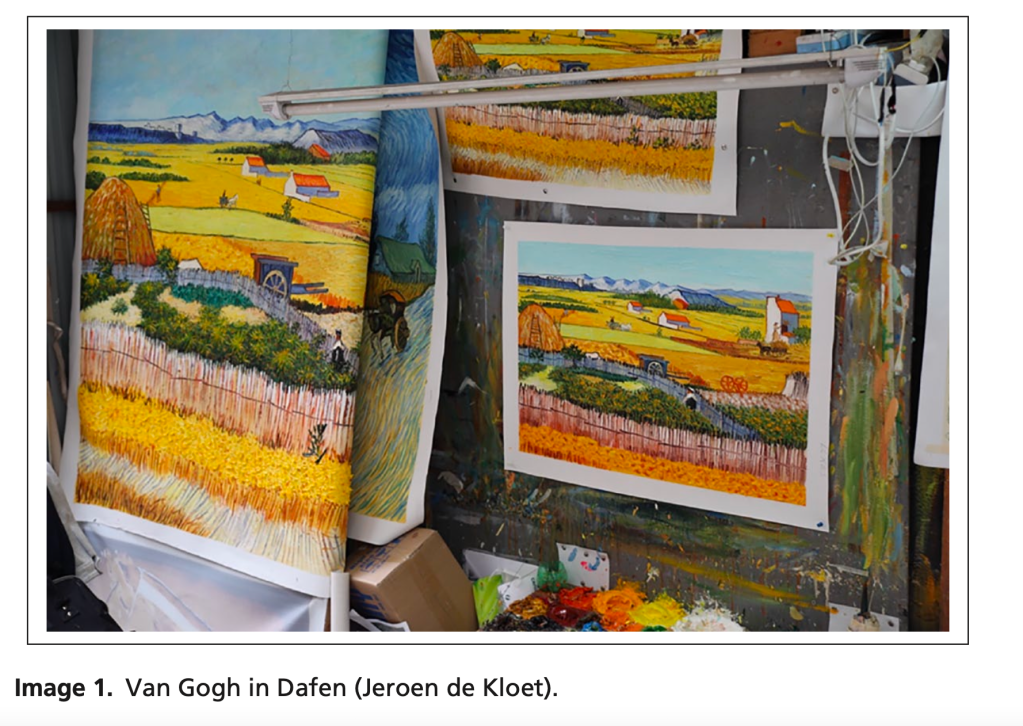
But when. . .researching shanzhai art made in Dafen village, located in Shenzhen, Southern China, and home to hundreds of painter-workers who make reproductions in every thinkable style and period, I was struck by the diversity of the artworks and their makers. The cheerfulness with which artworks were altered was liberating, for example, the ‘real’ van Gogh was considered too gloomy by customers, so the painters made a brighter version (see Image 1).

In another instance, I witnessed the face of Mona Lisa being replaced by one’s daughter to make it fit the household. When I brought an artwork home, the gallery called me later to ask if it matched my interior. Otherwise, I could change it. Such practices do turn conventional notions about art topsy-turvy. And shanzhai does not only concern art, it extends to phones, houses, cities, etc. As Lena Scheen (2019: 216) observes,

‘What makes shanzhai truly “unique” is precisely that it is not unique; that it refuses to pretend its uniqueness, its authenticity, its newness. A shanzhai resists the newness dogma dominating Euro-American cultures. Instead, it screams in our faces: “yes, I’m a copy, but I’m better and I’m proud of it”.’ https://journals.sagepub.com/doi/10.1177/13675494251371663

So what?

Any realistic attempt of ecological restoration with cloned bucardo [the Pyrenees ibex] would have to rely on hybridisation with other subspecies at some point; the genetic material from one individual could not be used to recreate a population on its own. Juan hypothesised: “we would have had to try to cross-breed in captivity, but you never know what could be possible, with new tools like CRISPR developing… and those [genome editing] technologies that come in the future, well, we don’t know, but maybe we could introduce some genetic diversity. This highlights a fundamental flaw in cloning as a means of preserving ‘pure’ bucardo—not only are ‘bucardo’ clones born with the mitochondrial DNA of domestic goats, but the hypothetical clone would also be subjected to further hybridisation. This begs the question, could such an animal ever be considered an authentic bucardo?” https://rgs-ibg.onlinelibrary.wiley.com/doi/10.1111/tran.12478

11. One honest response to the political awfulness of these times is the ostensive definition: “These are what’s worth defending.”

(The Comments at the originating YouTube sites provide background. Subtitles are available under CC or Settings.)

The now more noticeable limits of global analytic tip (updated)

I’m hardly the first struck by the analytic tip in my profession, policy analysis: What used to be dealt with at the local, regional and even national levels, at least when I started out in the early 1970s, is now addressed first and foremost globally (think “global warming”).

What I was unprepared for was how “the local” has been consigned to analytic oblivion as the tip proceeded. Let me give an example from the field of Infrastructure Studies. To be clear from the outset, I agree with every word in the following:

Infrastructures should be understood as plural, active, and dynamic, producing a range of impacts, both planned and unplanned, on the places and societies they traverse and inhabit. These insights reinforce the characterization of infrastructures as socio-technical networks, while their multiple and often ambiguous effects partially challenge the intentionality presumed in [Michael Mann’s 1984] conceptualization of infrastructural power. For example, recent scholarship highlights the unanticipated costs or forms of violence that infrastructures can impose on disenfranchised communities and regions.

The socio-technical nature of infrastructures is clearly reflected in their politicization and contestation, which reveal competing social interests across multiple scales. Commonly regarded as background systems, infrastructures rarely occupy public attention until they fail to meet expectations, whether through malfunction, inadequate supply, or clashes with users’ interests and needs. Increasing attention has also been paid to infrastructures’ negative externalities, or “public bads,” including ecological, social, and psychological harms, revealing both conflicting local perspectives and broader changes in societal priorities and beliefs, as well as new forms of collective identity and agency, manifested in labor strikes, acts of sabotage, or protests. (https://journals.sagepub.com/doi/10.1177/1368431026145776; internal citations deleted)

For me, this passage represents hard-won insights over years of research: the units and levels of analysis are socio-technical, networks, across scales, contingent on context, and often with unanticipated and unintended impacts.

But then comes the irresistible updraft in the article’s next sentence:

These dynamics are not confined to the local scale: transnational infrastructures are increasingly implicated in broader geoeconomic contexts, as exemplified by the Houthi attacks on the Red Sea shipping lanes, the shutdown of major Chinese ports under Beijing’s zero-COVID policy, and the disputes surrounding the Nord Stream 2 gas pipeline.

Well, yes, that too is true, but still: Just what is happening at the lower scales of analysis? Indeed, how do actual operations of critical infrastructures unfold at the local and regional levels?

The article, like so many others, is off and running to the international, global and now planetary levels–understandably so, since that’s global analytic tip after all–but! Even if what the article continues to say is just as true as what was said to that point, that truth needs to be pushed further, especially as variation in inter-infrastructural connectivities at the local and regional levels matter so often and so directly for policy and management.


NB. For more on this analytic tip, see my 1994 Narrative Policy Analysis.

“The greater danger may lie not in catastrophism itself but in the tendency to discount unwelcome historical diagnoses because their authors cannot specify what comes next.”

We are told the original Cassandra knew, with absolute clarity, that the catastrophes she prophesied would happen. Our really-existing Cassandra’s cannot have that certainty about their predictions of catastrophe, no matter how sure they may feel about this or that. Indeed, that is what the rest of us know.

But catastrophe-with-respect-to-what? Our scenarios for what’s next or later vary in terms of their details. Indeed, the more detailed, the more likely the scenario will not happen the way specified. If the latter is the starting assumptions, then it’s no surprise you respond to catastrophe (or its prospect) in real time by trying to keep your options to maneuver now and in the next steps ahead. You work through “what-ifs,” yes; but not so specific as to foreclose taking different pathways ahead, should they prove needed. The buzz term, “building in resilience,” often obscures this open-endness.

Whether you and your associates are able to keep options open is, of course, another matter. Here I want to underline that such real-time scenarioizing imports into it the “near real time”. The next steps ahead are also being prepared for, imagined if not actually anticipated. I take this to mean cognition in these circumstances is not an entire presentism where the current moment is what’s immediately real. Real time also incorporates some planning ahead and planning ahead imports elements of the future just as real as the moment now.

So, to return to the question posed in the title, even those who undertake the real-time operation of our large critical infrastructures typically have longer-than-immediate time horizons when confronted by unanticipated shocks or worse. Real-time operation of large, complex critical infrastructures is not rapid emergency response. This in turn means that those who predict catastrophe with respect to this or that failure scenario should at least avail themselves of the what-if scenarios discussed in the operation centers of the critical infrastructures with respect to the said catastrophe. That may not be certainty, but it is useful knowledge.

My experience–and here I stand to be corrected–is that not only do catastrophists not avail themselves of such operational scenarioizing, so too do some serious historical discussions evince prognostications devoid of any interest in the particulars. For them, this is the weeds–as if Cassandra shouldn’t have needed to be that specific in order to be heeded.

Worth repeating. . .Constant’s complexities

From: Stephen Holmes (1984). Benjamin Constant and the Making of Modern Liberalism. Yale University Press: New Haven, CT. Constant was a late 18th century – early 19th century French political thinker; Holmes is an American political scientist; and the book has been called a landmark study.

In truth, Constant’s hostility was never directed against democracy itself, but only against the pretext of democracy. He did not fear popular government, though (like Rousseau) he took it for granted that direct, polis-style self-rule was impossible in large modern states. He did not worry that if democracy were carried too far it would be transmogrified into its opposite. What he dreaded was the perverse exploitation of democratic rhetoric to justify the concentration of all power in a few hands and to conceal acts of oppression. In other words, Constant did not share the apprehensions of Tocqueville and Mill about a potential tyranny of the majority. He could not have been more explicit on this point. In 1829, he wrote: “during the last forty years, every time there has been tyranny in France, minorities have governed.” Even more emphatically: “The majority never oppresses. One confiscates its name, using against it the weapons it has furnished.” Not the majority but the all-justifying name of the majority, confiscated by a few, was his fundamental concern. (Holmes 1984, 25; internal endnotes deleted)

Refuting the crisis narrative: abandon third-person prophetic by admitting first-person uncertain

For those who surely know catastrophe is to come, I commend the initial section of Helen Vendler’s essay, “Loose Quotes” (in the journal, Liberties). Here, Vendler disrupts the understanding many of us have had about the familiar crisis lines opening “The Second Coming” by W.B. Yeats. She begins with the full poem and I quote Vendler’s analysis thereafter at length. I conclude with an upshot.


THE SECOND COMING 

Turning and turning in the widening gyre
The falcon cannot hear the falconer;
Things fall apart; the centre cannot hold;
Mere anarchy is loosed upon the world,
The blood-dimmed tide is loosed, and everywhere
The ceremony of innocence is drowned;
The best lack all conviction, while the worst
Are full of passionate intensity.

Surely some revelation is at hand;
Surely the Second Coming is at hand.
The Second Coming! Hardly are those words out
When a vast image out of Spiritus Mundi
Troubles my sight: somewhere in sands of the desert
A shape with lion body and the head of a man,
A gaze blank and pitiless as the sun,
Is moving its slow thighs, while all about it
Reel shadows of the indignant desert birds.
The darkness drops again; but now I know
That twenty centuries of stony sleep
Were vexed to nightmare by a rocking cradle,
And what rough beast, its hour come round at last,
Slouches towards Bethlehem to be born?

       W.B. YEATS

Turning and turning in the widening gyre
The falcon cannot hear the falconer;
Things fall apart; the centre cannot hold;

….

The best lack all conviction, while the worst
Are full of passionate intensity.

In every crisis they appear, those famous and familiar lines from “The Second Coming,” written in 1919 by W. B. Yeats. Journalists and critics alike seem to take them as final assertions of Yeats’ own beliefs. Such innocent judgments do not ask why those lines open the poem, or for how long their assertions remain asserted. The poem itself has become lost behind the quotability of its opening lines. And Yeats, it seems, wants to be a pundit.

In our ready “yes, yes” to those lines, we think we are accepting the judgment of a sage, but by the time we reach the close of the poem — which is a question, not an assertion — we are driven to imagine the changing states of the writer composing this peculiar poem, and we raise questions. . .In order to understand this poem, to free it from its ubiquitous misuses, and to restore it to both its opening grandeur and its subsequent humiliation, those are the questions that we must answer. . . .

“The Second Coming” is a lurid refutation of the lurid Christian expectations of the Second Coming of Christ, which Jesus himself foretells in Matthew 29-3:

Immediately after the distress of those days, the sun will be darkened, and the moon will refuse her light, and the stars will fall from heaven, and the powers of heaven will rock; and then the sign of the Son of Man will be seen in heaven; then it is that all the tribes of the land will mourn, and they will see the Son of Man coming upon the clouds of heaven, with great power and glory.

Yeats proposes a surreal alternative to Jesus’ prophecy, proposing that on the Last Day we will see not Christ in majesty but a menacing, pitiless, and coarse beast who “slouches toward Bethlehem to be born.” “After us, the savage god,” Yeats had said as early as 1896. He watched through the decades, appalled by the sequential horror of world events: The World War from 1914-1918; the failed Easter Rising in Ireland in 1916; the Bolshevik Revolution in 1917. And his first assertions in “The Second Coming” are indeed thoughts prompted by such political upheavals. . . .

The quotability of Yeats’ opening passage derives, of course, from the total and unmodified confidence of its initial reportage, impersonal and unrelenting, offering a naked list of present-tense events happening “everywhere.” Stripped to their kernels, these are Yeats’s truculently unmitigated hammer-blows of grammar:

The falcon cannot hear
Things fall apart
The centre cannot hold
Mere anarchy is loosed
The blood-dimmed tide is loosed
Everywhere the ceremony of innocence is drowned
The best lack all conviction
The worst are full of passionate intensity

The break, after Yeats’ introductory eight-line block, leads an educated reader to expect that a six-line block will follow, completing a sonnet [of 14 lines]. Yet the poet finds himself unable to maintain his original jeremiad, which has been aggressive, omniscient, panoramic, and prophetic. Yeats “begins over again,” and utters in the fourteen lines following the break a complete second “sonnet,” a rifacimento of the one originally intended, in which he rejects his earlier rhetoric of impersonal omniscience as inauthentic from his human lips. Who is he to speak as though he could see the world with the panoramic scan proper only to God? That so many successive writers have been eager to reissue his lines reveals how greatly the human mind is seduced by the vanity of the unequivocal. Can we requote without unease what the poet himself immediately rejected?

Although “The Second Coming” begins with an attempt at couplet-rhyme, soon — as Peter Sacks has pointed out to me — the couplets begin to disintegrate, as though they themselves were intent on demonstrating how “things fall apart”. . .The second, revisionary octave replaces the certainty of the poet’s original octave with the self-defensive uncertainty of “Surely.” Longing for a revelation more humanly reliable than an unsupported façade of godlike prophecy, Yeats insistently utters his second “Surely,” one no less dubious than the first. The second “Surely” attempts to locate a cultural myth to which he can attach the vision vouchsafed to him in a revelation arising within his human consciousness. “Surely the Second Coming is at hand. / The Second Coming!”

For the first time in the poem, we hear Yeats speaking in the first person, declaring that “a vast image out of Spiritus Mundi / Troubles my sight.” The poet is the sole spectator of this vast image, and he claims that it stems not from his own bodily sense of sight but from the World Spirit, a universal Spiritus Mundi always potentially able to rise into human awareness. (Poets so often describe the initial inspiration for a poem as something coming unbidden that the reader is not troubled by Yeats’ myth of a World-Spirit supplying the image for his revelation.) The poet has decided that it is more honest, more tenable, to write in the first person, to present himself as one whose imagination has reliably generated a telling and trustworthy “vast image” of his historical moment. He has forsaken his impressive but fraudulent rhetoric of omniscience for an account of his private inspiration.  

Once Yeats has repudiated his initial “divine” posture as a guaranteed seer-of-everything-everywhere, he can take on, in the first person, his limited historical image-making self and create with it a “human” sestet for his newly “remade” sonnet. Admitting the fallibility of any transient metaphorical image, he acknowledges that his image vanishes, “the darkness drops again,” and he is left alone. Yet he grandly maintains, in spite of his abandoning a prophetic stance, that he now definitely “knows” something.

The “something” turns out to be a single historical fact: the exhaustion of Christian cultural authority after its “twenty centuries” of rule. His “vast image” — its nature as yet unspecified — has shown him that Christianity will be replaced by a counter-force, a pagan one. Drawing on his reading of [Giambattista] Vico and Herbert Spencer, Yeats believed that history exhibited repetitive cycles of opposing forces. Just as Christianity overcame the preceding centuries of Egypt and Greece, now it is time for some power to defeat Christianity.

In his private “revelation” the poet has seen the Egyptian stone sphinx asleep “somewhere” in sands of a desert. (The uncertain “somewhere” admits the loss of the initial “everywhere” of Yeats’ prophetic opening.) The “stony sleep” of the Sphinx has lasted through the twenty centuries of Christianity, but now Fate has set an anticipatory cradle rocking in Bethlehem, birthplace of the previous god, and a sphinx-like creature rouses itself to claim supremacy:

The darkness drops again; but now I know
That twenty centuries of stony sleep
Were vexed to nightmare by a rocking cradle…

Although the poet “knows” that Christianity is undergoing the nightmare of its death-throes, he cannot declare with any confidence what will replace it. He can no longer boast “I know that…”: he can merely ask a speculative question which embodies his own mixed reaction of fear and desire to the vanishing of a now outworn Christianity, the only ideological system he has ever known. What will replace the Jesus of Bethlehem, he asks, and invents a brutal and unaesthetic divinity, a sphinx seen in glimpses — “with lion body and the head of a man, / A gaze blank and pitiless as the sun”. . .The indignant birds, their movement in the sky inferred from their agitated cast shadows, “reel about,” disoriented, projecting, as surrogates, the poet’s own indignation as he guesses at the future parallel upheaval of his own world. . .:

And what rough beast, its hour come round at last,
Slouches towards Bethlehem to be born?

(Accessed online at https://libertiesjournal.com/articles/loosed-quotes/?cache_busting=6ac95a404e605 and appearing in Chapter 1 of Helen Vendler (2025). Inhabit the Poem: Last Essays. Library of America: New York, NY)


Vendler continues her exegesis, but my upshot is established. What makes this a fine poem for Vendler is that its narrative of feeling also opens up to “an analysis of the origin and evolution of such feelings” (2025, xii). Fear and dread driving crisis narratives are, in contrast, more third-person societal and coarser than first-person uncertain–at least for this policy analyst.

Separating pastoralists out from pastoralism(s) leaves a category error driving policy & management

I

Let’s just say that governments and their donors are quite willing to distinguish pastoralists from pastoralism when their saving pastoralists means destroying the ways of pastoralism, e.g., sedentarize these herders as a way of bringing them more fully into modernity’s fruits of development.

But what are the policy and management implications in insisting that the primary unit and level of analysis are in fact systems/societies of pastoralism, not their “individuals”? For those who see older forms of pastoralism fast disappearing into history, this question seems moot. It is not, however, for those who still find a variety of pastoralisms not only in the past but now as well. I include myself in the latter group.

What is underway in “pastoralism” is complex enough for multiple interpretations. Outside-induced dynamics and change are evident, but also institutional inertia, interpersonal habits, and routine “second nature.” Some in the resulting mixes of memories and expectations are more relevant for policy and management, e.g., Ian Scoones and his PASTRES colleagues on implications of a new pastoralism narrative for agrarian studies (“Rethinking agrarian studies from a pastoralist perspective” in https://www.tandfonline.com/doi/full/10.1080/03066150.2020.1802249#d1e1561).

My own work has been to suggest a “critical infrastructure” approach to understanding the policy and management implications of contemporary pastoralisms. But, to repeat, today’s complexities open up other ways of reframing pastoralism collectively rather than individually. Below are four other “system-level” illustrations of reframing and their policy and management relevance (culled from previous blog entries with full references). Warning: I’ve chosen to be provocative in my selection.

II

1. Scenes, not issues. Instead of talking about grazing practices, herd mobility, shortage of herder amenities, overall poor living conditions for herders and their marginal social status, think of their practices as performance, their mobility and herding itineraries as travel, their scant amenities as the role of, say, everyday music while herding, and all that poor or picturesque herder clothing as, well, fashion in its own right. To do so means we end up describing “scenes” more than “issues”. As in, e.g., the frequently narrativized “downtown” scenes for the arts, music and lifestyle alternatives, where that “alternative” carries a quite different valence that the “marginal” of many pastoralism studies.

In shifting the policy and management focus from issues to scenes, we are explicitly shifting to what have been called frictional, improvisational contact zones that everyday pastoralism shares with other scenes organized around (alternative) performances, travel, music and fashion. That this analytic shift complicates official and academic policy narratives about pastoralism is a welcome one in my view. How so?

If we stick with the conventional view of herders as their own unit and level of analysis, we’ve been trained to think of informal contact zones as the decreasing space between two blades of modernity’s scissors: One blade is everyday pastoralism commodified by really-existing markets and state interventions; the other blade is everyday pastoralism disciplined into categories from really-existing officials, consultants, and social scientists.

The contact zones I am talking about, however, are a response to the scissors cutting one way only. Whether the zones are formal or informal is not the point. Pastoralism is, to use the phrase, an “infrastructural form.” It is a scene-making device that is exceptionally adept at rendering all that unromantic, unsentimental dust and sand and dirt in photos of herds and herders alive with working relations and affordances–a shared repertoire of practices and atmospheres–that necessarily extend beyond market and state. (One of the great virtues in looking at pastoralist practices at the event and situation level is that policy scenes can turn just as center-stage as discrete policy issues or processes.)

2. Mobility as shifts in interconnectivity. Think of herd/er mobility as the interconnections and their different configurations managed spatially and temporally by herders for what are still called the factors of livestock production (land, water, labor). Livestock “moving between different sites with variable forage resources within a mosaic of harvested crop fields, open pastures and thickets” necessarily refers to more than the uni-directional interconnection of livestock and herders moving from a ‘here’ to a ‘there.’ Shifts in reciprocal, mediated and pooled interconnectivity are also being managed as part and parcel of more granular, fine-grained mobility.

To expand: Livestock move sequentially from here to there, but their inter-relationships with sites along the way are anything but serially uni-directional. Reciprocal (bi-directional) relationships are also much discussed in the literature (the stubble for livestock, the manure for the crop field). Extensively-raised livestock fattened up at special sites just before sale or slaughter are examples of a mediated interconnection between the herders and that off-take. The grazing itinerary of moving livestock across time and space is a kind of pooled interconnectivity guiding the herders and herds involved. More, shifts in configurations are a centerpiece of mobility discussions in the literature, e.g., improvising and responding opportunistically, as livestock and herders move along the itinerary, if there is one.

(Note that once the interconnectivity configuration shift, so too the scale of operations, e.g., feedlots mean you no longer have to graze extensively should the opportunity arise. Currently, much of the literature focuses on a reversed causality, i.e. , the scale of rangeland grazing shrinks and new forms of interconnected pastoralist operations emerge.)

I want to suggest that “land mosaics” are more than primarily a set of property relations, or a set of different species in a habitat, or as a landscape with heterogeneous habitats. Practices associated with mobility as shifting interconnectivities over time and space are to my mind central. Practically, the notion of mosaic complexifies analysis. Because it is now “mobility with respect to the mosaic(s) of interest,” not just: “mobility as a response to task environment variability.” So what? The mosaic is the intervening template–if you will, the scenes–for understandingnterconnected exogenous and endogenous variabilities, now more granular with respect to practices than the critics’ usual suspects of climate, prices, and conflict.

3. The methodological problem of “pastoralists” as a social figure.

We consider a timeless model of a common property resource (CPR) in which N herdsmen are able to graze their cattle. The model has been constructed deliberately along orthodox economics lines. . . .We begin with a timeless world. Herdsmen are indexed by i (i = 1, 2, …, N). Cattle are private property. The grazing field is taken to be a village pasture. Its size is S. Cattle intermingle while grazing, so on average the animals consume the same amount of grass. If X is the size of the herd in the pasture, total output – of milk – is H(X, S), where H is taken to be constant returns to scale in X and S.Dasgupta, P. (2021), The Economics of Biodiversity: The Dasgupta Review. London: HM Treasury: 221 (internal footnotes deleted)

After such bloodless abstractions, it’s a wonder even more readers don’t rush to anthropology for descriptions of really-existing pastoralists and their herding practices.

The methodological problem, though, remains: It’s pastoralists who are interviewed and quoted, not societies and systems. The policy-relevant compromise is to treat the pastoralists studied as one or more social figures, a composite assembled to represent the typical features of pastoralists who have been studied (or not).

A problem arises because use of social figures extends significantly beyond the confines of anthropology and the social sciences. Social figures “potentially have all the characteristics which would be considered character description in literary studies,” notes a cultural sociologist, adding, “unlike ideal types, for example, which are written with a clear heuristic goal in a scientific context, social figures can also appear in public debate or be described in literary texts.”

So what? “For theorizing, this means. . .attention must be paid to a good figurative description: Is the figurative description vivid, descriptive and, as a figure, internally consistent? Does it accurately reflect the social context to which it refers? Therefore, the criteria to assess quality in theorizing must be complemented by literary criteria.”

And one of those literary conventions helps explain why the social figure of pastoralists today is frequently compared and contrasted to the social figure of pastoralists in the past. “[T]here are often antecedent figures for a social figure. . .The current social figure can then be understood as an update of older social figures.”

A small matter, you might think, and easily chalked up to “this is the way we do longitudinal analysis.” It is not, however, a slight issue methodologically, when comparing your pastoralist informants today with the social figure of pastoralists in the past ends up identifying “differences” that are more about evaluative criteria than about comparative empirics. Beware any benchmark of “pre-capitalist” pastoralism!

4. When government’s recurrent cost budget is the informal sector. Humor me and start with current debates over periodizing World Wars I and II. It’s one thing to adopt the conventional periodization of the latter as 1939 – 1945. It is another matter to read in detail how 1931 – 1953 was a protracted period of conflicts and wars unfolding into and from a central paroxysm (primarily but not exclusively) in Europe and the Pacific.

In the latter perspective, the December 1941 – September 1945 paroxysm, with carnage across multiple front-lines, and military engagements both in Europe and the Pacific, were embedded in a longer series of large regional wars. These in turn were less preludes than unfolding processes worldwide. (Think: Japan’s invasion of Manchuria in 1931, Italy’s invasion of Ethiopia in 1935, the late 1940s Dutch war in Indonesia, the French war in Indochina from the late 1940s through early 1950s, and the Korean War.)

Now, reframe the most recent extended East Africa drought as one such paroxysm, with drought-related conflicts leading up to and following from it. Current emergency management terminology about this or that “longer-term recovery” are considerably problematic when the longer term is one drought unfolding into another and then over again. Immediate emergency response would look considerably less proactive when embedded in a process of recurring response always before the next disaster.

What does this mean practically? One major follow-on is giving renewed attention to government budgets for their recurrent operations in dryland communities. Or more pointedly, you’re looking at the recurrent cost crises of East Africa governments–which, to my mind, far too few critics analyze when fixated on failures of capital development projects and programs for pastoralists (as individuals and as systems).

My view is that you have to have recurrent operating budgets already in place in order to get recurring drought response and recovery more effective on the ground over time. This means opening up our understanding of “government’s recurrent cost budget.” Networks and communities of pastoralist households already on the ground are the de facto recurrent budget.

More, this “informal sector as recurrent budget” centers around the fact that when acting like other networks of reliability managers, these teams or groups of pastoralists give ongoing priority to the real-time prevention of other disasters from happening along the way and the need for their improvisational behavior to do that.

III

“But that’s not pastoralism!,” you insist–and you may be right as far as you go.

My position is we need to go further. Despite “the mountains of research evidence about contemporary pastoralists,” to be told what not to do only increases uncertainty in the absence of recommendations for doing what instead. That is why the drive to more counternarratives, rather than more critiques, is so important.

Indeed, the second anyone recommends “interventions should heed African pastoralists’ understanding of environmental change and uncertainty and support their approach to dealing with these,” there are always those who immediately problematize by asking “which pastoralists and which approaches are we to listen to?” and “how do we listen to them without instrumentalizing those worldviews?”

In these and other ways, the researching of “pastoralists” can reduce to bearing witness, professions of solidarity with those totalized as victims, and calls for Big-T transformations without much detail. This too can be policy relevant in the sense of, say, the Black Sash vigils by white women in the mid-1950’s apartheid South Africa.

If only tyrants were extinguished by their own contraptions

The Prussian King Friedrich Wilhelm I felt compelled to refuse the request of Tsar Peter the Great that they try out the former’s new execution gallows on one of their own men. It’s also recorded that Phalaris, 6th century BCE tyrant in Sicily ordered the inventor Perillus to design a huge bronze bull in which to roast the former’s victims alive. Their screams would, that tyrant hoped, sound just like the bellows of a bull. Phalaris was so impressed with the contraption that his first victim was Perillus.

Civilization, it seems, would be one where Friedrich Wilhelm I, Peter the Great, Phalaris, and all the other tyrants end in their own contraptions. And yet: It’s hardly helpful to know that modern cosmology–string theory plus black holes–implies there is a planet out there, just like this one in virtually every way, save that its US President is being water-boarded for crimes against humanity.