Begin with the strategic orientations many have with respect to resilience and anticipation as distinct from each other. Resilience is said to be optimizing the ability to absorb or rebound from shocks, while minimizing the need to anticipate these shocks ahead of time. Anticipation, in contrast, is to optimize the ability to plan ahead and deal with shocks before they happen, while minimizing having to cope with shocks when they do occur. Consider the resulting Table 1:
System designers would like managers to be both optimally anticipatory and resilient at the same time—indeed that managers maximize their “readiness” for whatever arises, whenever. These all-embracing demands can, however, reduce the managers’ much-needed capacity to balance anticipation and resilience case by case.
More, the ideal of stabilizing the task environment so as to minimize the need for both anticipation and resilience—a common enough premise (promise) of macro-designers—is as impossible to realize as it is irresponsible to promote, when the aim is high reliability in real-time operations.
Who wouldn’t be right in avoiding or resisting burn-out, if told repeatedly they haven’t “taken control” of climate change, species extinction and biodiversity loss?
It would be good to know if we are nine missed meals away from civil unrest, or only four such meals as others say.
Isn’t everything-connected-to-everything-else an odd form of stasis?
To say endemic crises have many causes and are overdetermined is like saying there’s too much wind-up for the pitch thrown.
Since when has inequality been best described as a crisis? Inequality is much more the norm before it is a crisis. Norms are accepted or not; crises are to be managed or coped with. Shaming, humiliating and ostracizing those profiting from the scandal of the status quo is a more policy-relevant response to norms of inequality.
–Conflation of the physical system managed with the area of system impacts should the system fail is common. The spatial area managed by a water supply or electric grid is not the spatial area affected by indefinite loss of water or electricity. Large critical infrastructures may be operated within regions, but regions are not systems managed on their own in the same way critical infrastructures with central control rooms are.
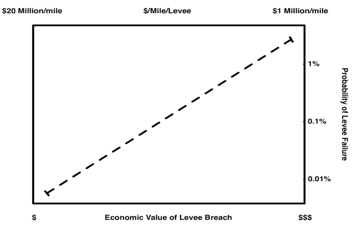
To see how this matters, picture a stylized relationship between the probability of levee failure (Pf, e.g., 1%, 0.1%, 0.01% per annum), the estimated cost per mile of levee stretch to bring it to high safety standard, and the estimated loss in economic value (including foregone earnings due to loss of life), should levee failure occur at a given Pf. One relationship is the diagonal read from the upper right to the lower left (my thanks for Robert Pyke for the figure):
The dotted line assumes that the losses in economic value of a levee breach decline as levees are brought to a higher, more costly standard with reductions in the probability of levee failure, Pf. What is managed directly is maintenance at a levee standard and the associated Pf; only indirectly is the “economic value of levee breach” managed..
–If you counter that this impact-shed is “the system to be managed,” then you beg the larger question: What infrastructure manages the impact-shed in terms of the consequences of levee breach (Cf), including economic losses?
Answer: Cf is most pertinent to the emergency management infrastructure, and not the flood and levee infrastructure, as in the illustration. The time period for the former involvement may well be limited (say, six weeks to three months after the disaster), leaving the bulk of the recovery to those infrastructures that manage systems–roads, waterways–and not the respective impact-sheds.
From the viewpoint of narrative policy analysis, the most obvious feature of the climate emergency is this narrative discrepancy: On one hand, all of us on this planet are in the terra incognita of the Anthropocene’s uncharted waters, and on the other hand, we know this because of those who stand on the terra firma of best-available science, technology and climate activism.
I do not mean that point to be a criticism nor do I see it as some kind of contradiction or inconsistency. In narrative policy analysis, the role of a narrative discrepancy is to point to a metanarrative (or metanarratives), that is: a wider narrative, if any, that explains holding both positions at the same time without inconsistency, contradiction or self-refutation. A readily-available metanarrative is the social psychological one about how persons experience the present. Even those feeling shipwrecked grasp at the prospect of life-saving wreckage and being tossed onshore as a castaway.
Where there is one metanarrative, there are often more, and my aim here is to illustrate four, among many, metanarratives that are more directly policy-relevant.
It should not surprise the reader that my strategy to identify these wider policy narratives is to differentiate both sides of the first-paragraph statement. On the one hand, how are we differently at sea and in uncharted waters? On the other, are there more specific shorelines than just science, technology and activism associated with those differences in unchartered waters and being at sea?
The following four metanarratives come into a view when and because we are operating more granularly in the climate emergency. New narratives emerge because at these levels the discrepancies that mislead analyses become clearer as do how to address them, particularly:
1. How to respond better to the climate emergency when viewed asymmetrically as failures and their costs
2. How to respond better to the climate emergency when viewed asymmetrically as having to stop this or save that
3. How to respond better to the climate emergency when viewed asymmetrically as US-style emergency management
4. How to respond better to the climate emergency when viewed asymmetrically with respect to the still much-needed reduction of global GHG emissions
————————
1. How to respond better to the climate emergency when viewed asymmetrically as failures and their costs
I recently attended a very informative conference on sea-level rise, storm surges and flooding in the greater San Francisco Bay Area, now and projected into the near decades.
Most of the day was spent on projects and interventions for climate change mitigation and adaptation about which I knew nothing, including: a Lake Mendocino water storage innovation, several dredging and sediment projects geared to beneficial uses, several wetlands restoration projects, and a great many planning and feasibility efforts funded with respect to not just sea-level rise, increased storm surges and inland flooding, but also for rising groundwater levels and changing air temperatures affecting major infrastructures differently.
In addition to these specifics, I was told:
that Bay Area would need some 477 million cubic yards of sediment–the vast majority of which can’t be sourced locally–to restore area wetlands and mudflats;
It would require an estimated US$110 billion dollars locally to adapt to higher sea levels by 2050, this being based on existing plans in place or used as placeholders for entities that have yet to plan; and
To expect much more sea level rise locally because of the newly accelerated melting of the ice cap melting in Antarctica and Greenland.
Millions of cubic yards equivalent to over 420 Salesforce Tower high-rises? Some $110 billion which has no possibility whatsoever of being funded, locally let alone regionally? And those massive new requirements posed even locally by the melting ice caps? How are these unprecedented high requirements to be met?
It’s not surprising that the individual interventions presented that day and all the hard work they already required paled into insignificance against the funding and work challenges posed by the bulleted challenges.
What to do? How to respond?
II
Such massively large sums are meant to underscore the urgency of the matter, to stir us to action that matches the unparalleled magnitude of the climate emergency. Such numbers do that for some people, but others respond by becoming instead even more uncertain than they already are. Part of that increased uncertainty is translated into dread over how to proceed (as seen with respect to nuclear weapons in the Cold War), and dread can also be instrumental in generating action.
More often though, I’ve found that the increased uncertainty generated by category-five sums ends up reinforcing the focus on and approach to narratives, projects and interventions already underway. At least we know and can see hard work achieves this!
III
And in that hard work is one answer to why such large numbers, even when they measure requirements, fall short of the needed analysis.
The problem lies in the asymmetrical estimates of losses (economic, physical, lives, and more) incurred if we don’t take action now. None of these estimated losses take into account the other losses prevented by infrastructure operators and emergency managers who avoid systemwide and regional system failures from happening that would have happened had they not intervened beforehand, sometimes at the last moment.
Why are these uncalculated billions and billions of saved dollars important when it comes to responding to sea level rise, increased storm surges, more inland flooding, rising groundwater levels and other sequelae?
Because it from this pool of real-time talent and skills and practices that society will be drawing for operationally redesigning the inevitable shortfalls in new technologies, macro-plans and regulations for climate restoration and recovery.
IV
Now deepen that wider perspective. You’d think that with the catastrophic disaster scenarios the planet faces, we’d see more investigations of how large critical infrastructures actually do avoid or avert massive system failures. You’d also think that the costs to society of confronting limitless disaster scenarios is set by the dangers of ignoring disasters, like earthquakes, floods and fires, easier to identify and assess.
So what?
Appeals to processes or state conditions such as “globalization,” “financialization,” “disaster capitalism,” and the like leave us assuming these processes are in fact the peoples’ chronic crises. The latter, though, is the case only if the with-respect-to scenarios detail how these broad processes are chronic because people have failed to avert all their own dreaded events.
————————
2. How to respond better to the climate emergency when viewed asymmetrically as having to stop this or save that
As in: Stop fossil fuels; stop cutting down trees; stop using plastics; stop defense spending; stop being imperialist; stop techno-solutionism; save biodiversity; save open spaces; save the coastlines; and in all of this never ever forget class, gender, race, inequality, identity and the rest. . .
I
An article starts with: “The climate crisis calls for a massive and rapid dismantling and retooling of our economy and society.” Yes, surely that and more; but what do we do now, right now, by way of existing options and procedures?
In the US setting, this means, among other things, decisions over activating a city or county emergency operations center and/or incident management teams at the department level to coordinate immediate response efforts. States also do the same with respect to their own EOCs, IMTs or equivalent.
This activation is done all the time, when high winds, ice storms, wildfires, heat dome effects, flooding and their combinations take down essential services, particularly backbone infrastructures of water, electricity, roads and telecoms.
II
Now the thought experiment: Activate the EOCs and IMTs, or at least the ones which know we are the climate emergency. Who then are the distressed peoples and sites? Well, that’s not something you can answer a priori or universally. It’s up to the EOCs and IMTs, who recognize the climate emergency is leaving local people hungry, making local spaces uninhabitable, taking away local employment. . .
In having to think about these things, one seemingly counter-intuitive implication becomes clearer.
Those oft-mentioned “stop-this-and-save-that” immediately hit a major obstacle. In really-existing emergency response, fossil fuel is needed to evacuate people, ship goods and services to distressed areas, keep the generators running when electricity fails, and so on. Cutting down trees, distribution of water in plastic bottles, and wide use of readily available gas-guzzling vehicles, in case it needs saying, are not uncommon.
III
Indeed and now necessarily more globally, years and years of R&D have gone into studying, prototyping and distributing more sustainable options, like eco-friendly stoves, toilet facilities, renewable-energy generators, and other alternatives.
Shouldn’t we then expect and want their increased use in immediate emergency response, especially when (not: “even if”) expediting them to the distressed sites and peoples means, e.g., using petrol to get them there? Isn’t the latter the wider narrative in which we operate in a world needing far more EOCs?
————————
3. How to respond better to the climate emergency when viewed asymmetrically as US-style emergency management
I
If your world is the world, you will quickly come across the literature on Shock-Responsive Social Protection that also addresses massive multiple shocks. But here you’d find almost an entirely different set of terms, namely, how social protection programs work with humanitarian response and disaster risk management for what is called here in the US emergency preparedness, immediate response and initial service restoration.
II
A social protection program might focus on how to transfer and get cash into the hands of the victims asap; the emergency management efforts we looked at worried about how ATMs and cellphone transactions would work once the infrastructures failed.
Humanitarian programs readily admit the need for international assistance; we interviewed no one in our recent research on disaster management in Oregon and Washington State who described “humanitarian aid” as a key emergency response, let alone from anywhere outside the US.
For its part, disaster risk management, while close to what we mean by emergency management in the States, might also include insurance mechanisms (e.g., assisting in paying premiums before the disaster) and contingency credit programs not just for recovery but also during immediate response
III
How does this wider perspective reframe US emergency management? One example will have to suffice.
Managed retreat is increasingly recommended as a response to rising sea levels confronting coastal communities, cities and major ports in the US (including the Bay Area mentioned in #1 above). We already have climate migrants in coastal Louisiana and like places, and the proposals are to manage this out-migration more systematically.
What’s missing, however, are assessments of the track records in the various managed retreat strategies out there already. Relocating capitols, for example, has not been without its major problems. Relocation of large numbers of people is even more notoriously difficult in humanitarian work.
What then might this mean in practice? One point of departure already suggested in thinking about managed retreat on the West Coast is captured in following:
Every time I visit South Sudan, the angels’ response to my criticisms never varies. “What would you have us do?” asked one exasperated aid worker as we sat drinking cold beers one night by the bank of the Nile. “If we leave, people will die.” He was right. A decade of government withdrawal from the provision of services, enabled by the humanitarian presence, and campaigns of government violence, partly paid for from humanitarian resources, had created a situation in which some people in the camps in Maban would probably starve if it were not for the aid agencies. The only solution the humanitarians can envision is to continue with this dystopic system.
Imagine, that is, not a massive withdrawal and resettlement of peoples from the West Coast (or any other major coastline for that matter), but rather masses of people who stay behind having nowhere else to go practically and who need indefinite humanitarian aid in order to survive.
Stay or not stay–either way means disaster preparedness as the wider frame of operations.
————————
4. How to respond better to the climate emergency when viewed asymmetrically with respect to the still much-needed reduction of global GHG emissions
I
One of the most famous typologies in organization theory in that of James D. Thompson:
The entry in Wikipedia explains the typology this way:
Where both preferences and cause/effect relations are clear, decision making is “computational”. These decisions are often short term and information about the decision is fairly unambiguous.
Where outcome preferences are clear, but cause/effect relations are uncertain, Thompson suggest that “judgment” takes over and you make your best educated guess. These decisions are based on prior experience and are often qualitative in nature.
When the situation is reversed, and preferences are uncertain, then you rely on compromise between different groups. Political coalitions may be built which rely on negotiating and bargaining.
When neither preferences nor cause/effect relations are clear, then you rely on “inspirational” leadership. This is where the charismatic leader may step in and this type of decision often takes place in times of crisis. (https://en.wikipedia.org/wiki/James_D._Thompson)
I want you to keep Thompson’s typology in mind when you read the following article on the case for better emissions reductions by Dr. Hannah Ritchie in the Guardian.
It’s quoted at length, in large part because I agree with every word of it. The virtue of Thompson’s typology is that it unlocks reasons why her points need to be extended, and when doing so, the important policy and management implications that follow for the climate emergency.
II
The big idea: why climate tribalism only helps the deniers
Hannah Ritchie
One of the most effective ways to be a climate sceptic is to say nothing at all. Why expend the effort slapping down climate solutions when you can rely on feuding climate activists to tear each other’s ideas apart? We tend to fight with those we are closest to. This is true of family. But it’s also true of our peers, which for me, are those obsessed with trying to fix climate change. Step into the murky waters of Twitter and you’ll often find activists spending more time going after one another than battling climate falsehoods.
These might seem like small squabbles, but they have a real impact. They slow our progress and play into the hands of the deniers, the oil companies, the anti-climate lobbyists. These groups push on while our heads are turned.
What we want to achieve is the same: to reduce carbon emissions. The problem is that we are stubborn about how we get there. We often have strong opinions about what the evils are, and how to fix them. The nuclear zealots want to go all-in on building new power stations. The renewable zealots want no nuclear at all. Some promote electric cars; their opponents want car-less roads. Vegans advocate for cutting out animal products; flexitarians feel judged when they eat their weekly roast chicken. . . .
. . .But the reality is that we can’t afford to be choosy. The answer to almost every climate dilemma is “We need both”. We need renewables and nuclear energy (even if that means just keeping our existing nuclear plants online). We need to tackle fossil fuels and our food system; fossil fuels are the biggest emitter, but emissions from food alone would take us well past a temperature rise of 1.5C and close to 2C. Not everyone can commute without a car, so we need electric vehicles and cycle-friendly cities and public transport networks. We can’t decarbonise without technological change, but we need to rethink our economic, political and social systems to make sure they flourish. . . .
So how can we make these debates work better? First, we need to become less fixated on the ideal pathway. None of us will get precisely what we want; we need to compromise and take a route that reduces emissions effectively and quickly, using a combination of solutions.
Second, we need to be more generous when dealing with our rivals. Intellectual disagreements can quickly descend into name-calling. Real conversation stops and we talk past one another instead. We become more focused on winning the argument than understanding the other side. This makes the climate solution space hostile, which is counterproductive considering we want the world’s best minds to be there.
Third, we need to be honest about what is and isn’t true about the solutions we don’t like. “EVs emit just as much CO2 as petrol cars” is simply wrong. They emit significantly less, even if they emit more than the subway or a bike (and yes, this is still true when we account for the emissions needed to produce the battery). “Nuclear energy is unsafe” is wrong – it’s thousands of times safer than the coal we’re trying to replace, and just as safe as renewables. It’s fine to advocate for your preferred solutions, but it’s not OK to lie about the alternatives to make your point. . .
For me, Dr. Ritchie speaks the truth; better yet, truth to power. But if you’ve kept in mind the Thompson typology, you’ll see what she’s doing a bit differently.
In Thompson terms, the article posits a low uncertainty over preferences—we do want to reduce carbon emissions—even if there are among us people more uncertain as to what best achieves our preferred outcome. Where so, the decisionmaking process is primarily a matter of judgment, and involving the drive to consensus not just among experts but also among more and more people who have come to the same judgment about the priority of reducing emissions.
Fair enough, but now return to that part of her text about “the need to compromise,” a term that for Thompson means something quite different. For him, yes of course there are occasions when negotiating and bargaining are the primary decision processes, but these are more the cases of greater uncertainty or disagreement over preferred outcomes than over the available means to achieve them. But for Dr. Ritchie the ends remain clear(er). That is also why her article reads at points almost computational in Thompson terminology: “’Nuclear energy is unsafe’ is wrong – it’s thousands of times safer than the coal we’re trying to replace, and just as safe as renewables”.
IV
So what? The wider policy and management challenge is now more one of documenting those really-existing cases, where computation, judgment, compromise and inspiration are achieving lower emissions.
This means that the wider policy narrative includes cases of actually-existing compromises, whose ends while not being explicitly emission reductions, nevertheless prove to have means that lead to reductions even greater than those promoted as doing so directly and explicitly. Yet have we even begun to measure that, regionally let alone globally?
On Shock-Responsive Social Protection, see: O’Brien, C., Scott, Z., Smith, G., Barca V., Kardan, A., Holmes, R., Watson, C. and Congrave, J. (2018), Shock-Responsive Social Protection Systems Research: Synthesis Report, Oxford Policy Management, Oxford, UK
The statement above establishes time/space between at one end, “When one dog takes a leak, all dogs around take a leak,” and at the other, “It’s not as wet as the forecast predicted,” something the Irish say to others on their routine walks.
It’s easy to cook up disaster scenarios. Film producer, Sam Goldwyn, who, when asked about staging the Last Supper, exclaimed: “Why only twelve? Go out and get thousands!” Such is the low-skill toehold of many disaster scenarios.
It’s not just that we’re wrong about some disaster scenarios.
The point is that we are back to a key narrative discrepancy in crisis scenarios—between the stated urgency to do something even if it includes massive experiments, and on the other side the requirement that the planet is to be made reliably safe—yet both claims underwritten by demands of unpredictability at the same scale of analysis, the system level.
“If you want stability, you have to change,” but also: “Since you have nothing to lose, why not change?” This is said without full appreciation of that discrepant “you”—singular or plural, personal or impersonal?—in each statement. Such narrative discrepancies can’t be written off or talked out of. They are to be managed as the messes we are in.
II
So what?
You’d think that the costs to society of confronting limitless disaster scenarios is set by the dangers of ignoring disasters, like earthquakes, floods and fires, easier to identify and assess. More, claims about “globalization,” “financialization,” “disaster capitalism,” and the like as causes of disasters run the risk of diminishing the centrality of those disasters averted by and for real people in real time with real problems.
Such displacement leaves us assuming macro-causes or macro-unknowns are indeed the peoples’ chronic crises. The latter, though, is the case only if the with-respect-to scenarios detail how these are chronic because people have failed to avert all their own dreaded events.
S. Bose (2023). Photovoice With Pastoralists: A Practical Guidebook. PASTRES, Institute of Development Studies, Sussex and the European University Institute in Florence. Reproduced with permission and accessed online at https://pastres.files.wordpress.com/2023/11/photovoice-guide-digital.pdf (Photo by Malicha, used with permission of the ERC PASTRES project)
Graduate students in public policy analysis and management will know the idealized sequence for undertaking a professional policy analysis, e.g., first define the problem, then assemble the evidence, then analyze it so and so on until we make our recommendation. This sequence, or something like it, is cast in the present tense.
My experience is that the idealized steps are markedly not in the present tense, but rather:
Having completed the analysis, I wrote the memo with my recommendations.
The past gerund, “having completed the analysis,” indicates something finished, a hope that stands in sharp contrast to real-world policies in their persisting incompletion—a very different kind of “present tense.” The gerund also serves to situate analysis within an ongoing context without which there wouldn’t be analysis.
In turn, the prepositional object , “recommendations,” introduces its own promise that our memo will be dealt with, albeit beyond our control but still within that context of which we analysts are part. Indeed, the point of the past gerund/past tense/object formulation is to make clear that, “objectively speaking”, analysts in the present are not to blame for anything like the real-world incompletion all around us.
II
Here’s another way to look at the incompletion.
It’s also common enough that today’s accounts of policy and management be presented from not just one discipline’s perspective (say, economics), but many—including political science, psychology, organization theory, and more.
Yet what frequently gets missed are the implied hyphens, i.e., “from a socio-politico-economic-cultural-historical-psychological. . .perspective”. How so?
Consider Polonius in Hamlet: “The best actors in the world, either for tragedy, comedy, history, pastoral, pastoral-comical, historical-pastoral, tragical-historical, tragical-comical-historical-pastoral. . .”
The hyphens there function as the performative demonstration of Polonius’s long-windedness. Interdisciplinary accounts of policy analysis and management, however, insist that you take their added wordage as anything but long-windedness.
Or another example: “It is obviously a highly complex phenomenon that needs global cooperation as a response as well as a holistic approach because the potential collapses are interrelated” Each word is written as if it anchored, resolute, placed there to resist being dragged elsewhere. In fact, each word functions as a cowpat to be stepped into and distract us into something that looks like. . . longwindedness as another form of incompleteness.
Source
Moretti, F. (2013). The Bourgeois: Between History and Literature. Verso: London and New York
This week I attended an informative conference on sea-level rise, storm surges and flooding in the greater San Francisco Bay Area, now and projected into the near decades.
Most of the day was spent on projects and interventions for climate change mitigation and adaptation that I knew nothing about, including: a Lake Mendocino water storage innovation, several dredging and sediment projects geared to beneficial uses, several wetlands restoration projects, and a great many planning and feasibility efforts funded with respect to not just sea-level rise, increased storm surges and inland flooding, but also for rising groundwater levels and changing air temperatures affecting major infrastructures differently.
In addition to these specifics, I was told:
that Bay Area would need some 477 million cubic yards of sediment–the vast majority of which can’t be sourced locally–to restore area wetlands and mudflats;
It would require an estimated US$110 billion dollars locally to adapt to higher sea levels by 2050, this being based on existing plans in place or used as placeholders for entities that have yet to plan; and
To expect much more sea level rise locally because of the newly accelerated melting of the ice cap melting in Antarctica and Greenland.
Millions of cubic yards equivalent to over 420 Salesforce Tower high-rises? Some $110 billion which has no possibility whatsoever of being funded, locally let alone regionally? And those massive new requirements posed even locally by the melting ice caps? How are these unprecedented high requirements to be met?
It’s not surprising that the individual interventions presented that day and all the hard work they already required paled into insignificance against the funding and work challenges posed by the bulleted challenges.
What to do? How to respond?
II
These massively large sums (and like figures) are meant to underscore the urgency of the matter, to stir us to action that matches the unparalleled magnitude of the crisis. Such numbers do that for some people, but others instead respond by becoming even more uncertain than they already are. Some of that increased uncertainty is translated into dread over how to proceed (like we saw with respect to nuclear weapons in the Cold War), and dread can also be instrumental in generating action.
More often though, I’ve found that the increased uncertainty generated by category-five sums ends up reinforcing the focus on and approach to projects and interventions already underway. At least we know and can see hard work achieves this!
III
And in that hard work is one answer to why such large numbers, even when they measure true requirements, fall short of the needed analysis.
The problem lies in the estimates of losses (economic, physical, lives, and more) incurred if we don’t take action now, right now. It’s been my experience that none of these estimated losses take into account the other losses prevented from occurring by infrastructure operators and emergency managers who avoid systemwide and regional system failures from happening that would have happened had they not intervened beforehand, sometimes at the last moment.
Why are these uncalculated billions and billions of saved dollars important when it comes to responding to sea level rise, increased storm surges, more inland flooding, rising groundwater levels and other sequelae?
Because it from this pool of real-time talent and skills and practices that society will be drawing for operationally redesigning the inevitable shortfalls in new technologies, macro-plans and regulations for climate restoration and recovery.
IV
We have a pool of such professionals already. They are not being consulted nor is their professionalism adequately recognized for the Anthropocene challenges ahead. Those in infrastructures who are already making billion-dollar saves are going to be needed even if the impossible sums were funded, and most assuredly because they won’t be.
————————
You’d think that with the catastrophic disaster scenarios the planet is said to face, we’d see more investigations of how large critical infrastructures actually do avoid or avert massive system failures. You’d also think that the costs to society of confronting limitless disaster scenarios is set by the dangers of ignoring disasters, like earthquakes, floods and fires, easier to identify and assess.
So what?
Appeals to processes or state conditions such as “globalization,” “financialization,” “disaster capitalism,” and the like leave us assuming these processes are indeed the peoples’ chronic crises. The latter, though, is the case only if the with-respect-to scenarios detail how these broad processes are chronic because people have failed to avert all their own dreaded events.
————————
I
Retrofitting a bridge pre-disaster isn’t a chancy wager on what might or might not happen to the bridge later. Retrofitting is managing latent interconnectivities between bridges and other infrastructures that become manifest during and immediately after the disaster. That inter-infrastructural connections will shift and these shifts will involve bridges is far more predictable than this or that bridge will fail, unless retrofitted.
This means attention is crucial to the track record in retrofitting bridges before and after disasters, here and elsewhere. Note the implication: Retrofitting has to occur in order to have a track record to monitor and learn from.
Since there are real material and cognitive limits on controlling inter-infrastructural connectivity at any point in time, doing more by way of managing the pre-disaster latency of interconnectivities is elemental. An interviewee with engineering and management experience told us their city water infrastructure was behind the electricity utility in the adoption of automatic shut-off valves. Bringing water systems up to power’s better practices is a way of managing latent interconnectivity in advance of disaster.
II
In other words, the question we should be asking is more akin to: “What have we learned, here or under like conditions elsewhere, that actually works in better managing latent interconnectivity for post-disaster response and recovery?”
————————
I
An article starts with: “The climate crisis calls for a massive and rapid retooling of our economy and society.” Yes, surely that and more; but what do we do immediately?
Which means in the US setting, activating a city or county emergency operations center and/or incident management teams at the department level to coordinate immediate response efforts. States also do the same with respect to their own EOCs, IMTs or equivalent.
This activation is done all the time, when high winds, ice storms, wildfires, heat dome effects, flooding and their combinations take down essential services, particularly backbone infrastructures of water, electricity, roads and telecoms.
II
Now the thought experiment: Activate the EOCs and IMTs, or at least the ones which know we are the climate emergency. And who are the distressed peoples and sites? Well, that’s not something you can answer a priori or universally. It’s up to the EOCs and IMTs, who recognize the climate emergency is leaving local people hungry, making local spaces uninhabitable, taking away local employment. . .
In thinking these things through, one rather counter-intuitive implication becomes clearer.
Those oft-mentioned “stop-this-and-that” (fossil fuel, biodiversity loss, and so much more) immediately hit a major obstacle. In really-existing emergency response, fossil fuel is needed to evacuate people, ship goods and services to distressed areas, keep the generators running when electricity fails, and so on. Cutting down trees, distribution of water in plastic bottles, and wide use of readily available gas-guzzling vehicles, in case it needs saying, are not uncommon.
Indeed and more globally, years and years of R&D have gone into studying, prototyping and distributing more sustainable options, like eco-friendly stoves, toilet facilities, renewable-energy generators, and other alternatives. Shouldn’t we then expect and want their increased use in immediate emergency response, especially when (not: “even if”) expediting them to the distressed sites and peoples means, e.g., using petrol to get them there?
————————
Below in full and without edit is a letter to the editor of the TLS:
Sir, – Unless a substantial proportion of the world’s scientists are
deluded and are (innocently) deluding us, articles that blithely project a
long-term future extrapolated from a continuing present need to be challenged
(see “The last mortals” by Regina Rini, May 17). Or rather the publishing of
them. To make predictions based on the present could be an act of climate
catastrophe denial, an act that recursively makes the catastrophe more likely.
This article is particularly odd in that it posits the exact opposite problem
to the one we (almost certainly) face. It’s not how we cope with watching the
next generation sail off into immortality, but how we cope with leaving them to
face the conclusion of our civilization. Even the most sophisticated actuarial
programs would struggle to tell me my grandchildren’s life expectancy, but I’d
bet it’s shrinking by the day. A more useful challenge for philosophers would
be to ask why environmental and social collapse are increasingly inevitable
now, why we don’t care, and perhaps why we seem not to care that we don’t care.
Are we incapable of seeing the world as real? Better to deal with these sorts
of questions than to go floating off into Elfland.
MARK STEINHARDT Bedford.
I wonder if Mr Steinhardt and like-minded people fully appreciate the equally strident policy implication that directly follows from the climate emergency being so catastrophic that thinking about anything else is irresponsible?
Namely: Such persons should be publicly shamed and humiliated, if it turns out that, of course the climate emergency is going on and yes, it is disastrous, but that does not excuse humanity from thinking about other existential disasters.
————————
I
It’s not surprising that those who don’t “give whatever it takes to save the planet” justify doing so by focusing on what they know can be managed or realized for the climate emergency. Consider one such example:
We emphasize the importance of taking political time and maintain that collective social responses to major climate impacts must center actually existing material and symbolic inequalities and place procedural and distributive justice at the heart of transformative action. This is so even where climate change will have devastating physical and social consequences.
Note this dissent at least has the merit of recognizing the human devastation entailed in its approach, quite unlike those who insist we must do whatever it takes, full stop. Nor is the quoted passage on its own. Others just as well insist the pre-eminent fact is that “doing whatever it takes” will be on the backs and in the flesh of already poor people and immiserated minorities globally (e.g., https://papers.ssrn.com/sol3/papers.cfm?abstract_id=4416499).
II
So what?
“In your plans for reform, you forget the difference between our two roles: you work only on paper which consents to anything: it is smooth and flexible and offers no obstacles either to your imagination or to your pen, whereas I, poor empress, work on human skin, which is far more prickly and sensitive,” so wrote Catherine the Great to Denis Diderot, the French Enlightener.
How has it come to pass that so many today think they are Enlighteners but act as our Empress?
Recently, I attended an informative conference on sea-level rise, storm surges and flooding in the greater San Francisco Bay Area, now and projected into the near decades. It was held by the Propeller Club of Northern California and the Society of American Military Engineers (San Francisco Post), both long established marine-focused institutions in the Bay Area.
Most of the day was spent on projects and interventions for climate change mitigation and adaptation that I knew nothing about, including: a Lake Mendocino water storage innovation, several dredging and sediment projects geared to beneficial uses, several wetlands restoration projects, and a great many planning and feasibility efforts funded with respect to not just sea-level rise, increased storm surges and inland flooding, but also for rising groundwater levels and changing air temperatures affecting major infrastructures differently.
In addition to these specifics, I was told:
that Bay Area would need some 477 million cubic yards of sediment–the vast majority of which can’t be sourced locally–to restore area wetlands and mudflats;
It would require an estimated US$110 billion dollars locally to adapt to higher sea levels by 2050, this being based on existing plans in place or used as placeholders for entities that have yet to plan; and
To expect much more sea level rise locally because of the newly accelerated melting of the ice cap melting in Antarctica and Greenland.
Millions of cubic yards equivalent to over 420 Salesforce Tower high-rises? Some $110 billion which has no possibility whatsoever of being funded, locally let alone regionally? And those massive new requirements posed even locally by the melting ice caps? How are these unprecedented high requirements to be met?
It’s not surprising that the individual interventions presented that day and all the hard work they already required paled into insignificance against the funding and work challenges posed by the bulleted challenges.
What to do? How to respond?
II
These massively large sums (and like figures) are meant to underscore the urgency of the matter, to stir us to action that matches the unparalleled magnitude of the crisis. Such numbers do that for some people, but others instead respond by becoming even more uncertain than they already are. Some of that increased uncertainty is translated into dread over how to proceed (like we saw with respect to nuclear weapons in the Cold War), and dread can also be instrumental in generating action.
More often though, I’ve found that the increased uncertainty generated by category-five sums ends up reinforcing the focus on and approach to projects and interventions already underway. At least we know and can see hard work achieves this!
III
And in that hard work is one answer to why such large numbers, even when they measure true requirements, fall short of the needed analysis.
The problem lies in the estimates of losses (economic, physical, lives, and more) incurred if we don’t take action now, right now. It’s been my experience that none of these estimated losses take into account the other losses prevented from occurring by infrastructure operators and emergency managers who avoid systemwide and regional system failures from happening that would have happened had they not intervened beforehand, sometimes at the last moment.
Why are these uncalculated billions and billions of saved dollars important when it comes to responding to sea level rise, increased storm surges, more inland flooding, rising groundwater levels and other sequelae?
Because it from this pool of real-time talent and skills and practices that society will be drawing for operationally redesigning the inevitable shortfalls in new technologies, macro-plans and regulations for climate restoration and recovery.
IV
We have a pool of such professionals already. They are not being consulted nor is their professionalism adequately recognized for the Anthropocene challenges ahead. Those in infrastructures who are already making billion-dollar saves are going to be needed even if the impossible sums were funded, and most assuredly because they won’t be.



 WHEN COMPLEX IS AS SIMPLE AS IT GETS