(In my personal opinion.)
Human agency as the world’s global counternarrative (updated and much revised)
I
Let me state my conclusion upfront: in the policy and management world I know best, human agency is the only genuinely global counternarrative I’ve encountered.
Because human agency is constrained differently across times, places, and conditions, it plays a more important role than hegemonic or universalized policy narratives like that for human rights. The human agency counternarrative persists — even as dominant policy narratives shift — precisely because it is not tied to any single macro-framework.
First, a working definition: human agency is “an individual’s capacity to determine and make meaning from their environment through purposive consciousness and reflective and creative action.” My version emphasizes reflexivity; others might stress self-determination or the capacity to act on one’s environment. Either way, I think the points that follow hold across most reasonable definitions.
II
To clarify what I mean by human agency, consider two examples — one from migration studies, one from research on child labor:
Specifically, the current mainstream narrative is one that looks at these people as passive components of large-scale flows, driven by conflicts, migration policies and human smuggling. Even when the personal dimension is brought to the fore, it tends to be in order to depict migrants as victims at the receiving end of external forces. Whilst there is no denying that most of those crossing the Mediterranean experience violence, exploitation and are often deprived of their freedom for considerable periods of time (Albahari, 2015; D’Angelo, 2018a), it is also important to recognize and analyse their agency as individuals, as well as the complex sets of local and transnational networks that they own, develop and use before, during and after travelling to Europe.
Schapendonk, J. (2021). “Counter moves. Destabilizing the grand narrative of onward migration and secondary movements in Europe.” International Migration: 1 – 14 https://doi.org/10.1111/imig.12923
The relationship between young people and organized crime is complex and multifaceted. Young people are victims of acute marginalization, poverty and violence but they do have some agency over their decision making. The data from all studies illustrated how gangs offer young people ways to earn an income but they also provide social mobility, ‘social protection’ (Atkinson- Sheppard, 2017) and ‘street capital.’ In some instances, criminal groups offer young people ways to earn ‘quick and easy money.’ Thus, the young people are not devoid of agency, but their decision making should be considered within the context of restricted and bounded lives.
Atkinson-Sheppard, S. (2022). “A ‘Lens of Labor’: Re‐Conceptualizing young people’s involvement in organized crime.” Critical Criminology https://doi.org/10.1007/s10612-022-09674-5
III
With those examples in mind, let’s first turn to four positions often taken with respect to “human agency.”
There are those who think human agency is among core precepts around which to design large-scale systems involving humans, individually or collectively (think philosopher Kant and “human autonomy”). Others are more apt to focus on the individual or micro-level, where the agent acts under case-specifics. Whether at the macro- or micro-levels, contestation abounds over the term, human agency, if only because of different optics on the micro and macro from psychology, phenomenology, law, economics, and more.
There are, however, two other levels and units of analysis, which are the ones I want to focus on with respect to human agency as the global counternarrative.
Far less mentioned than the micro and the macro are really-existing better practices for realizing human agency–in your or my definitions–that have evolved and over widely different cases. Then there are also the cases where macro-precepts are modified over contingency scenarios that vary subnationally, regionally or more “locally”. In both instances, human agency is better understood as an insistent counternarrative for moving away from the current dominant micro- and macro-level narratives of human agency.
IV
From this vantage point, sweeping claims about human agency applying to or governing all cases are simply unworkable in a world shaped by highly variable system(s) patterns and highly variable local conditions.
Human agency as a counternarrative emerges from a run of different cases; it is not an a priori position from which to assert macro-principles or micro-experience. Human agency in this way becomes sufficiently granular to be actionable when applied and modified to the next case at hand. The limitation of staying at the macro and/or micro positions, e.g., “human rights apply uniformly to every single individual on this planet,” is that these positions degranularize the highly differentiated real-time conditions for taking action between whole system and single person.
An example helps. A recent article “questions the analytical and empirical dominance of the term ‘resistance’ and contends that the term may at times obscure the proactive, enduring and often existential dimensions of political action which might be better captured by the term ‘struggle’” (https://www.tandfonline.com/doi/full/10.1080/2158379X.2026.2681610). An earlier article on resistance, however, finds:
As is often noted, resistance is a term that seems impervious to stable definition. The term has a number of conceptual neighbours which are not quite its synonyms, and sometimes even function as its antonyms: dissent, rebellion, opposition, revolt, insurrection, revolution, protest, civil disobedience and conscientious objection. (https://www.tandfonline.com/doi/full/10.1080/01916599.2018.1473955; internal footnote deleted)
Oops, no ‘struggle’ in that list either.
Just as I distrust speculative metaphysics, so too I distrust discussions framed around macro-levels of terminological abstraction. Meanings are in the uses of the respective term and differentiated uses emerge across a range of events, situations, contexts, and applications. What looks like “resistance to a state-imposed agenda” in one place may look like “the defense of still-evolving practices” somewhere else. Any serious account of human agency as a counternarrative has to be that nuanced if it is to reflect the work in transforming policy and management systems already shaped by macro-principles and a few decision-makers.
The trouble with calls for big-T transformation is not just their gravitational pull toward abstraction. It’s that advocates for such transformations do not sufficiently admit the starting-point legitimacy of really-existing better practices that have evolved but still diverge from master plans. Better a billion small, practice-based just-transitions than the handful currently proclaimed in principle for the globe.
NB. See also When Complex is as Simple as it Gets: Guide for recasting policy and management in the Anthropocene (Institute of Development Studies, University of Sussex, 2023) https://opendocs.ids.ac.uk/opendocs/handle/20.500.12413/18008
How starting analyses of risk coupled with resilience lead to the real-time mismanagement in the operations of critical infrastructures
I
Say, you are a policy analyst tasked by your agency to produce a desk-top report answering, “What’s the risk of flooding in downtown Helsinki due to changing sea levels, storm surges, and inland run-off because of climate change in the next decade or two?”
You look first for existing probability and risk estimates, and not just in official documents but also in the grey literature of engineering and consultants’ reports, including modeling and simulation findings. Unsurprisingly, given the fragmentary findings, you recommend, among other priorities, increasing the resilience of existing flood management and emergency management infrastructures to better respond to the unpredictabilities ahead.
In this iteration, you–and we–start with risk and work our way to calling for more resilience as part of the solution portfolio, especially for the critical infrastructures directly involved in flood and emergency response.
There is a problem,though. The analysis looks very different when you begin with the existing infrastructures, how they are actually managed for the physical systems actually operated on the ground, and then look for the risks (and resiliencies) that come with managing the sociotechnical system(s) that way or those ways, now that changing climate conditions have been posed as above.
II
So return to the starting question: “What’s the risk of flooding in downtown Helsinki due to changing sea levels, storm surges, and inland run-off because of climate change in the next decade or two?”
Questions of risk/resilience are only raised after answering two logically and empirically prior questions, if infrastructures start the analysis. First the analyst has to answer:
Q1. What are the infrastructure systems of concern and how are they operated and managed on the ground? It’s of course not just flooding and emergency management infrastructures you are concerned with, but lifeline infrastructures interconnected with the two, not least of which are energy (e.g., electricity), transportation, telecommunications and water supplies (including wastewater). Even more important is the focus on how these systems operate in real time, irrespective of how they are supposed to operate because of design, regulation or technology blueprints.
Q2. What are the standards of reliability and safety to which these systems are actually managed (e.g., if it is managed to a precluded-event standard, what are the events that must never happen—for instance, urban water supplies should not be contaminated by cryptosporidium or LSD, the electricity grid should not island, airplanes should not drop from the sky all over the place)?
Once Q1 and Q2 have been answered and only then does our analyst ask and answer:
Q3. What then are the risks and resiliencies to be managed that follow from meeting these standards for those systems as they operate and interconnect in real time and over time on the ground?
Of course, much of the above (as below) is compressed. Still, it’s safe to say much of the critical infrastructure literature starts with a version of Q3—the risks to be managed (let alone other unpredictabilities)—without answering the two prior questions. Ignoring questions about operational boundaries and standards and starting instead with the third serves to import economic and engineering assumptions about optimal reliability into the analysis that are not empirically correct. When spatial boundaries and reliability standards are not addressed first, it is too easy to reduce “management” to an altogether unrealistic choice: Do I, the decisionmaker, take on more or less risk in light of my optimality criteria? That is one huge way operational mismanagement can and has happened.
III
Now let’s unpack Q2 and Q3 in more useful detail: What are the different standards of reliability and safety? and What are the different risks and resiliencies that follow from these respective standards? What, then, about important interconnections?
1. Infrastructure performance standards and stages (states) of operation.
Our research identified the following four performance standards to which critical infrastructures managed in real time (there could of course be more):
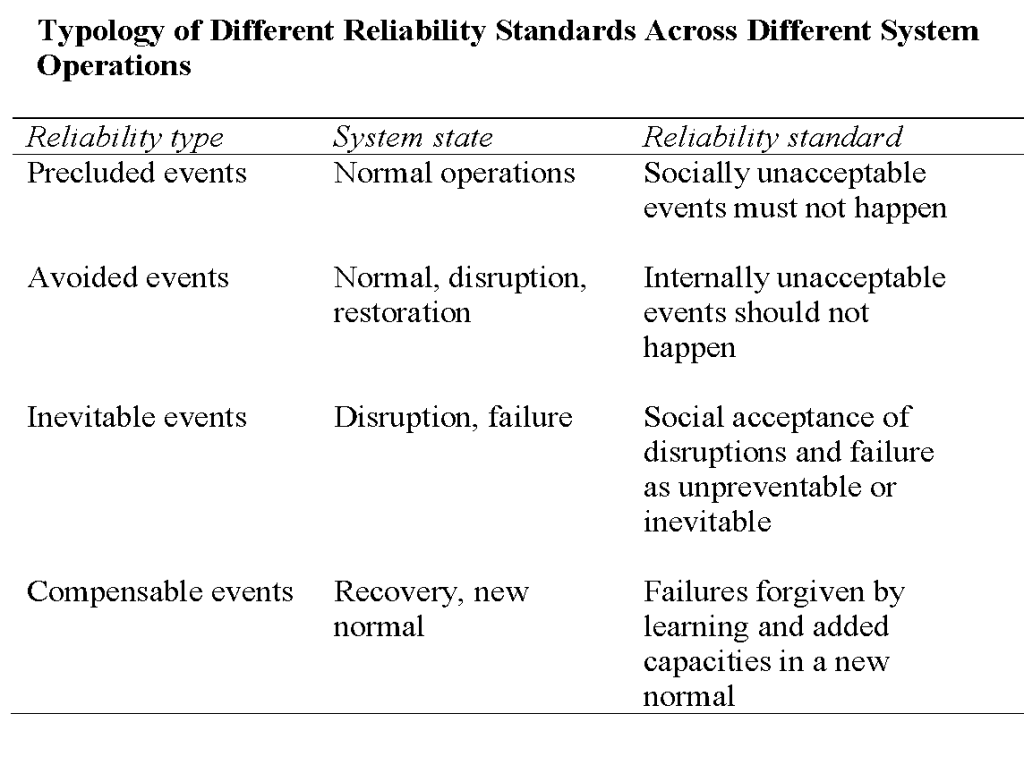
Note that standards are intimately tied to the frequency of different stages of operation in the critical infrastructure: normal or routine operations, sometimes temporarily disrupted and then restored back, at other times tripping over into outright system failure, thereafter responded to urgently as an emergency and eventually to be recovered, from which a new normal may evolve systemwide (though no guarantees!).
In a world of few disruptions let alone outright system failures, normal operations (which are not static!) dominated and were often associated with a precluded events standard of high reliability, i.e., certain events like loss of containment at nuclear reactors, must never happen (think also of those faraway days of the integrated energy utility, where generation could determine transmission and then distribution).
But it may no longer be possible to preclude such events (especially in the infrastructures which this infrastructure depends upon), such that an avoided events standard is adopted. Some dreaded events, on the other hand, may be treated as inevitably creating major infrastructure disruptions or failures (e.g., earthquakes in Indonesia) or can be compensated for in some major safety improvements afterwards (as after Three-Mile Island). (This “compensatory reliability” standard, needless to say, reduces social pressures for a precluded or avoided event standards.)
The take-away point is that the risks and resiliencies to be managed look very different given the standard to be operated to and the stage(s) of operations the (variably interconnected) infrastructure finds itself today.
2. Risks follow from performance standards being managed to.
Below are findings from our research which identified different systemwide risks faced by the central control of a major energy infrastructure, operating under a precluded events standard and depending on the volatility of its task environment and the options available to respond to that volatility:
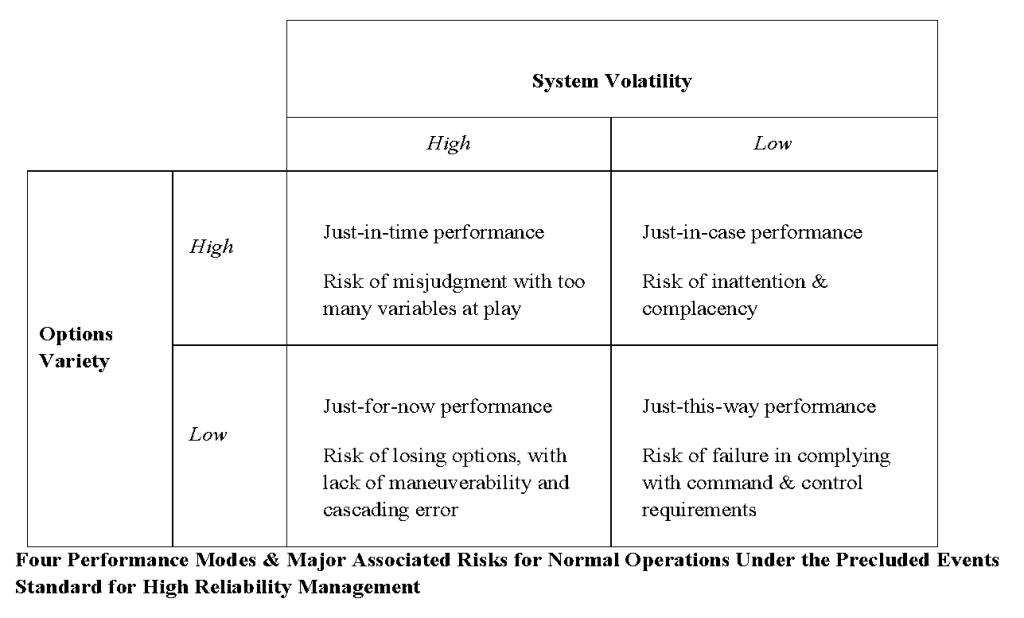
Under the precluded events standard that the transmission infrastructure must never island, we observed four performance modes of normal operations, ranging from anticipatory exploration of options (just in case) when operations are more routine and many control strategies and options are available, to a real-time (just in time) improvisation of options and strategies when task conditions are unstable (i.e., they are unpredictable or uncontrollable even if predicted). Operators may have to operate temporarily in a high-risk mode (just for now) when system instability is high and options are few.
They may also be able, in emergencies when options have dwindled, to impose onto grid participants a single emergency scenario (just this way) in order to stabilize a situation. These alternative but interrelated performance modes are part of an overall requisite variety of responses needed to match the full range of input variance that operators can encounter in their systems, all for the purposes of reliable output management.
But each performance mode has its own dominant risk from the control room perspective. According to our interviewees, the big risk in just-in-case performance is that someone in the control center is not paying attention to and being complacent with respect to sudden or emerging changes in system volatility or network options variety. “What you want to do is avoid complacency,” a senior utilities control room official said about his operators. When it comes to just-in-time performance, the risk is misjudgment by control operators with so many balls in the air at one time. The great risk in just-this-way performance is that not everyone who must comply will comply with the emergency.
Last but decidedly not least, just-for-now performance (“just keep that online right now!”) is the most unstable performance mode of the four and the one control operators and managers want most to avoid or exit from as soon as they can. Here the risk is tunneling into a course of action without escape alternatives. What you do now could increase the risks later (in effect, options and volatility are no longer independent dimensions). Speaking of a major vessel collision and spill, a support person in the Coast Guard Vessel Traffic Service noted, “The closer it [a large ship] got to the bridge, the more the options dwindled.” In effect, the few options remaining may be such that to use one risks increasing volatility elsewhere in the infrastructure, if not in the other infrastructures dependent upon it.
Note the major policy and management implication of just-for-now performance. If the real time challenge is to increase options and/or reduce task volatility, the most efficient strategy is to adopt and modify better practices already used by like operators in like just-for-now situations. Crudely put, if they are better able to jump a bar of politics, dollars and jerks like yours, then start from their practices.
The take-away point here is that these are systemwide management risks of key importance to the infrastructure’s real-time operators.They are NOT the specific risks of corroding pipes underground, or underwater seepage of flood levees, or the risks of climate change. Of course, the latter can and do affect task volatility and/or options availability, which however are important precisely when they affect and/or shift the more important systemwide management risks identified above. (Note that the above systemwide risks were observed for infrastructures with central control rooms operating under the avoided events standard.)
3. Types of system resilience vary by stage of infrastructure operations.
Our research identified four specific types of resilience for reliability management at the system level, each varying by stage (or state) of system operations discussed above:
- real-time system operators adjusting back to within official or unofficial reliability bandwidths to continue normal operations (precursor resilience);
- Restoration from disrupted operations (temporary loss of service) back to normal operations by these real-time operators (restoration resilience);
- immediate emergency response (as its own kind of resilience) after system failure but often involving others different from system’s reliability professionals; and
- recovery of the system to a “new normal” by real-time infrastructure operators along with others (recovery resilience)
These four specific types of resilience for reliability management constitute overall systemwide resilience, summarized together as “the system’s capability in the face of its reliability mandates to withstand the downsides of uncertainty and complexity as well as exploit the upsides of new possibilities and opportunities—sometimes called “affordances”—that emerge in real time.”
Please note the implications of this classification. Not only are normal operations NOT static or uniform, resilience options differ depending on whether or not the large sociotechnical system is in normal operations versus disrupted operations versus failed operations versus recovered operations.
Resilience, here, is not a single property of the system to be turned on or off as and when needed. It is not one stable portfolio called “process variance” from which to choose this or that already-existing option depending on the stage of operations. (Again, improvisation in the face of unexpected contingencies and assembly of options just in time are instead found, though never guaranteed.)
Note also that it’s not inevitable that the failed system recovers to a new normal. It is crucial, nevertheless, to distinguish recovery from the new normal. To outsiders, it may look like some of today’s sociotechnical systems are in unending recovery, constantly trying to catch up with one disaster after another.
The reality for real-time system operators however, may be that the system is already at a new normal, operating to a standard of reliability different than the outsiders might think. (One thinks immediately of new media platforms, e.g.: Is the capacity to achieve reliable normal operations in digital platforms—not by precluding or avoiding certain events but by adapting to electronic component failure most anywhere and most all of the time—a key skill set of software professionals and their wraparound support in critical infrastructures for emergency management?)
4. The special importance of inter-infrastructural connectivity during infrastructure failure, immediate emergency response & initial service restoration, and longer-term recovery.
What were latent interconnections between and among infrastructures before a disaster often become manifestly evident in that disaster. The earthquake hits, underground water mains break, leakage spreads first out of sight, and then above-ground sections of the road collapse.
The principal management elements of interest in these changes from latent to manifest infrastructural interconnectivity are: the types of interconnectivity configurations among network elements (sequential, reciprocal, mediated and pooled between and among infrastructures); the shifts in configurations during failure, response and recovery states (e.g., the road now becomes a firebreak); and the joint improvisations involving more than one infrastructures because the respective control variables of these systems are shared or interconnected (e.g., river navigation, town water supplies, and regional hydro-power depend on changes in related dam water releases and pressures). Here too we see that resiliencies triggered in failure, response and recovery must themselves be differentiated when it comes to practice and interventions.
IV
A final point (for an already overly long blog entry). Much of the above is centered around on-the-ground practices (for infrastructure management and operation in particular). This is because I am a practicing policy analyst by profession–although it might seem a small point to you.
Yet it is a very big point, if your profession or discipline gives pride of place to human values, beliefs and attitudes as determinants of really-existing behavior. I come from a literature which repeatedly finds a low statistical correlation between why people say they act and how they actually act. I come from a profession that constantly asks not what is planned or designed but how it is implemented and operated, full of contingent events, situations and context, notwithstanding the power asymmetries attributed to system operations by outsiders.
In more general and summary terms, the logic of capitalist accumulation has had a clear impact on infrastructure operations over time; the logic of requisite variety has now a clear albeit contingent impact on infrastructure operations in the Anthropocene. The difference between the two is due in large part to shifting infrastructural interconnectivities: then, now and ahead.
NB. The above has been spliced and sutured together from a number of previous publications and blogs. The original research for the above was undertaken and co-authored with my colleague Paul R. Schulman. As such, I am responsible for any misleading simplifications or hydraulic interpretations that have crept into the preceding.
Managing vacancy across urban and rural landscapes
This photograph shows what were formerly residential lots later abandoned in a part of Detroit, Michigan:

According to an expert, these instances require us “to think about innovative and productive ways to manage and transform vacancy for long-term sustainability” not only in Detroit but in like areas (Dr. Toni Griffin, Professor in the Practice of Urban Planning at the Harvard Graduate School of Design commenting on the presentation, “Last House on the Block: Black Homeowners, White Homesteaders, and Failed Gentrification in Detroit,” accessed online at https://www.youtube.com/watch?v=umqU1xj5yPA).
I want to take up Dr. Griffin’s challenge and recast what you see (and don’t see) in that picture in equally policy relevant ways for “low-density” (mixed-use) grasslands in parts of Africa with which I am familiar.
I
Let’s start with the obvious points raised by the above photo.
In reality, the space bounded by the two edge sidewalks isn’t vacant. What you don’t see are not just the biophysical activities on the ground and below, you also don’t see the socioeconomic relations that crisscross the space even now. For all I know, new construction could be happening the day after tomorrow or the lot was the site of a crafts fair a week before the photo was taken.
Far-fetched, you say? Consider the description of one such project on one Detroit lot:
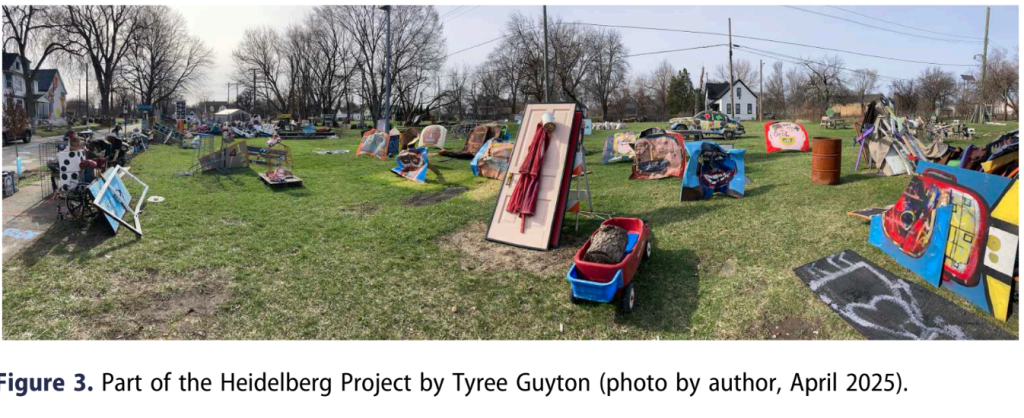
The Heidelberg Project, founded by Tyree Guyton in the mid-1980s, is perhaps Detroit’s most well-known – and controversially discussed – outdoor art environment. Spanning a block of vacant houses and lots, the project comprises a dense assemblage of discarded objects. . . (accessed online athttps://www.tandfonline.com/doi/full/10.1080/02723638.2026.2676282)
And yet, the blisteringly obvious in the photo is that the space is NOT vacant. It’s full of repurposed objects (about which, by the way, you know little unless described further). Such however is the powerful imaginary that “vacant” still carries with it.
II
So what?
Just what does this mean for “the management of vacancy,” be it in peri-urban Detroit or low-density (mixed use) rangelands of East or Southern Africa?
It means we have to think more granularly than snapshot reality could ever permit.
For example, what if the former settler ranches in parts of Africa now subject to the mixed (arable, horticultural, animal) uses are in fact the result of that having, as Dr. Griffin put it, “to think about innovative and productive ways to manage and transform [really-existing] vacancy“?
In Detroit, white urban farmers have moved into some of these depopulated neighborhoods. In Africa examples, the racial demographics are largely reversed, but the analogy remains strong: Just as this urban farming has been mistakenly criticized as failed gentrification (the first wave of Detroit urban farmers never saw themselves as gentrifiers), so too arable and agro-pastoral farmers are mistakenly criticized for falling short of specialized livestock rearing or crop production thought to be more suitable by governments and their experts.
More important (for me) the policy implications differ depending on the benchmark against which to assess really-existing use variety on the ground. Is it any wonder that “gentrification”, like “dryland livestock ranching”, have no agreed-upon definitions? (Academics are still debating the causes and consequences of gentrification here in the US.) Is it any wonder then that both concepts are never so fiercely argued over as when they’re offered up as “solutions”? Ideal types are just another version of blueprint development.
Today’s policy relevance of poets A.R. Ammons, Jorie Graham, Robert Lowell and J.H. Prynne
Read the finer essays of George Steiner, John Berger, Adam Phillips—or if you will, Helen Vendler, Marguerite Yourcenar, Jane Hirshfield, Lydia Davis—and you encounter in each an analytic sensibility, sui generis. No need here for a shared point of departure to understanding complexity’s implications for public and private.
Indeed, there are times when the very different analytic sensibilities posed by the poetry of A.R. Ammons, Jorie Graham, Robert Lowell and (yes, even) J.H. Prynne achieve actual policy relevance. I say this knowing it’s outrageous to demand policy relevance from poets. But I suggest you also can read them and others that way.
Ammons and regulation
Policy types fasten to knowledge as a Good Thing in the sense that, on net, more information is better in a world where information is power. Over an array of accounts, A.R. Ammons insists that the less information I have, the better off I am—not all the time, but when so, then importantly so. (To be clear, he is not talking about “ignorance as bliss.”)
For those working in policy and management, how could it be that “the less we know, the more we gain”? In order to make our exercise here more interesting, what would that mean when it comes to the heavy machinery called official regulation? Is there something here about the value of foregrounding inexperience—having less “knowledge”—as a way of adding purchase to rethinking government regulation?
–By way of an answer, jump into the hard part—Ammons’s poem, “Offset,” in its entirety:
Losing information he
rose gaining
view
till at total
loss gain was
extreme:
extreme & invisible:
the eye
seeing nothing
lost its
separation:
self-song
(that is a mere motion)
fanned out
into failing swirls
slowed &
became continuum.
You may want to reread the poem once more.
Part of what Ammons seems to be saying is that by losing information—the bits and pieces that make up “you”—you gain by becoming less separate, your bits and pieces slow down, fan out, spread into a vital whole. We empty our minds so as to attend to what matters—emptying the eye to have the I.
So what? How, though, is this different from ignorance is bliss or, less pejoratively, seeking to know only what you need to know?
–When pressed by an interviewer, Ammons’s response illuminates much about how knowing less is gaining more: “I’m always feeling, whatever I’m saying, that I don’t really believe it, and that maybe in the next sentence I’ll get it right, but I never do”.
Imagine policymakers and regulators, when pressed, recognizing that not getting it right today places them at the start of tomorrow’s policymaking—not its end but its revision of even the categories of “policymaking” and “regulation.” Ammons, if I understand him, is insisting that in the compulsion to “get it right the next time around” there is more importantly a next time to make it better. Again, not just to make a specific regulation better, but to revise what we mean by “regulating.”
To recast (revise, redescribe, rescript, recalibrate) the categories of knowing and not-knowing is to make room for—empty your mind for—resituating the cognitive limits of “regulation.”
Jorie Graham and the climate emergency
No one could accuse Jorie Graham of being hopeful about the climate emergency. There is not a scintilla, not a homeopathic whiff, of environmental optimism, techno-social-otherwise, in the poetry I’ve read of hers.
Which poses my challenge: Can we readers nevertheless find something to move forward with from her recent poetry? Is there some thing that I can see of possible use in my own response to the climate emergency?
In answer, consider the lines from her book, Sea Change:
                                                                         the last river we know loses its
form, widens as if a foot were lifted from the dancefloor but not put down again, ever,
                                                         so that it's not a
dance-step, no, more like an amputation where the step just disappears, midair, although
                                                         also the rest of the body is
missing, beware of your past, there is a fiery apple in the orchard, the coal in the under-
                                                         ground is bursting with
                                                         sunlight, inquire no further it says. . .
There’s that tumbling out and after-wash of words and the turns of phrase. Witness though how they bounce off and back from, in this case, the hard left-side margins and that right-side enjambment.
Some might call her rush of words a compulsion to continue but for someone with my background and training, it’s difficult not to see this as resilience-being-performed as the dark messages bounce back or forth. Following Graham, we readers make resilience happen.
Robert Lowell and alertness
“Design” too often assumes one can macro-design the micro. Anyone who has tried to implement as planned knows how plug-and-play designs don’t work in complex policy and management, as contingency in the form of situation, context and even invariably get in the way. (For my part, it’s difficult to imagine two words scarier in the English language than business schools’ “designing leadership.”)
To see how this matters for policy and management, consider a late poem of Robert Lowell, “Notice,” and a gloss on it by Helen Vendler, the late literary critic. Here’s the poem in its entirety, centering around Lowell’s leaving an asylum after a manic-depressive episode:
Notice
The resident doctor said,
“We are not deep in ideas, imagination or enthusiasm –
how can we help you?”
I asked,
“These days of only poems and depression –
what can I do with them?
Will they help me to notice
what I cannot bear to look at?”
The doctor is forgotten now
like a friend’s wife’s maiden-name.
I am free
to ride elbow to elbow on the rush-hour train
and copy on the back of a letter,
as if alone:
“When the trees close branches and redden,
their winter skeletons are hard to find—”
to know after long rest
and twenty miles of outlying city
that the much-heralded spring is here,
and say,
“Is this what you would call a blossom?”
Then home – I can walk it blindfold.
But we must notice –
we are designed for the moment.
I take up Vendler’s gloss when she turns to Lowell’s last line:
In becoming conscious of his recovery by becoming aware, literally moment by moment, of his new capacities for the most ordinary actions of life, the poet sees that ‘we are designed for the moment’—that our consciousness chiefly functions moment by moment, action by action, realization by realization. Biologically, ‘we are designed for the moment’ of noticing.
For my part, what Lowell is doing in the last two lines is also revisiting the second line, “We are not deep in ideas, imagination or enthusiasm” and making this point: The designs put upon us by ideas and enthusiasms differ from the noticing designed into us in at least one major respect: We notice the ideas-that-design because noticing is not an idea. It’s an alertness. It is a kind of watchfulness—“Is this what you would call a blossom?” It’s the analytic sensibility that saves us from those other designs.
An application of J.H. Prynne for policy relevance
I’m new to Prynne’s poetry and haven’t yet gotten a knack for how to read and interpret the more recent ones. This means I, more than not, don’t have a clue about the author’s intention (which shouldn’t matter anyway, so some say).
Which also means I get to interpret his lines far more in my own terms than others might like. Take the following stanza:
Indefatigable, certainly impracticable, chronic                                                                                                                                                                                                                                                                                                                                                                    unretractable, spree; indistinguishable
epiphenomenal dink-di flunk, rhetic;                                                                                                                    insurmountable,  unaccountable,                                                                                                                            incommensurate, providentially,                                                                                                                                        turn up your nose as we suppose,                                                                                                                      environmentalism, fiddle-de-dee.
Whatever this means to others, to me it’s a clear example of how many advocates for and against environmentalism overstate their case through argument by adjective and adverb.
Or consider a different stanza:
Casting out terror leaves a vacant spot, your care-free jubilation to out-jest these heart-struck injuries, mimic new disasters; they crowd like fresh battalions, eager spies trying our patience, good out-runs the best.
I interpret “casting out terror leaves a vacant spot” to mean that once we lose widespread social dread over large technical disasters like nuclear plant explosions, we vacate any notion of reliably managing such extremely hazardous systems.
There are, of course, those who celebrate such an eventuality–think of them as eager spies for the other side. But the loss of reliable infrastructures also does injury and harm to many more other people. Indeed, new disasters arise (imagine the effects of a society no longer fearful of jet planes dropping from the air like flies). The new disasters would “crowd like fresh battalions” and “try our patience” by way of increased calls for different policy and management interventions.
But note Prynne’s “good out-runs the best” as a consequence. No problem. For many trained in policy analysis, such as myself, the best is the enemy of the good. That is, better to have good enough when the best is not achievable (which would be to prevent disasters in the first place). What then is good enough in having a disaster? Ironically, disasters are a way to get rid of legacy infrastructures and components that, under other circumstances, one is precluded from doing so because of existing regulation and law. These would be suspended during the emergency.
My reading too far-stretched? In my view, Prynne’s words read as if they are the only ones left legible on the surface of a thick, many-layered palimpsest. A good deal has been effaced or scored away below and down. My point is that those very same words are also left visible on policy palimpsests with which I am familiar.
Reframing migration crises
“Wir schaffen das” (“We can manage this“) Angela Merkel, 2015, then-Chancellor of Germany, referring to the migrant crisis in Germany and Europe.
Many migration crises probably need substantive rethinking, if we are to make them more tractable to policy and management (without, that is, simplifying them or obscuring the complexities involved). There are a variety of policy optics to recast complex policy issues, including counternarratives, different methods, other-than-usual analogies, and a more granular, differentiated analysis. More, I believe these already exist.
Below are examples of each type with respect to the currently understood “migration crises”. No pretense is made that these quoted excerpts are relevant for policy and management everywhere. They are offered, with little edit, in the spirit of softening up what look to be crises that cannot be redefined in ways other than currently rendered.
1. Counternarratives
For instance, with regards to the Migrant Victim Narrative, migrants and refugees using smuggling services are almost never only victims, because they need to overcome considerable obstacles and need strong willpower in order to bear the costs and risks usually involved in moving. Yet the images and stories of migrants dying while crossing deserts or seas, or of migrants abused and exploited by smugglers and employers, are the ones that dominate the headlines.
Without denying the realities of extreme suffering and exploitation, the problem is that such narratives typically deny human agency involved in most forms of forced and precarious migration or represent them as an irrational act. In reality, people can be victims and exert agency at the same time in an active effort to defy or overcome constraints. Most vulnerable migrant workers, including victims of trafficking, see an interest in migrating despite being exploited, if only because the alternative of staying at home was worse for them. Therefore, they avoid being ‘rescued’ as in practice this usually means deportation and loss of investments, income and livelihood (e.g., Costello 2015; O’Connell Davidson 2006; Weitzer 2000; Parreñas 2006). For this reason, one of the slogans of anti-anti-trafficking activists has even become ‘rescue us from our rescuers’ (de Haas 2023, 311).
The point is not to trivialize abuses and extreme exploitation, but that reducing migrants and refugees to passive victims is simplifying the reality. Crucially, this ignores the rather inconvenient truth that, for most of them, immigration is a rather deliberate investment into a better future, that most ‘victims’ have migrated out of their own will, essentially because leaving was still much more attractive than staying because of the real hope for a better future that migration represents for millions of people around the world, particularly in the form of labour opportunities and the ability to send remittances back home (Agunias 2009).
This is not to morally justify human rights abuses, or to deny states’ responsibilities in upholding the rule of law and preventing exploitation by criminals and employers, but to acknowledge a lived reality in which migrants exert their agency within such severe constraints.
The implicit underlying assumption often seems to be that migrants, particularly when they are perceived as poor, uneducated and non-Western, somehow do not know what they are doing and that they would have stayed at home if only somebody had told them about the terrible circumstances in which they have ended up. On a deeper level, this seems based on often barely conscious, colonial stereotypes of non-Western people as somehow less capable of thinking, acting, or speaking for themselves (see Said 1978), or to act in their own best interests. In other words, such patronizing, condescending victimhood narratives continue to portray the non-Western and low-skilled other as ‘less rational’ who must be ‘sensitized’ and ‘informed’ about what is best for them: staying at home. . . .
de Haas, H. (2024). Changing the migration narrative: On the power of discourse, propaganda and truth distortion. IMI Working Paper No. 181/PACES Project Working Paper No. 3. Amsterdam: University of Amsterdam (accessed online at https://www.iss.nl/en/media/2024-06-pacesimi-181-wp-n3dehaasfinal)
2. Different methods
Irregular migrants need to be able to safely report labour exploitation and exercise their labour rights without fear of deportation. We therefore propose creating a special temporary work permit – call it a ‘redress work permit’ – specifically for irregular migrant workers who have come forward to claim their rights and whose employment conditions, while working illegally, were found to constitute a significant breach of their fundamental rights. Such a redress work permit could be included in European laws either by amending the current Employer Sanctions Directive, or as part of a new EU Directive on Labour Standards for Irregular Migrant Workers in the EU. . .
https://www.europarl.europa.eu/RegData/etudes/STUD/2022/702670/IPOL_STU(2022)702670_EN.pdf
3. Not-your-usual analogies
I argue that detained migrants become valued not only for their exploited labour, but as bedspace occupants who trigger rent payments from ICE to corrections firms. . . . As detention occupants, migrants’ cash value for others is more than metaphorical. Formally and institutionally, they are made fungible, exchangeable, transformed from people with lives and stories into chargeable bed days.
https://onlinelibrary.wiley.com/doi/full/10.1111/anti.12992
Beds have been the center of urgent political struggles — be they in prisons, detention centers, hospitals, or nursing homes. Our virtual conversation series centers “bed activism” [as] complex forms of resistance and visionary care that emerge from the intimate spaces of sick, disabled, detained, and imprisoned peoples. It connects a long-term vision of connecting communities and movements at the nexus of abolition feminism, migrant justice, and disability justice.
https://tisch.nyu.edu/art-public-policy/events/the-reciprocal-politics-of-bed-space-activism–creative-resistan#:~:text=Beds%20have%20been%20the%20center,%2C%20detained%2C%20and%20imprisoned%20people.
4. More granular, differentiated analyses
Between 2010 and 2019, over 2 million people have crossed the Mediterranean to reach the shores of Europe, escaping conflicts, persecution and poverty and looking for a better chance in life (D’Angelo, 2018a; UNHCR, 2020). Since the mid-2010s, this phenomenon, widely labelled as a ‘Refugee Crisis’ (Crawley, 2016), has been at the centre of media and academic debates, with considerable attention being devoted to the humanitarian concerns over search and rescue at sea and the implementation of the European Asylum System (Crawley et al., 2017; Spijkerboer, 2016; Vassallo Paleologo, 2016). . .Specifically, the current mainstream narrative is one that looks at these people as passive components of large-scale flows, driven by conflicts, migration policies and human smuggling. Even when the personal dimension is brought to the fore, it tends to be in order to depict migrants as victims at the receiving end of external forces. Whilst there is no denying that most of those crossing the Mediterranean experience violence, exploitation and are often deprived of their freedom for considerable periods of time (Albahari, 2015; D’Angelo, 2018a), it is also important to recognize and analyse their agency as individuals, as well as the complex sets of local and transnational networks that they own, develop and use before, during and after travelling to Europe.
https://onlinelibrary.wiley.com/doi/epdf/10.1111/glob.12312
For migrant workers who do not have access to other means of income, the platform economy offers a viable yet exploitative alternative to the conventional labour market. Migrant workers are used as a source of cheap labour by platforms – and yet, they are not disempowered. They are at the heart of a growing platform worker movement. Across different international contexts, migrants have played a key role in leading strikes and other forms of collective action. This article traces the struggles of migrant platform workers in Berlin and London to explore how working conditions, work experiences, and strategies for collective action are shaped at the intersection of multiple precarities along lines of employment and migration status. Combining data collected through research by the Fairwork project with participant observation and ethnography, the article argues that migrant workers are more than an exploitable resource: they are harbingers of change.
https://www.cambridge.org/core/journals/the-economic-and-labour-relations-review/article/platform-work-exploitation-and-migrant-worker-resistance-evidence-from-berlin-and-london/30DF1A5FD18F4B86983332ABE401E88E.
5. A migration example combining different counternarrative, method, analogy and differentiation
Managed retreat is increasingly recommended as a response to rising sea levels confronting coastal communities, cities and major ports. We already have climate migrants in coastal Louisiana and like places, and the idea is to manage this out-migration more systematically.
What’s missing are assessments of the track records in the various managed retreat strategies already out there. The management of moving capitols, for example, has not been without its major problems. Relocation of large numbers of people is even more notoriously difficult in humanitarian work.
With respect to the latter, one such place to start thinking about managed retreat on the West Coast where I live and have done my research is the following:
Every time I visit South Sudan, the angels’ response to my criticisms never varies. “What would you have us do?” asked one exasperated aid worker as we sat drinking cold beers one night by the bank of the Nile. “If we leave, people will die.” He was right. A decade of government withdrawal from the provision of services, enabled by the humanitarian presence, and campaigns of government violence, partly paid for from humanitarian resources, had created a situation in which some people in the camps in Maban would probably starve if it were not for the aid agencies. The only solution the humanitarians can envision is to continue with this dystopic system.
Joshua Craze (2023). “The Angel’s Dilemma” (accessed online at https://thebaffler.com/salvos/the-angels-dilemma-craze)
Imagine, that is, not a massive withdrawal and resettlement of peoples from the coastline but rather masses of people who stay behind having nowhere else to go practically and who need, above their own resources and ingenuity, indefinite humanitarian aid in order to persist.
Why small-m metanarratives matter more than the big-M ones
I
When I started doing narrative analysis of public policy, big-M metanarratives were getting the attention. These were the grand overarching storylines criticized by the likes of Lyotard and Baudrillard (think today of criticizing “the Enlightenment Project”).
But just as there were varieties of Enlightenment (not just the very different French and Scottish versions, but others: Dutch, Naples, English, German, etc.), there are small-m metanarratives far less grand and far more local (think of the many, many varieties of capitalism currently being differentiated [1]). Some observers, of course, have tried to find family resemblances across the disparate versions (an Urpflanze of Enlightenments or Capitalism). But the more granularity the levels of really-existing context, situation and/or event, the harder it is to dismiss the narrative priority of this particularity in seeking policy relevance now and in the next steps ahead.
Small-m metanarratives have always been around, both conceptually and empirically, in the form of those narratives that center on how both “a” and “not-a” positions can be the case at the same time. More recent explications of conceptual held by sociologist Pierre Bourdieu and philosopher Paul Ricoeur are illustrative:
Through a reconstruction of Bourdieu’s conceptual architecture, I show that his mediation of oppositions transforms dichotomies into internal tensions. Universality is historicized without being relativized; practice is structured yet generative; objectivity is socially produced yet binding. The result is not inconsistency but a dynamic relational framework that preserves theoretical depth at the cost of stability. (https://papers.ssrn.com/sol3/papers.cfm?abstract_id=6293418)
Ricoeur argues that genuine political compromise acknowledges the irreducible plurality of legitimate value frameworks. . . .Based on this understanding, I argue that successful compromise becomes not a matter of finding the lowest common denominator but of generating new social arrangements that honor multiple justificatory logics simultaneously. (https://link.springer.com/article/10.1007/s11007-026-09731-8)
For example, sustainable development has had to address how that term is not an oxymoron, but in fact can accommodate very different positions (e.g., https://www.academia.edu/164914632/Taking_Complexity_Seriously). In so doing, the metanarrative functions as a repair of fragmented conditions, however indefinitely. (Narratives have always been more than storytelling; they also seek to repair, stabilize or weave anew.)
II
The harder problem has been identifying small-m metanarratives that are about “neither ‘a’ nor ‘not-a'” positions but still policy or management relevant. It would appear we are in an entirely different language game here, if not cosmology. To return to our examples, when it comes to Enlightenment, one can think of Asian approaches to an enlightenment that differs vastly from the Western versions mentioned. So too “policy messes”–situations without agreed upon beginnings and an agreed upon ending, but rather exist in an indefinite present time–fall outside convention notions of policy narratives as stories having beginnings, middles and ends or policy arguments with premises and conclusion (https://library.oapen.org/bitstream/handle/20.500.12657/30263/1/648154.pdf). (Terms like wicked policy problems and now polycrisis also convey an intractability outside the policy and management realms.)
If or where so, one can then argue that what is “neither sustainable development nor not-sustainable development” might be a policy mess or a form of Asian enlightenment(s). Even so, it still is difficult to see where this gets us in the absence of a particular case and its specifics for analysis.
III
We are left then to refine our understanding of those specifics of context, situation or event. An earlier blog outlines what is meant by actionable granularity [2]. What needs underscoring here is the importance to a policy analyst of the first step in any really-existing policy analysis, namely, asking and answering: What is the problem? (Or better yet: What’s the story or stories here?)
It’s banal to say we should define our terms upfront and that different problem definitions entail different problem solutions (i.e., to ask or answer a question assumes you know what would qualify as an answer, were one given). What is less banal is recognizing the necessity of defamiliarizing taken-for-granted problem definitions treated as givens.
For example, the policy narratives we tell ourselves today are all about crises and their intractability to political resolution. It’s another matter, however, to say these contexts, situations and events more resemble “settlements of commotions,” as when royal and counter-royal forces brokered an indefinite cessation of physical battle [3]. You can call such settlements “political” and “polarized,” but that misses the point that indefinite stalemate is itself a form of tractability. Tractability here is a small-m metanarrative that intractable crises occlude. Why? Because the latter are all about big-T transformations that are, we are told, better able to do away with the tractable/intractable binary. Ha!
Endnotes
[1] https://mess-and-reliability.blog/2026/04/01/rethinking-capitalism-and-its-upsho
[3] I’m reading a history of British satire which makes just this point (Ian Sperrin [2025]. State of Ridicule: A history of satire in English Literature. Princeton University Press: Princeton and Oxford.)
When the cross-road of being at cross-roads means you can go either way
While about recent French literature, this too can be said of many policy narratives and their compositors in many places:
Once a thief of fire, the writer is now a sentinel of the present or a witness of memory, a psychiatrist or a judge, a tailor, a social worker, a priest or investigator, a psychologist, a lawyer, or even a mechanic of the soul: stitching back up, getting better, helping, healing, and saving are the guiding principles for twenty-first-century literature at a time when literature has become a way of coping with terrorism, thinking about the climate crisis, protecting the subject from the logics of digital surveillance, coping with health crises and lockdowns, and rearticulating forms of universality compatible with varied experiences as well as those that suffered from previous domination.
So what? is answered with:
In the face of doctrines in which “literature is called on for assistance,” I have responded with both interest and perplexity: whether this new transitivity [from representing good to doing good] is seen as a fruitful and effective return to humanist literary optimism or an improvised and utilitarian response to the existential and social distress of the contemporary subject remains largely a matter of opinion.
Either opinion is ok with me at a time when, to paraphrase philosopher David Hume, opinions rule the world.
Source.
Alexandre Gefen (2024 [2017]) Repair the World: French Literature in the Twenty-First Century, translated from the French by Tegan Raleigh, Volume 28 of Culture & Conflict, Walter de Gruyter GmbH, Berlin/Boston: 236 -237 (accessed online at https://ibrary.oapen.org/handle/20.500.12657/94387, internal footnotes deleted)
Points worth repeating. . .
Instead, the ongoing retreat of neoliberalism is occurring in a piecemeal and tacit way. It is driven not by politicians and intellectuals acting as the vanguard of a class war—that battle was won long ago by the capitalist camp—but by a governing class, custodian of the prevailing regime, which mostly sees itself as reacting to unforeseen shocks the best it can and coming to terms, as it figures it should, with the formidable geopolitical challenge that is China. In such a conjuncture, fondness for the Gramscian concept of a historical interregnum does not pass muster. There is no organic crisis to speak of. The accumulation regime is solidly entrenched, and faring well on its own terms. It is not the case that the old is dying and the new cannot be born. The new is already busy replacing the old, only this process is unfolding gradually, bereft of doctrine and theoretical coordinates, shepherded by the establishment and conforming with the interests of the already privileged.
(accessed online at https://newleftreview.org/issues/ii158/articles/nathan-sperber-beyond-neoliberalism)
Time to think more radically: three new policy narratives extremely different from current positions in pastoralist development
1. New Narrative: The last thing you should expect is the end of pastoralism(s)
I type “collapse of pastoralist societies?” into Google search and get this AI-generated answer:
Pastoralist societies have been declining for a variety of reasons, including:
- Lack of government support: Pastoral communities receive little support from their governments.
- Loss of land: Pastoralists have lost access to land due to the development of large-scale cultivation and irrigation, the establishment of nature reserves and game parks, and the imposition of national boundaries.
- Climate change: Climate change has threatened the availability of water and arable land, which are critical for pastoralism.
- Government policies: Governments have expropriated land from pastoralists, and converted communal property systems to open access situations.
- Migration: Some pastoralists have moved to populous areas to pursue education, abandoning traditional lifestyles.
- Conflict: Conflict, disease, drought, and famine have particularly affected vulnerable pastoralist communities.
- Arms proliferation: Arms proliferation has significantly altered the pastoralism landscape.
No surprises here. This is the gist of what we’ve been reading for years. But the obvious question remains from the standpoint of our framework of pastoralists as reliability professionals and pastoralism as a critical infrastructure: How many pastoralists see this in the same way or for similar reasons?
I don’t know that number, but I most certainly see how some herders believe their pastoralist systems are changing dramatically but nevertheless adhere to a very different narrative of what is going on and being responded to.
To see how, turn to a recent article that describes the parallel case: Urban people who see it inevitable that modern societies are also collapsing but who act differently than expected.
In his 2024 “The conviction of the inevitable: Collapsism and collective action in contemporary rural France,” Jérôme Tournadre, a political scientist and sociologist, wonders why some people who are totally convinced of the inevitability of collapse in modern (“thermo-industrial”) societies–for them, it’s self-evident the collapse is already underway–respond predictably by moving to the countryside and but then act unexpectedly there. They did not “go back to nature” nor did they eschew all things modern and technological:
Sophie, for example, has no trouble using a thermal brush cutter when it comes to freeing agricultural commons from overly invasive vegetation. Alex earns a little money by occasionally installing photovoltaic panels for individuals. However, he does not see the need to use it at home insofar as his connection to the electricity grid satisfies him. Similarly, if the members of the neo-village [one of the research sites] have chosen to gradually do without cars, it is not to reduce their greenhouse gas emissions but, above all, to no longer depend on oil that is bound to become rare or to lose its usefulness in a collapsed world. This logic obviously leads them to use bicycles but also to learn how to handle and maintain tools such as the scythe, the lumberjack’s handsaw or the Japanese saw that is supposed to replace both the chainsaw and the jigsaw. The acquisition of new skills is in any case a central ambition within these collective actions, which endeavour to break away from the specialization found in industrial civilization and develop a versatility more in line with troubled times: knowing how to milk goats and process their milk, graft fruit trees, recognize wild plants and mushrooms, etc.
Now turn this lens toward pastoralists. Say you do find pastoralists who are convinced that their systems are collapsing and that collapse is inevitable. We nonetheless must ask: So what?
So yes, pastoralists tell you they now use new tools while acquiring different skills, but still continue to milk the goats, process milk and collect local herbs. Yes, you see them cutting firewood for cooking but relying on electricity where available. Yes, they readily undertake money-paying jobs off-site to support household livelihoods, including those related to livestock. Yes, you see them breaking away from the specializations of older pastoralisms and developing more versatility and newer options related to that livestock.
Yes, there are pastoralists, like some urbanites, who are alarmed by current events and situations. But their response is more like whistleblowers who still live among us while pressing: “Something’s wrong here and it has to change and here’s what I have to say and am doing” (see the above link).
2. New Narrative: Not only is pastoralism harder to assetize than other critical infrastructures, it’s also too-big-to-fail in positive respects
Livestock or water points or fencing or motorbikes or vet stocks and such are treated as assets. But the question here is: “Has pastoralism as a global infrastructure been assetized and securitized as fully as the other infrastructures today?” My answer: not entirely, and significantly so.
Start with the fact that the current privatization literature focuses on how schools, health facilities, and large infrastructure projects are assetized for the purposes of securing rents and profits over time. Critics understandably see these changes in negative terms.
If so, why then are persistent failures and difficulties in establishing—read: assetizing—fixed-point pastoralist schools, stationary pastoralist health facilities, and settled livestock projects treated in overwhelmingly negative terms by like-minded critics? Some of these “failures” are in fact those of having prevented full-scale assetization, or which is presumably a positive outcome for some.
Or to put the point from another direction: By viewing pastoralism as hard-to-assetize infrastructure, we see a different longer-term operating horizon at work than we would be the case, were its assets financialized as easily as it has been for other infrastructures. Indeed, for this reason and others, I suggest that pastoralism, as a global infrastructure, is too-big-to-fail in significant respects (and which, in turn, explains the persistence of pastoralisms).
Too big to fail has been used negatively in the 2008 financial crisis to describe systematically important banks and financial institutions. I use the term in its more mixed positive sense where variation in policy and management practices centers around the logic of requisite variety in critical infrastructures, like pastoralism, with highly variable inputs and mandates for low and stable (reliable) outputs. According to the principle of requisite variety, these conditions and mandates produce a set of dynamic management options and improvisations that, while no longer looking like older pastoralism–e.g., herding households now use plastic buckets instead of earthen gourds–nonetheless serve the same functional role as in the older systems. This pressure to generate and assemble new or improvised options to transform highly variable inputs into reliable outputs is global because critical infrastructures (and their logic of requisite variety) are global.
This notion that different practices (resources, options, strategies) can serve the same function (as part of a dynamic process variance to translate high inputs into low and stable outputs) is especially crucial to recasting narratives of herd/er mobility for more relevant policy and management purposes.
3. New Narrative: Herd/er mobility is very different today, and so too its policy and management implications differ from current understandings
I want to offer a different reason for why really-existing practices associated with herd/er mobility deserve special attention. To telegraph ahead, mobility is special because its associated practices are best understood as the interconnections and their different configurations managed spatially and temporally by herders for what are still called the factors of livestock production (land, water, labor)
Livestock “moving between different sites with variable forage resources within a mosaic of harvested crop fields, open pastures and thickets” (Semplici et al, 2024; https://www.tandfonline.com/doi/full/10.1080/26395916.2024.2396928) necessarily refers to more than the uni-directional interconnection of livestock and herders moving from a ‘here’ to a ‘there.’ Shifts in reciprocal, mediated and pooled interconnectivity are also being managed as part and parcel of “mobility”. The policy and management implications are major.
II
Let me start with an extended quote that gets to this take-home message directly (Nori 2019):
To tackle the uncertainty settings embedding their livelihoods, pastoralists strategically adapt their range, herd, and household resources and continuously reconfigure use as much as the interrelationships amongst land, livestock, and labour according to conditions. This dynamics and constant recombination creates a mosaic of strategies where concepts such as intensification, diversification, and the individual, public, and collective fade and combine according to places, seasons, and periods in what d’Elie (2014b:4) describes as ‘”patching up” (Van Wageningen, Wenjun, 2001; Takayoshi, 2011; Hadjigeorgiou, 2011; López-i-Gelats, 2013; Manoli et al., 2014; Moreira et al., 2016; Ragkos et al., 2018). Connections with other societal actors—including urban dwellers, market agents and farming communities—help expand available opportunities and contribute to an overall diversification of livelihood patterns to complement and support their livestock-centred economy. . . .
Following the important changes and innovations that have reconfigured pastoral livelihoods, rangelands are being reorganized accordingly as mosaics of different but functionally interconnected landscape units. In order to exploit existing and fluctuating opportunities (e.g. seasonal rainfall—but also market pricing related to religious festivities or localized subsidy schemes—rangelands and more generally pastoral territories are reorganized accordingly as webs of linked nodes. These webs serve to connect and articulate resources, actors, and opportunities at different levels and scales through ‘reticular’ dynamics that make these mosaics manageable and governable (Tache, 2013; Gonin and
Gautier, 2015; Nori, 2010; Apolloni et al., 2018).Nodes are strategic hubs that concentrate specific resources and opportunities, including strategic range resources, money, information, services, people, and social connections. In rangeland settings these are typically water points (Lewis, 1961), market places, hot grazing spots (Motta et al., 2018), wetland pastures and dryland farming plots, communal range enclosures (Tache, 2013), urban settings and rural towns, milk collection areas (Nori, 2010), and animal health facilities.
Links are lines that cut through rangelands providing for interstitial, albeit relevant, resources and critical connections. These are typically transhumance routes, market channels, range corridors, main roads, and river banks.
The connections between diverse territorial assets and their articulations in the wider reticulum are governed by tailored sets of rules and regulations that define roles and responsibilities. The reiterated and regular presence and passage through certain territories is key to generating and stabilising herders’ territorialities and ensuring tight links between a group/clan/community and its range territories (Gautier et al. 2005; Bonnet et al., 2010).
[accessed online at https://cadmus.eui.eu/server/api/core/bitstreams/0e201842-8218-5bd1-9661-502a6d2863ed/content; my underlines]
In other words, even when livestock move sequentially from here to there, their inter-relationships with those sites along the way are anything but serially uni-directional.
Reciprocal (bi-directional) relationships are also much discussed in the literature (the stubble for livestock, the manure for the field). Extensively-raised livestock fattened up at special sites just before sale or slaughter are examples of a mediated interconnection between the herders and that off-take. The grazing itinerary of moving livestock across time and space is a kind of pooled interconnectivity guiding the herders and herds involved. More, shifts in configurations are a centerpiece of other mobility discussions, e.g., improvising and responding opportunistically, case by case, as livestock and herders move along the itinerary, if there is one.
In infrastructural terms, what is going on here is not only widening and extending the repertoire of management options (again, the process variance) in response to task environment surprises and contingencies and mandates for reliable outputs. Rather, management itself also becomes one of interconnecting (re-assembling) these options in order to transform high input variability into low variance, more stable outputs (including livelihoods).
III
For example, the much-remarked-upon use of cellphones by pastoralists is not only a way to expand real-time management options in their face of task volatility. There is a scale issue here as well that comes with shifting sequential, reciprocal, mediated and pool interconnectivities–and cellphone use is especially adept at accommodating and monitoring scale shifts.
Not only are feed-stock and water brought to the herd rather than at the older scales, but livestock are reared and fattened at altogether at different scales and in different than before (e.g., Hoffmann, Schareika, Dittrich, Schlecht, Sauer and Buerkert, 2023). In some cases, the time and space of mobility are best understood as condensed; in other cases, the time and space of mobility are better understood as lengthened, as in livestock export supply chains (e.g., Duffield and Stockton 2023). But either way–now more near-linked or now more far-linked–mobility remains functionally part of the logic of requisite variety.
So what? Conceptually, the unit and level of analysis is now “mobility with respect to the setting and scale(s) of interest,” not just: “mobility as a response to task environment variability.” This is because setting and scale are the intervening template for understanding interconnected exogenous and endogenous variabilities, now more granular than the critics’ usual suspects of climate, prices, and conflict. That the older temporal and spatial movements no longer occur, again, does not mean that herd/er mobility has disappeared.
As for practically, condensed/enlarged mobility means we are light-years away from the older discussions of the effects of disappearing wet season grazing on herd movements.
Implications
So then, are we to conclude that everything is hunky-dory and copacetic for pastoralists? No. I am, however, asking you to draw implications for priority policy and management attention from these–well very different–ways of understanding pastoralist development. In the bluntest terms possible, the key here is to shift the policy analytic focus from the economic logic of capitalist relations to the institutional (actually, cybernetic) logic of requisite variety in critical infrastructures found not just under capitalism.
To see how this works by way of implications, focus on the most important finding in the current pastoralist literature. Yes, pastoralists are being displaced from their past herding sites by land encroachment, sedentarization, and climate change, among other economic factors. But the three narratives compel us to first answer much more specifically: So what?
Focus on that subgroup of displaced pastoralists who are reliability professionals, namely those networks of pastoralists (if any) who are skilled in systemwide pattern recognition and localized scenario formulation. One major question becomes what are the compensation, investment and steering policies of government and international agencies to address this displacement (e.g., see Bürgisser 2023).
That is, where are the policies and management protocols to: (1) compensate such skilled herders for loss of productive livelihoods, (2) upskill these herders further in the face of eventually losing their current employment, and (3) efforts to steer herding economies and markets in ways that do not lose out if and where new displacement occurs?
By way of answer, I am aware of no such national policies. Yet, it’s precisely these missing pieces that should be on the UN agenda for the 2026 International Year of Rangelands and Pastoralists.
Lastly, the three narratives suggest we spend more time asking ourselves and others, “What is it that we don’t hear in official or formal discussions of pastoralist development but should now expect to?” My list includes the following three:
–“We must fight for the expansion of pastoralism as a universal public infrastructure, just as is now being done for universally available electricity!”
–Pastoralists explain their responses to government, donors and NGOs this way: “We corrected a few things on the ground. Our job, after all, is to protect you.”
–“We refuse to play the game that starts with tables and numbers of livestock. Why? Because the follow-on question, almost immediately, is: ‘Who owns the livestock?’ and, sooner than a blink of the eye, we are down to: ‘But what about the old woman with 5 goats or fewer?’ Which in turn becomes: ‘What are you going to do about these inequalities!’ As if the most ethical response weren’t to first determine more effective ways to think about this than one starting with counts of livestock owned and held.
Additional References
Bürgisser, R. 2023. Policy Responses to Technological Change in the Workplace. JRC Working Papers Series on Social Classes in the Digital Age 2023/04. European Commission, Seville (accessed online at https://publications.jrc.ec.europa.eu/repository/handle/JRC130830)
Duffield, M. and N. Stockton 2023. “How capitalism is destroying the Horn of Africa: sheep and the crises in Somalia and Sudan,” Review of African Political Economy (accessed online at https://www.tandfonline.com/doi/full/10.1080/03056244.2023.2264679)
Hoffmann E., N. Schareika, C. Dittrich, E. Schlecht, D. Sauer, and A. Buerkert 2023. “Rurbanity: a concept for the interdisciplinary study of rural–urban transformation” Sustainability Science (accessed online at
https://doi.org/10.1007/s11625-023-01331-2)
Roe, E. 2020a. A New Policy Narrative for Pastoralism? Pastoralists as Reliability Professionals andS Pastoralist Systems as Infrastructure, STEPS Working Paper 113, Brighton: STEPS Centre (accessed online at https://steps-centre.org/publication/a-new-policy-narrative-for-pastoralism/)
———. 2020b. “Pastoralists as reliability professionals.” PASTRES blog (accessed online at https://pastres.org/2020/04/17/pastoralists-as-reliability-professionals/)
———. 2023. “The global infrastructure of pastoralist systems.” PASTRES blog (accessed online at https://pastres.org/2023/06/09/the-global-infrastructure-of-pastoralist-systems/)
———. 2026. “Rethinking pastoralists’ development from their perspective of disasters-averted.” Pastoralism 16 (accessed online at https://doi.org/10.3389/past.2026.15551)

