“Make a decision” is what policy analysis is supposed to be all about. Gather the information, choose the evaluative criteria, and then decide and make a recommendation for possible implementation and afterwards evaluation of actual impacts, if any. Of course, we were taught it’s more complex and less hydraulic than that. But still the objective was that really-existing deliberation led to a decision followed by some kind of execution (with delays or changes along the way).
The complexification comes from the necessary center-staging of the “balancing test” that is: the weighing of the information in light of the economic, technical and political feasibility criteria for deciding the case at hand. Weighing the pros and cons, the push and pulls, and those hard-to-determine costs and benefits or risks-and-returns can end up feeling like the last resort over and within a longer process. Having to balance is what you do when the evaluative criteria selected–efficiency, equity, feasibility, whatever–do not clearly lead to a recommendation.
In this way and now more broadly, “decide” can feel like not just last-minute, but also a “last ditch effort” in the face of urgency but lack of clarity. When so, it’s rather odd that the next steps, “implement, operate and evaluate” rarely make explicit mention of the chief consequence of making a decision under urgency but lack of clarity while undertaking the balancing, namely: the need for repair afterwards. As Isaiah Berlin put it, this “promoting and preserving an uneasy equilibrium. . .is constantly threatened and in constant need of repair.” Last-resort decisionmaking continues well after the “decide” step, as new information comes in and subsequent responses are crafted. To call the latter “adaptation” or “muddling through” misses, literally, the ongoing repair needed for the infrastructures and processes undergirding ongoing decisionmaking.
This means that an often under-acknowledged feature of the “decide” cycle are the organizational/institutional efforts to normalize last-ditch efforts under conditions that feel last-resort.
Courts are institutional niches in which to make real-time decisions, including those for which there is no clear precedent or existing legal norm (Duncan Kennedy 2024). Centralized control rooms in critical infrastructure turn out also to be an unique organization formation to balance competing system and local demands is under pressures of real-time (Roe and Schulman 2008, 2016). (In narrative analytical terms, such formats are meta-narratives that accommodate, at least in real time, conflicting/uncertain storylines.) These and other institutionalized formations merit, I believe, as much attention as currently given to extraordinary powers granted to executives during emergencies. Both mechanisms necessitate “repairs” afterwards, but of a very different nature.
ll
To see how, consider recent developments with the US Supreme court. A growing concern has been its expanding “shadow docket.” “Emergency applications,” writes the New York Times‘s Adam Kushner,
require a snap decision about whether a policy can go ahead or must wait while lower judges argue over its legality. Critics call this the “shadow docket,” and the court usually rules on the urgent cases within weeks. Trump has won almost all 18 of these petitions. And unlike normal rulings, justices often don’t explain their rationale.
What is of interest here isn’t so much the shadow docket itself as it is how some Justices see what they are doing in deciding this way. Kushner elaborates:
None of these emergency decisions are final. In each, lawyers can fight the policy in lower courts. Perhaps the Supreme Court will eventually decide that the government can’t deport migrants from around the world to Sudan or unmake a federal agency without the say-so of Congress. But by then, critics of the shadow docket say, the work will already be done.
The justices themselves have battled over the propriety of emergency rulings. In a 2021 dissent, Elana Kagan rued a midnight ruling that effectively overturned Roe v. Wade in Texas. A month later, Samuel Alito returned fire in a speech:
“The catchy and sinister term ‘shadow docket’ has been used to portray the court as having been captured by a dangerous cabal that resorts to sneaky and improper methods to get its ways. … You can’t expect the E.M.T.s and the emergency rooms to do the same thing that a team of physicians and nurses will do when they are handling a matter when time is not of the essence in the same way.”
The problem is Alito’s analogy. Our early Federalists also worried about systemwide emergencies, and the accommodation they made was that, yes, presidential emergency powers may be needed in extraordinary times (think of Lincoln during the Civil War). But these would not serve as precedent for governance thereafter (Fatovic 2009). Or in the case of the shadow docket, the final legal determination comes later after lower court deliberations.
Yes, there are doctors in the emergency room, but the point here is that the justices are not incident management teams in emergencies, and physicians the rest of the time. Career physicians and career emergency staff are different professions requiring different skills and orientations, at least if you take the management literatures seriously.
The court is not a control room, and this is best seen when it comes to urgencies and their respective balancing tests. Repairs undertaken to restore activities back to the prevailing normal–back into the current legal system and adjudication processes–look very different from repairs that end up leading to a new normal and legal precedents.
Other sources
Berlin, I. (1998). “The Pursuit of the Ideal.” in The Proper Study of Mankind: An Anthology of Essays. Farrar, Straus and Giroux: New York, p. 16. (For those who associate “repair” with “maintenance”, see p. 15 where Berlin focuses on the need to “maintain” this precarious equlibrium).
Fatovic, C. (2009). Outside the Law: Emergency and Executive Power. Baltimore: Johns Hopkins University Press.
“Make a decision” is what policy analysis is supposed to be all about. Gather the information, choose the evaluative criteria, and then decide and make a recommendation for possible implementation and afterwards evaluation of actual impacts, if any. Of course, we were taught it’s more complex and less hydraulic than that. But still the objective was that really-existing deliberation led to decision followed by some kind of execution (with delays or changes along the way).
The complexification comes the the necessary center-staging of the “balancing test” that is: the weighing of the information in light of the economic, technical and political feasibility criteria for deciding the case at hand. Weighing the pros and cons, the push and pulls, and those hard-to-determine costs and benefits or risks-and-returns can end up feeling like the last resort in a longer process. Having to balance is what you do when the evaluative criteria selected–efficiency, equity, feasibility, whatever–do not clearly lead to a recommendation.
In this way, “decide” can feel like a last ditch effort in the face of urgency but lack of clarity. It’s rather odd then that the next steps, “implement, operate and evaluate” rarely make explicit mention of the chief consequence of making a decision under urgency but lack of clarity while undertaking the balancing, namely: the need for repair afterwards. As Isaiah Berlin put it, this “promoting and preserving an uneasy equilibrium. . .is constantly threatened and in constant need of repair.” Last-resort decisionmaking continues well after the “decide” step, as new information comes in and subsequent responses are crafted. To all the latter “adaptation” or “muddling through” misses, literally, the ongoing repair needed for the infrastructures and processes undergirding ongoing decisionmaking.
This means that an often under-acknowledged feature of the “decide” cycle are the organizational/institutional efforts to normalize last-ditch efforts under conditions that feel last-resort. Courts are institutional niches in which to make real-time decisions, including those for which there are no clear precedent or existing legal norm (Duncan Kennedy 2024). Centralized control rooms in critical infrastructure turn out also to be an unique organization formation to balance competing system and local demand is under pressures of real-time (Roe and Schulman 2008, 2016). (In narrative analytical terms, such formats are meta-narratives that accommodate, at least in real time, conflicting/uncertain storylines.) These and other institutionanalized formations merit, I believe, as much attention as currently given to extraordinary powers granted to executives during emergencies. Both mechanisms necessitate “repairs” afterwards, but of a very different nature.
ll
To see how, consider recent developments with the US Supreme court. A growing concern has been its expanding “shadow docket.” “Emergency applications,” writes the New York Times‘s Adam Kushner,
require a snap decision about whether a policy can go ahead or must wait while lower judges argue over its legality. Critics call this the “shadow docket,” and the court usually rules on the urgent cases within weeks. Trump has won almost all 18 of these petitions. And unlike normal rulings, justices often don’t explain their rationale.
What is of interest here isn’t so much the shadow docket itself as it is how some Justices see what they are doing in deciding this way. Kushner elaborates:
None of these emergency decisions are final. In each, lawyers can fight the policy in lower courts. Perhaps the Supreme Court will eventually decide that the government can’t deport migrants from around the world to Sudan or unmake a federal agency without the say-so of Congress. But by then, critics of the shadow docket say, the work will already be done.
The justices themselves have battled over the propriety of emergency rulings. In a 2021 dissent, Elana Kagan rued a midnight ruling that effectively overturned Roe v. Wade in Texas. A month later, Samuel Alito returned fire in a speech:
“The catchy and sinister term ‘shadow docket’ has been used to portray the court as having been captured by a dangerous cabal that resorts to sneaky and improper methods to get its ways. … You can’t expect the E.M.T.s and the emergency rooms to do the same thing that a team of physicians and nurses will do when they are handling a matter when time is not of the essence in the same way.”
The problem is Alito’s analogy. Our early Federalists also worried about systemwide emergencies, and the accommodation they made was that, yes, presidential emergency powers may be needed in extraordinary times (think of Lincoln during the Civil War). But these would not serve as precedent for governance thereafter (Fatovic 2009). Or in the case of the shadow docket, the final legal determination comes later after lower court deliberations.
Yes, there are doctors in the emergency room, but the point here is that the justices are not incident management teams in emergencies, and physicians the rest of the time. Career physicians and career emergency staff are different professions requiring different skills and orientations, at least if you take the management literatures seriously.
The court is not a control room, and this is best seen when it comes to emergencies and their respective balancing and last ditch efforts. Repairs undertakento restore activities back to the prevailing normal–the current legal system and adjusication–look very different than repairs that end up leading to a new normal and legal precedents.
Other sources
Berlin, I. (2013). “The Pursuit of the Ideal.” in The Crooked Timber of Humanity 2nd edition. Princeton NJ: Princeton University Press.
Fatovic, C. (2009). Outside the Law: Emergency and Executive Power. Baltimore: Johns Hopkins University Press.
It’s common to think of frustration as distinctly personal and individual–at least until I get to the point of explaining why you and others are cause the frustrations. At that point, frustrations aren’t just interpersonal; the type of relationship we have with each other may well not exist without the velcro of frustration. As the psychoanalyst, Adam Phillips, and others underscore, you know you’re connected precisely because it’s frustrating (e.g., Phillips 2012).
Take a random walk through the pastoralist literature and you will find explicit references to: frustrated pastoralists and communities (Nori 2022, passim); frustrated politicians in pastoralist areas (Allouche et al 2025, p.16); security forces frustrated by pastoralists (Casola 2022, p. 25); pastoralists frustrated by security forces (Scott-Villiers et al 2025, p. 29); pastoralists frustrated with researchers (Bell et al 2025, p.10/17), and frustrated researchers in pastoralist areas (Semplici et al 2024, p. 13). There are also frustrated younger men in pastoralist Kenya and their frustrated elders (Muneri 2024, passim; Hazama 2023, p. 267), along with frustrated—well, you get the picture.
Pastoralists are frustrated, researchers are frustrated, NGO staff are frustrated, and so too government officials. To repeat, that is how they know they’re connected: They frustrate others and others frustrate them. They wouldn’t be in these relationships if they weren’t annoyed with each other.
So what? Now, here is where things get interesting from a pastoralist development perspective!
II
To start with, frustration highlights what’s missing in notions of “resilience in the face of uncertainty.” Handling their joint frustrations is what pastoralists, NGO staff, researchers, and government officials are to do between bouncing back and bouncing forward.
This is why it’s such a big issue to determine just with whom pastoralists are in fact interacting. Are they actually frustrated with this really-existing government official or that actually-existing NGO staff person? Or is it that the others are more a nuisance for them, if that? Is the researcher actually frustrated with the pastoralists s/he is studying and, if so, in what ways is that frustration keeping their interactions going? Answers to such questions problematize currently popular binaries like caring/not caring and not only notions of caring and private self/public role.
The follow-on analytic step then is to look at other major pastoralist binaries and see to what extent, if any, frustration relationships problematize them as well. The reader is already familiar with the debunking of any hard and fast line between nature/nurture and ecosystems/humans, so no need to repeat the familiar criticisms here. What does need highlighting, I believe, is the critics’ own use of another very popular binary, that of justice/injustice, as if there were in fact just systems which can or should correct for the equally well-known injustices pastoralists undergo and have undergone.
The twofold obstacle to any such conclusion is that (1) all manner of injustices are incurred without specific reference to principles or norms of justice and, anyway (2) those principles and norms prove contradictory, inconsistent or ambiguous when it comes to specific contexts (Douglass 2025). This is both an empirical and theoretical argument most recently associated with the political philosopher, Judith Shklar:
What sort of problem is injustice? One way of thinking about it is as an ethical problem. If not the first virtue of social institutions, justice is one of the most important moral values that should guide our reflections on politics. Injustice negates (or is a departure from) justice and is therefore a problem. Understood this way, there is a strong case for maintaining that we require principles of justice to evaluate cases of injustice: we can only identify the nature and scale of injustices with reference to some prior idea of justice. As should now be evident, this is not Shklar’s approach to theorizing injustice. She instead starts from our experiences of injustice and explores the political problems to which they give rise. The sense of injustice that we all experience should be understood in reference to the plural, competing, and ever-changing expectations that exist within any society, which cannot be formalized into determinate principles of justice. As this sense of injustice is a deep and inescapable feature of all social life, there is a political imperative to find ways of living together that can mitigate it as effectively as possible without (at the extreme) descending into cycles of violent revenge. To understand the problem of injustice in this way is to treat it as a political problem, first and foremost, rather than as an ethical one.
Such a sense of injustice repeatedly appears in the pastoralist literature (e.g., Krätli and Toulmin 2020, p. 68). That there is injustice across many pastoralist areas and that the frustrating challenge is a political one in preventing or coping with ensuing cycles of violence are neatly captured by many pastoralist observers, including Nori (2022; see also Benjaminsen and Ba 2021):
Political leaders, mafia-like organisations, and insurgent groups have successfully manipulated ethnic identities, political asymmetries, and local grievances to mobilise support for their activities. These provide weapons, salaries and opportunities to seize power at the local level, and with these the promise of redressing the many injustices faced by pastoralists and thereby transforming the local political economy. Cases include Islamic State and al-Qaeda in the Sahelo-Saharan fringes, Boko Haram in the Lake Chad region, Al-Shabaab in the Somali ecosystem, and other organisations operating across SSA drylands and beyond, where local communities are drawn into a ‘war economy’ dominated by politicians, smugglers commanders, and fighters whose interests lie in generating new forms of power, protection and profit. . .
In other words, it should not be surprising when existing local justice systems are commended for providing some everyday order and stability (e.g., Scott-Villiers 2025, p.35).
Why? Because even weak systems demonstrate the frustrating–really, frustrating–importance of giving injustice and grievances their due, whatever the global justice systems appealed to (see also Douglass 2025; on local and global justice systems and their tensions, start with Elster 1992).
Bell, A. R., O. S. Rakotonarivo, W. Zhang, C. De Petris, A. Kipchumba, R. S. Meinzen-Dick. 2025. “Understanding pastoralist adaptations to drought via games and choice experiments: field testing among Borana communities.” Ecology and Society 30(1) (accessed online at https://doi.org/10.5751/ES-15836-300125)
Benjaminsen, T.A., B. Ba 2021. “Fulani-Dogon Killings in Mali: Farmer-herder conflicts as insurgency and counterinsurgency.” African Security (accessed online at https://www.tandfonline.com/doi/full/10.1080/19392)
Elster, J. 1992. Local Justice: How Institutions Allocate Scarce Goods and Necessary Burdens, Russell Sage Foundation: New York NY
Hazama, I. 2023. “Man-Animal Social Relationship as Source of Resilience,” Chapter 9 in Reconsidering Resilience in African Pastoralism: Toward a Relational and Contextual Approach, Eds. S. Konaka, G. Semplici and P. Little, Kyoto University Press and Trans Pacific Press, Japan
Krätli S., C. Toulmin 2020. Farmer–Herder Conflict in Sub-saharan Africa? IIED, Briefing. International Institute for Environment and Development, London (accessed online at http://pubs.iied. org/17753IIED)
Muneri, E.W. 2024. Intersectional Subjectivities, Embodied Experiences, and Everyday Responses among the Maasai Pastoralists Amidst Environmental Changes: Insights from the Mara in Kenya, PhD dissertation, Institute of Development Studies at the University of Sussex (accessed online at https://sussex.figshare.com › ndownloader › files)
Semplici, G., L.J, Haider, R. Unks, T.S. Mohamed, G. Simula, P. Tsering (Huadancairang), N. Maru, L. Pappagallo, M. Taye 2024. “Relational resiliences: reflections from pastoralism across the world.” Ecosystems and People, 20(1) (accessed online at https://doi.org/10.1080/26395916.2024.2396928)
West, S., L.J. Haider, S. Stålhammar & S. Woroniecki 2020. “A relational turn for sustainability science? Relational thinking, leverage points and transformations.” Ecosystems and People, 16:1, 304-325 (accessed online at https://www.tandfonline.com/doi/full/10.1080/26395916.2020.1814417)
1. A policy analyst’s prose poem for these timesand in phrases I wish were mine
“true as a wet stone’s shine” (Sally Festing); the whole vivarium; time to bed in; to run into the sand; always playing aide-de-camp; oppresses the eye; socio-technical quotient far outstrips its political quotient; cratered bromides; pockmarked and punched through by carve-outs and concessions; beggardly cheeseparing; we get a peak beneath the waves; seeking some sort of no-miracles argument; waiting-for-the-general-strike strategy; more in the spirit of fatalism than apologia; criticism as shit on the sleeve; right up there with Lysenkoism as proletarian science; the sundial that marks the outside sunny hours only; so true to its date and so false to its subject; the critic’s preternaturally strong powers of abstraction;
something as ever-present as outer space; a role that knits you to those outside; what is happening here is purely gestural, and deeply destructive; usefully polemical but it cannot be our resting place; only happiest with the work he’s defaced; a shake-up and a dumb-down, like a pink toilet seat hanging around one’s neck; about as useful as snow polo in Saint-Moritz; fraught as when Bob Dylan or Miles Davis went electric; jumping in with berserk ideas before disappearing; the welfare state replaced by the save-yourself-if-you-can mentality of the-only-thing-between-you-and-death-is-you; when the juice is no longer worth the squeeze; on the edge of the burn pit; “What an interesting person you probably are” (Barry Humphries); The $upreme ¢ourt; there are lettuces with better political instincts;
some are so good at describing the water we’re drowning in; as close to Romance as Rudolph Nureyev was to arc welding; akin to Nestlé commercializing water and selling it back to locals; not sunshine and lollipops, but a mix of cream and lemon with high notes of piss, sauerkraut and room-temperature ranch dressing; as tea dust is to tea leaves; a touch more panic-room chic, shall we?; category-five haplessness is a throughline of his work; as heavy as cold dumplings in stew; Heaney said that Robert Frost inhabited the world at body heat; “Did it hurt when you fell from heaven?”; what a sham(e); in today’s omnipresent binary of Oppressor/Oppressed; that chance is vanishingly small; Well no actually, I was immensely irritated, bored witless and occasionally moved to laughter; stutters and stalls, this current clusterfuck of crises; self-important things were always better in the past; to know them in silhouette only; please colour me sceptical;
grandiose proclamations followed by appalled second looks; a bit like the corpse having to drive the hearse; too close a contact with men who couldn’t even write a Valentine; Xenophanes: “If triangles were alive, they would worship triangles”; So thick the confusion,/Even the cowards were brave. [Archilochis translated by Davenport]; humankind is declined in the plural; just as late 19th canine veterinarians derided their precursors, 18th century dog doctors; suggestive yes, but persuasive?; a clinic in close reading; it was the early 2000s and having a blog was like having a guitar in the 1960s; plenty of holes open up in the fly screen that separates manifesto from religion; even the subtitles are better than the actor; this surely must be the nail in the coffin of Regietheater!; the point of view is generally transatlantic and aimed at re-evaluation; sofa realism; dilemmatic
2. Climate emergency parsed through a poem by Jorie Graham
–I liken one of our complexity challenges to that of reading Hardy’s “Convergence of the Twain” as if it were still part of the news (it had been written less than two weeks after the sinking of the Titanic).
So too the challenge of reading the first sequence of poems in Jorie Graham’s Fast (2017, Ecco HarperCollinsPublishers). The 17 pages are extraordinary, not just because of pulse driving her lines, but also for what she evokes. In her unfamiliar words, “we are in systemcide”.
–To read the sequence—“Ashes,” “Honeycomb,” “Deep Water Trawling,” and five others—is to experience all manner of starts—“I spent a lifetime entering”—and conjoined ends (“I say too early too late”) with nary a middle in between (“Quick. You must make up your/answer as you made up your//question.”)
Because hers is no single story, she sees no need to explain or explicate. By not narrativizing the systemcide into the architecture of beginning, middle and end, she prefers, I think, evoking the experience of now-time as end-time:
action unfolded in no temporality--->anticipation floods us but we/never were able--->not for one instant--->to inhabit time…
She achieves the elision with long dashes or —>; also series of nouns without commas between; and questions-as-assertions no longer needing question marks (“I know you can/see the purchases, but who is it is purchasing me—>can you please track that…”). Enjambment and lines sliced off by wide spaces also remind us things are not running.
–Her lines push and pull across the small bridges of those dashes and arrows. To read this way is to feel, for me, what French poet and essayist, Paul Valery, described in a 1939 lecture:
Each word, each one of the words that allow us to cross the space of a thought so quickly, and follow the impetus of an idea which rates its own expression, seems like one of those light boards thrown across a ditch or over a mountain crevasse to support the passage of a man in quick motion. But may he pass lightly, without stopping—and especially may he not loiter to dance on the thin board to try its resistance! The frail bridge at once breaks or falls, and all goes down into the depths.
The swiftness with which I cross her bridges is my experience of the rush of crisis. I even feel pulled forward to phrases and lines that I haven’t read yet. Since this is my experience of systems going wrong, it doesn’t matter to me whether Graham is a catastrophizer or not. She takes the certainties and makes something still new.
–I disagree about the crisis—for me, it has middles with more the mess of contingencies and aftermath than beginnings and ends—but that in no way diminishes or circumscribes my sense she’s right when it comes to systemcide: “You have to make it not become/waiting…”
3. Global Climate Sprawl
You get them wrong before you meet them, while you’re anticipating meeting them; you get them wrong while you’re with them; and then you go home to tell somebody else about the meeting and you get them all wrong again. Since the same generally goes for them with you, the whole thing is really a dazzling illusion empty of all perception, an astonishing farce of misperception. And yet. . .It’s getting them wrong that is living, getting them wrong and wrong and wrong and then, on careful reconsideration, getting them wrong again. That’s how we know we’re alive: we’re wrong.
I suggest that Global Climate Change isn’t just a bad mess; it’s a spectacularly, can’t-keep-our-eyes-off-it, awful mess of getting it wrong, again and again. To my mind, GCC is a hot mess–both senses of the term–now sprawled all over place and time. It is inextricably, remorselessly part and parcel of “living way too expansively, generously.”
GCC’s the demonstration of a stunningly profligate human nature. You see the sheer sprawl of it all in the epigraph, Philip Roth’s rant from American Pastoral. So too the elder statesman in T.S. Eliot’s eponymous play admits,
The many many mistakes I have made
My whole life through, mistake upon mistake,
The mistaken attempts to correct mistakes
By methods which proved to be equally mistaken.
That missing comma between “many many” demonstrates the excess: After a point, we no longer can pause, with words and thoughts rushing ahead. (That the wildly different Philip Roth and T.S. Eliot are together on this point indicates the very real mess it is.)
That earlier word, sprawl, takes us to a more magnanimous view of what is going on, as in Les Murray’s “The Quality of Sprawl”:
Sprawl is the quality
of the man who cut down his Rolls-Royce
into a farm utility truck, and sprawl
is what the company lacked when it made repeated efforts
to buy the vehicle back and repair its image.
Sprawl is doing your farming by aeroplane, roughly,
or driving a hitchhiker that extra hundred miles home…
This extravagance and profligacy–the waste–are not ornery contrarianism. For poet, Robert Frost, “waste is another name for generosity of not always being intent on our own advantage”. If I had my druthers, rename it, “GCS:” Global Climate Sprawl.
4. Power is where it belongs in opera
The last link below is to a very accomplished production of the opera, Il Giustino, by Antonio Vivaldi. There’s lots of stuff about this power of this opera, e.g. from online sources:
Il Giustino relates the appearance of the goddess Fortune to the peasant Giustino, his rise to leadership of the Byzantine army and the defeat of a Scythian army under Vitaliano, and the jealousy of the emperor Anastasio, who suspects Giustino of having designs on his wife Arianna and on the throne itself. misunderstandings straightened out for a peasant to be proclaimed emperor? https://operavision.eu/performance/il-giustino
Love, eroticism, jealousy and intrigue, war and violence, lust for power, tests of courage and great visions: Antonio Vivaldi’s »Il Giustino« offers an action-packed and emotionally charged stage spectacle about the young farmer Giustino’s rise to the apex of Roman politics. https://www.staatsoper-berlin.de/en/veranstaltungen/il-giustino.11043/
As the opera is long, those who can afford 20 minutes to get a sense of what’s on store try from 1:08.20 minutes – 1:28.16 minutes at https://www.youtube.com/watch?v=cur90vb_5ko&list=RDcur90vb_5ko&start_radio=1 (for those who seek serviceable English subtitles, go to Settings, then Auto-Generate, and click on “English”)
5. War
–I finish reading the Collected Critical Writings of Geoffrey Hill, which discussed a poet I don’t remember reading before, Ivor Gurney. Which in turn sends me to his poems, which leads me to his “War Books” from World War I and the following lines:
What did they expect of our toil and extreme
Hunger - the perfect drawing of a heart's dream?
Did they look for a book of wrought art's perfection,
Who promised no reading, nor praise, nor publication?
Out of the heart's sickness the spirit wrote
For delight, or to escape hunger, or of war's worst anger,
When the guns died to silence and men would gather sense
Somehow together, and find this was life indeed….
The lines, “What did they expect of our toil and extreme/Hunger—the perfect drawing of a heart’s dream?”, reminded me of an anecdote from John Ashbery, the poet, in an essay of his:
Among Chuang-tzu’s many skills, he was an expert draftsman. The king asked him to draw a crab. Chuang-tzu replied that he needed five years, a country house, and twelve servants. Five years later the drawing was still not begun. ‘I need another five years,’ said Chuang-tzu. The king granted them. At the end of these ten years, Chuang-tzu took up his brush and, in an instant, with a single stroke, he drew a crab, the most perfect crab ever seen.
It’s as if Chuang-tzu’s decade—his form of hunger—did indeed produce the perfect drawing. Gurney’s next two lines, “Did they look for a book of wrought art’s perfection,/Who promised no reading, no praise, nor publication?” reminds me, however, of very different story, seemingly making the opposite point (I quote from Peter Jones’ Reading Virgil: Aeneid I and II):
Cicero said that, if anyone asked him what god is or what he is like, he would take the Greek poet Simonides as his authority. Simonides was asked by Hiero, tyrant of Syracuse, the same question, and requested a day to think about it. Next day Hiero demanded the answer, and Simonides begged two more days. Still no answer. Continuing to double up the days, Simonides was eventually asked by Hiero what the matter was. He replied, ‘The longer I think about the question, the more obscure than answer seems to be.’
I think Hiero’s question was perfect in its own right by virtue of being unquestionably unanswerable. In the case of Chuang-tzu, what can be more perfect than the image that emerges, infallibly and unstoppably, from a single stroke? In the case of Simonides, what can be more insurmountable than the perfect question without answer?
–Yet here is Gurney providing the same answer to each question. War ensures the unstoppable and insurmountable are never perfect opposites—war, rather, patches them together as living: Somehow together, and find this too was life.
Ashbery records poet, David Schubert, saying of the great Robert Frost: “Frost once said to me that – a poet – his arms can go out – like this – or in to himself; in either case he will cover a good deal of the world.”
6. An intertextual long run
I’m first asking you to look and listen to one of my favorites, a short video clip of Anna Caterina Antonacci and Andreas Scholl singing the duet, “I embrace you,” from a Handel opera (the English translation can be found at the end of the clip’s Comments):
Antonacci’s performance will resonate for some with the final scene in Sunset Boulevard, where Gloria Swanson, as the actress Norma Desmond, walks down the staircase toward the camera. But intertextuality–that two-way semi-permeability between genres–is also at work. Antonacci brings the opera diva into Swanson’s actress as much as the reverse, and to hell with anachronism and over-the-top.
–Let’s now bring semi-permeable intertextuality closer to public policy and management. Zakia Salime (2022) provides a rich case study of refusal and resistance by Moroccan villagers to nearby silver mining–in her case, parsed through the lens of what she calls a counter-archive:
My purpose is to show how this embodied refusal. . .was productive of a lived counter-archive that documented, recorded and narrated the story of silver mining through the lens of lived experience. . . .Oral poetry (timnadin), short films, petitions, letters and photographs of detainees disrupted the official story of mining ‘as development’ in state officials’ accounts, with a collection of rebellious activities that exposed the devastation of chemical waste, the diversion of underground water, and the resulting dry collective landholdings. Audio-visual material and documents are still available on the movement’s Moroccan Facebook page, on YouTube and circulating on social media platforms. The [village] water protectors performed refusal and produced it as a living record that assembled bodies, poetic testimonials, objects and documents
What, though, when the status quo is itself a counter-archive? Think of all the negative tweets, billions and billions and billions of them. Think of all negative comments on politics, dollars and jerks in the Wall Street Journal or Washington Post. That is, think of these status quo repositories as a counter-archive of “status-quo critique and dissent.”
–So what? Consider now the status quo as archives and counter-archives across multiple media that can be thought of as semi-permeable and in two-way traffic over time and space.
This raises an interesting possibility: a new kind of long-run that is temporally long because it is presently intertextual, indefinitely forwards and back and across different genres. As in: “the varieties of revolution do not know the secrets of the futures, but proceed as the varieties of capitalism do, exploiting every opening that presents itself”–to paraphrase political philosopher, Georges Sorel–who, importantly for the point here, could not know all secrets of the past either.
7. Quoting our way to answering, “What happens next?”
I
Yes, it’s a radical critique that tells truth to power, yes it is a manifesto for change now; yes, it’s certain, straightforward and unwavering.
But, like all policy narratives with beginnings, middles and ends, the big question remains: What happens next? Without provisional answers, endings are always immanent. “The thing is that you can always go on, even when you have the most terrific ending,” in the words of Nobel poet, Joseph Brodsky.
What to do? One answer is in Lucretius:
quin etiam refert nostris versibus ipsis cum quibus et quali sint ordine quaeque locata; . . .verum positura discrepitant res. (Indeed in my own verses it is a matter of some moment what is placed next to what, and in what order;…truly the place in which each will be positioned determines the meaning.) Lucretius, De Rerum Natura
That is, an answer to “What happens next?” is to juxtapose disparate quotes in order to extend the endings we have. An example follows.
II
Large proportions of the Chinese collection are perhaps copies in the eyes of those collectors and dealers, who believe that authentic African art has become largely extinct due to diminishing numbers of active traditional carvers and ritual practices. However, the ideological structure and colonial history of authenticity loses its effects and meanings in China, where anything produced and brought back from Africa is deemed to be “authentically African” https://www.tandfonline.com/doi/full/10.1080/13696815.2021.1925089
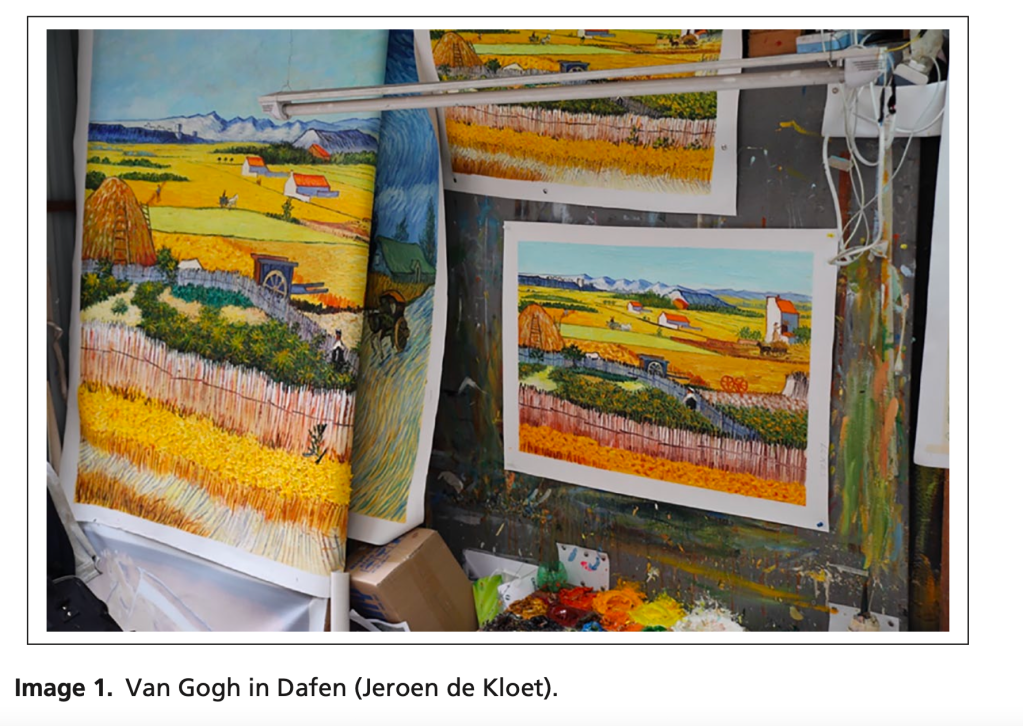
But when. . .researching shanzhai art made in Dafen village, located in Shenzhen, Southern China, and home to hundreds of painter-workers who make reproductions in every thinkable style and period, I was struck by the diversity of the artworks and their makers. The cheerfulness with which artworks were altered was liberating, for example, the ‘real’ van Gogh was considered too gloomy by customers, so the painters made a brighter version (see Image 1).
In another instance, I witnessed the face of Mona Lisa being replaced by one’s daughter to make it fit the household. When I brought an artwork home, the gallery called me later to ask if it matched my interior. Otherwise, I could change it. Such practices do turn conventional notions about art topsy-turvy. And shanzhai does not only concern art, it extends to phones, houses, cities, etc. As Lena Scheen (2019: 216) observes,
‘What makes shanzhai truly “unique” is precisely that it is not unique; that it refuses to pretend its uniqueness, its authenticity, its newness. A shanzhai resists the newness dogma dominating Euro-American cultures. Instead, it screams in our faces: “yes, I’m a copy, but I’m better and I’m proud of it”.’ https://journals.sagepub.com/doi/10.1177/13675494251371663
So what?
Any realistic attempt of ecological restoration with cloned bucardo [the Pyrenees ibex] would have to rely on hybridisation with other subspecies at some point; the genetic material from one individual could not be used to recreate a population on its own. Juan hypothesised: “we would have had to try to cross-breed in captivity, but you never know what could be possible, with new tools like CRISPR developing… and those [genome editing] technologies that come in the future, well, we don’t know, but maybe we could introduce some genetic diversity. This highlights a fundamental flaw in cloning as a means of preserving ‘pure’ bucardo—not only are ‘bucardo’ clones born with the mitochondrial DNA of domestic goats, but the hypothetical clone would also be subjected to further hybridisation. This begs the question, could such an animal ever be considered an authentic bucardo?” https://rgs-ibg.onlinelibrary.wiley.com/doi/10.1111/tran.12478
8. Colonial violence, domestic violence: an example of how genre, juxtaposition and intertext matter.
1. “The Canto of the Colonial Soldier” (sung in English with French subtitles). From the opera, Shell Shock, by Nicholas Lens (libretto by Nick Cave) from 3.25 minutes to 10.00 minutes in the following link:
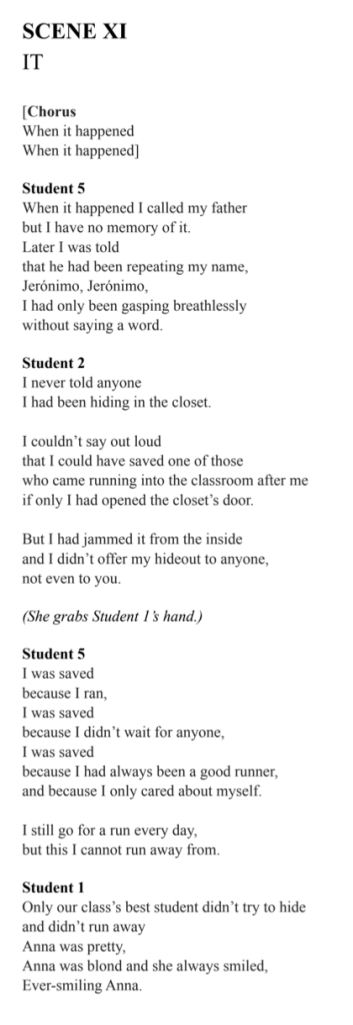
2. “IT” (Scene XI) from the opera, Innocence, by Kaija Saariaho (multilingual libretto by Aleksi Barrière of the original Finnish libretto by Sofi Oksanen) from 44.25 minutes to 49.33 minutes in the following link.
This particular scene is about a mass school killing, sung by the students and in different languages. You will want to read the English translation before watching the clip.
Saariaho stipulates that the Shooter should not appear on stage at any time, while the Colonial Soldier is the first shooter to be heard in Lens’s work.
The title may come off as a mass of abstractions, but it is my attempt to move analysis beyond the vile repellant man while avoiding commonplaces we encounter but which tell us nothing about the next steps ahead, e.g.:
What happens then when the state effectively becomes “strong” and retakes a more active role against the free market, but does not necessarily move toward where we want? What happens when the state presents itself to us in its most naked form: not as the neutral instrument that can be used for the common good, but as what it really is: the guarantor of capitalist profit?
Because that is exactly what we see both with Trump and with the limits that progressive strategies faced: the state does make “public policy,” but public policy at the service of capital, not social majorities.
I agree with every word and sentence as far as it goes. But it does not go far enough because of that quoted term, “public policy”.
First, the term doesn’t deserve scare quotes. Public policy is the stuff of life and interaction like you find in a good novel or film. Second and related, really existing public policies, at least for the major issues with which I’m familiar, are much more complicated than the politics, dollars and jerks doing the servicing. There is a granularity there, and to telegraph ahead, it’s a granularity made particularly suitable to policy and management as experienced and lived.
Why is this important? Because, professionally, I don’t believe that pitching and then keeping the analysis at the level of free market, the state, capitalism, and a synecdoche called Trump (like “The White House says”) lead to policy-relevant conclusions locally and regionally. Principles no more macro-design every micro-operation than does every micro-operation of Donald J. Trump macro-design all policy. The actionable granularity happens in between.
II
What is this “granularity made particularly suitable to policy and management as experienced and lived”? Yes, it’s the devil in the details of policy implementation and operation. But those details in a crucial sense include what now absent as much as what’s now present.
Presidents claiming emergency powers are nothing new in the US. The claim now, however, is that what had hitherto been the status quo ante is the very emergency we face, at least when it comes to levels of immigration, neoliberalism and international security. But that status quo ante also includes the Founders’ proviso that, while presidents may need emergency powers in extraordinary times, their exercise would not be precedent for future policies. That however is precisely what is being claimed when the current Treasury Secretary states, “the national emergency is avoiding a national emergency”.
So what? Emergency powers accruing to leaders is, of course, a very old, high overwritten policy palimpsest, even if we limit the analysis to Caesarism and from the Founders to the present. Over this time and space, the exercise of presidential emergency powers (Lincoln during the Civil War, Roosevelt during World War II) has often been associated with violence, and so too should more violence be no surprise were the historical no-precedent-for-future-policy excised from current readings off the policy palimpsest.
III
Now stop, and assert the very caveat I introduced about discussions at too high a level of abstraction.
The fact is that the violence will not be homogenous and universal. Local/regional differences will be manifest, as we have already seen. This differentiation is necessitated not only because of resisting higher-level agendas, but also because of defending lower-level ones. The combination of case-specific resistance and defence is, I argue, one highly suitable to a more granular policy and management.
Reducing that resistance and that defence to the standard explanation of policy as a function of politics, dollars and jerks is a grave mistake.
Among tactics developed by European activists to resist [sic] formalization processes, we find the use of personal bank accounts or means of transportation, partial undeclared payments and sales, the circulation of money in cash, the use of personal connections to avoid bureaucracy, hidden storage spaces, and the attempt to develop projects of self-certification and artisanal roasting. The organic certification process has generated endless debates both within the autonomous cooperatives and European networks, as official international labels are considered neocolonial devices. In Chiapas, producers don’t believe in Western agencies determining whether their product deserves to be considered organic, but they allow it out of necessity in order to export. This is a particularly delicate subject for a struggle built around peasant and indigenous rights for self-determination [sic]. While similar dilemmas have been discussed in the U.S. context regarding Fair Trade certification (Naylor 2019), European networks engage with these mechanisms in distinct ways. Only a portion of the coffee exported to Europe bears the official Fair Trade label, as many collectives explicitly reject it, and Zapatista producers themselves clearly differentiate their experience from that of non-Zapatista cooperatives. In this context, Fair Trade and organic certifications operate as separate and differently mobilized devices, and the coffees distributed across Europe under diverse “rebel” labels are explicitly marked as political products, openly positioned as part of a broader and collective anticapitalist struggle.
[For more on the difference between resistance and defence (especially the role of diversity in the latter), see Kristin Ross (2024), The Commune Form: The Transformation of Everyday Life (London: Verso, pp. 50-56).]
Environmental degradation driven by the climate crisis systemically worsens living standards, thereby heightening socioeconomic and political tensions. These tensions often ignite armed conflicts, forcing populations to migrate and creating environmental refugees. The mass migration stems from both the decline of ecosystems and conflicts intensified by resource shortages. As a result, the climate crisis inflicts extensive and lasting damage on ecosystems and human communities, aligning with the definition of ecocide. Recognizing this causal chain highlights the necessity for global governance to address the ecological and humanitarian impacts of climate-induced conflicts.
One admittedly incomplete review of the literature:
We draw three initial conclusions from [our review of the literature]. First, across the five environmental issues surveyed, the evidence on the contribution of environmental variables to violent political conflict is thin, weak, uncertain, and/or contradictory. Notwithstanding headline claims about climate being “a risk factor for conflict,” for instance, the consensus view of even the mainstream scholars who reached this verdict is that climate is a relatively low risk factor for conflict (evaluated as fourteenth out of 16 factors considered), is particularly uncertain (evaluated as the most uncertain of 16 factors), and is a factor over which there is “low confidence” in the mechanisms through which climate affects conflict. . .Second, scarcity accounts of environmental conflict, which focus on the security impacts of natural resource availability shortages, are particularly unconvincing, there being much stronger evidence on the conflict effects of relative resource abundance, as argued in “resource curse” or “honey pot” . . .interpretations of environmental conflict, and discussed further in the next section. And third, although the body of evidence on climatic variables and conflict is much more extensive than on the other environmental issues considered here, dominating climate–security research, it is no less uneven. Indeed, our assessment is that the evidence is most robust on water and forests, through resource curse dynamics; that it is most extensive but also mixed on climatic variables; and that it is thinnest in relation to biodiversity and pollution.
In short, the broader the narrative, including those for the climate emergency, the more likely there are granular counternarratives. Does the one negate or cancel the other? No, but it does force new questions, e.g. in this case: What local injustices would the earmarked global justice produce?
II
Some three decades ago, Jon Elster, the political philosopher, wrote Local Justice: How Institutions Allocate Scarce Goods and Necessary Burdens (1992). It’s of continued interest because one of the points is that not only can local justice systems lead to global injustice, global justice systems can lead to local injustices.
First, Elster’s definitions.
Local justice can be contrasted with global justice. Roughly speaking, globally redistributive policies are characterized by three features. First, they are designed centrally, at the level of the national government. Second, they are intended to compensate people for various sorts of bad luck, resulting from the possession of ’morally arbitrary properties.’ Third, they typically take the form of cash transfers [e.g., think reparations]. Principles of local justice differ on all three counts. They are designed by relatively autonomous institutions which, although they may be constrained by guidelines laid down by the center, have some autonomy to design and implement their preferred scheme. Also, they are not compensatory, or only partially so. A scheme for allocating scarce medical resources may compensate patients for bad medical luck, but not for other kinds of bad luck (including the bad luck of being turned down for another scarce good). Finally, local justice concerns allocation in kind of goods (and burdens), not of money.
Elster (1992, p4)
The semi-autonomous institutions are local in three senses for Elster: arena, country and locality. Different arenas, such as organ transplantation, college admissions and job layoffs, follow different principles: “Need is central in allocating organs for transplantation, merit in admitting students to college and seniority in selecting workers for layoffs” in the US. Allocative principles vary by country as well: “In many European countries, need (as measured by number of family dependents) can be a factor in deciding which workers to lay off”. Finally, allocative principles can also vary by locality within the same country or arena, as with the case of local transplantation centers in the US. (In case it requires saying, these systems have changed since Elster’s writing!)
In short, complexity in local justice systems comes not just from the fact that the goods are scarce, heterogeneous and in kind and that the sites of allocation may well be local contingent. Local justice systems vary also because principles are tied to complex arrays of criteria, mechanisms, procedures, and schemes.
Implications, including for climate justice.
Not only are local justice systems not designed to compensate for global injustices, they can also lead to those injustices:
From childhood to old age, [the individual] encounters a succession of institutions, each of which has the power to give or deny him some scarce good. In some cases the cumulative impact of these decisions may be grossly unfair. We can easily imagine an individual who through sheer bad luck is chosen for all the necessary burdens and denied all the scarce goods, because in each case he is just below the cutoff point of selection. To my knowledge this source of injustice has not been recognized so far…. Those who are entrusted with the task of allocating a scarce good rarely if ever evaluate recipients in the light of their past successes or failures in receiving other goods. Local justice is largely noncompensatory. There is no mechanism of redress across allocative spheres….
[B]y the nature of chance events, some individuals will miss every train: they are turned down for medical school, chosen by the draft lottery, laid off by the firm in a recession, and refused scarce medical resources; in addition, their spouse develops cancer, their stocks become worthless, and their neighborhood is chosen for a toxic waste dump. It is neither desirable nor possible to create a mechanism of redress to compensate all forms of cumulative bad luck. For one thing, the problems of moral hazard would be immense [i.e. if people knew they were going to be compensated for whatever happened to them, they could take more risks and thereby incur more harm]. For another, the machinery of administering redress for bad luck would be hopelessly complex and costly.
(Ibid 133-4)
Where so, local justice clearly can lead to global injustice.
But just as clearly from a local justice perspective, the global justice promised in, say, climate justice (e.g., via reparations), leads to local injustices, when the former is implemented uniformly over an otherwise differentiated landscape. One thinks immediately of how to define an “extreme event” that triggers so-called automatic debt relief.
To expand, the more uniform the application of climate justice policies, the greater the local pressure for suitably heterogeneous applications, if not alternatives. But the more differentiated on the ground, the greater the chance of global injustice when considered as universal principles uniformly applicable at the micro-level.
So what?
For one thing, the continued insistence that global climate justice involves money transfers (as distinct from in-kind compensation typical of local justice systems) ends up further monetarizing a global environment that local systems take to be quite otherwise.
In so doing, the insistence obscures the huge importance of in-kind compensations at the local level. Think here of the livestock sharing systems (e.g., khlata in Tunisia and mafisa in Botswana). These are local justice systems irrespective of the livestock involved being methane producers from a techno-managerial perspective on global climate. Indeed, I can’t think of a better example of global climate justice at odds with local justice systems, globally.
It also remains an open question—to be settled case by case, in my view—as to whether the persistence of in-kind transfers within a cash economy (e.g., Scoones 2024) is more about pastoralist systems that are locally just than it is about the global injustices of the cash nexus.
III
What needs further highlighting is how far we can only get analytically and normatively in deploying that binary of justice/injustice. Indeed, for some critics who question binaries (like nature/nurture, public/private, political/non-political, and human/non-human), the binary justice/injustice is alive and well! They commonly assume that there are justice systems which can or should correct for the equally well-known injustices.
The twofold obstacle to any such conclusion is that (1) all manner of injustices are incurred without specific reference to principles or norms of justice and, anyway (2) those principles and norms prove contradictory, inconsistent or ambiguous when it comes to specific contexts (Douglass 2025). This is both an empirical and theoretical argument most recently associated with the political philosopher, Judith Shklar:
What sort of problem is injustice? One way of thinking about it is as an ethical problem. If not the first virtue of social institutions, justice is one of the most important moral values that should guide our reflections on politics. Injustice negates (or is a departure from) justice and is therefore a problem. Understood this way, there is a strong case for maintaining that we require principles of justice to evaluate cases of injustice: we can only identify the nature and scale of injustices with reference to some prior idea of justice. As should now be evident, this is not Shklar’s approach to theorizing injustice. She instead starts from our experiences of injustice and explores the political problems to which they give rise. The sense of injustice that we all experience should be understood in reference to the plural, competing, and ever-changing expectations that exist within any society, which cannot be formalized into determinate principles of justice. As this sense of injustice is a deep and inescapable feature of all social life, there is a political imperative to find ways of living together that can mitigate it as effectively as possible without (at the extreme) descending into cycles of violent revenge. To understand the problem of injustice in this way is to treat it as a political problem, first and foremost, rather than as an ethical one.
Such a sense of injustice repeatedly appears in the pastoralist literature (e.g., Krätli and Toulmin 2020, p. 68). Is it any wonder then that existing local justice systems are commended for providing some everyday order and stability? Scott-Villiers et al (p.35) write in their cases study of Somali-Kenya borderlands:
Most importantly, it is the ways in which people have been served by the Xeer system and Sharia over the many years of state neglect and war that is our focus here. Flawed though the system may be in relation to current circumstances and aspirations, community members across the rural borderlands feel that, on balance, it is a vital element in their lives. Its capacities not only to provide justice, but also insurance should also not be underestimated. Where else, people ask, do we have any assurances for carrying out business?
If your premiss is that global justice systems should correct for local injustices, then I don’t see how you can avoid your starting point being the really-existing messy nature of global justice and of local justice. Which makes it even odder that just when the North’s techno-solutionism is called into question, pressures mount that the North, as a matter of climate justice, fund massive climate adaptation in the South.
IV
An example of this messiness is geoengineering. It’s offered up as a last-ditch effort to save the planet in the midst of its very real climate emergency. Such indeed is the rationale for having in place robust monitoring and evaluation (M&E) systems of the geoengineering interventions. Now of course, much of the current debate is about the unintended consequences of geoengineering and about the early warning systems for monitoring and evaluating them. But those consequences are almost exclusively dominated by concerns of global North and South experts and scientists.
I suggest that the major priority of governments and the regulators of geoengineering initiatives is to ensure that the early warning systems for droughts and bad weather still in operation among pastoralists and agriculturists of the developing world are also included and canvassed. Otherwise, we will be measuring the decrease (or increase for that matter) in the murders of local “rainmakers” (forecasters) because of a globalizing geoengineering.
Which takes us full circle, back to where the more global the system, the more unavoidable are local differences for policy and management.
Elster, J. 1992. Local Justice: How Institutions Allocate Scarce Goods and Necessary Burdens, Russell Sage Foundation: New York NY
Krätli S., C. Toulmin 2020. Farmer–Herder Conflict in Sub-saharan Africa? IIED, Briefing. International Institute for Environment and Development, London (accessed online at http://pubs.iied. org/17753IIED)
Roe, E. 2023. When Complex is as Simple as it Gets: Guide for Recasting Policy and Management in the Anthropocene. IDS Working Paper 589, Brighton: Institute of Development Studies, DOI: 10.19088/IDS.2023.025
Environmental degradation driven by the climate crisis systemically worsens living standards, thereby heightening socioeconomic and political tensions. These tensions often ignite armed conflicts, forcing populations to migrate and creating environmental refugees. The mass migration stems from both the decline of ecosystems and conflicts intensified by resource shortages. As a result, the climate crisis inflicts extensive and lasting damage on ecosystems and human communities, aligning with the definition of ecocide. Recognizing this causal chain highlights the necessity for global governance to address the ecological and humanitarian impacts of climate-induced conflicts.
One admittedly incomplete review of the literature:
We draw three initial conclusions from [our review of the literature]. First, across the five environmental issues surveyed, the evidence on the contribution of environmental variables to violent political conflict is thin, weak, uncertain, and/or contradictory. Notwithstanding headline claims about climate being “a risk factor for conflict,” for instance, the consensus view of even the mainstream scholars who reached this verdict is that climate is a relatively low risk factor for conflict (evaluated as fourteenth out of 16 factors considered), is particularly uncertain (evaluated as the most uncertain of 16 factors), and is a factor over which there is “low confidence” in the mechanisms through which climate affects conflict. . .Second, scarcity accounts of environmental conflict, which focus on the security impacts of natural resource availability shortages, are particularly unconvincing, there being much stronger evidence on the conflict effects of relative resource abundance, as argued in “resource curse” or “honey pot” . . .interpretations of environmental conflict, and discussed further in the next section. And third, although the body of evidence on climatic variables and conflict is much more extensive than on the other environmental issues considered here, dominating climate–security research, it is no less uneven. Indeed, our assessment is that the evidence is most robust on water and forests, through resource curse dynamics; that it is most extensive but also mixed on climatic variables; and that it is thinnest in relation to biodiversity and pollution.
Moral: All broad narratives, including those for the climate emergency, come with more granular counternarratives. Does one negate or cancel the other? No, but it does force new questions, e.g. in this case: What local injustices would the earmarked global justice produce?
Let’s look at the implications of that curious asymmetry in the analysis of socio-technical disasters, past and future.
If you start analysis by elucidating the genesis of a disaster, then how far back in history do you go in the diagnoses of causes to be ameliorated? There’s no closure rule, or at least like the one in place after the disaster. Then there’s urgency and a clarity about what needs to be done by way of immediate emergency response and initial service restoration. Even longer-term recovery funds can increase–never again!–until the hype fades. All the while, causal explanations of past disasters continue and compete, are incomplete or open-ended, and rarely fade away entirely.
What’s at issue, I think, is much more than the fact that ex post analysis of the past ends up more a search for ultimate causes while ex ante analysis of measures to prevent the next disaster focuses on proximate causes.
Say we readily agree our economic systems get us into some, or many, of socio-technical disasters. But the very same infrastructures that need to be restored immediately, if only for mass care, after the disaster–energy, water, transportation, telecommunications–are those that undergird these economic systems up to and now through the emergency. How else do you stabilize post-disaster conditions, even if the aspirations are to recover to new normals economically different? Improvising with what’s at hand is necessary, whether or not alternative futures are out of reach.
II
This asymmetrical nature of socio-technical infrastructures, at least under emergency conditions, is under-acknowledged normatively. For example, it’s easy to document the harms done by digital surveillance of border controls (just tap in a Google search). Less cited are the real-time upsides of digitalization for those seeking to cross the borders:
. . . .social media platforms also become dynamic infrastructures which actively mediate global migration. It performs three key functions. First, it fosters individual digital resilience. Migrants use encrypted or anonymous apps to evade law enforcement, navigate dangerous terrains, and plan clandestine departures. They share their journeys through videos and posts, and make public documentation, including pleas for help or evidence of abuse, to support their asylum claims and attract attention to their lived experiences (Leurs & Smets, 2018). Second, social media creates and strengthens online diasporic communities (Díaz de León, 2022). Platforms such as Facebook, WeChat, and Telegram maintain interpersonal ties and develop support networks for both practical assistance and affective support (Gillespie et al., 2018). Third, social media platforms offer real-time updates on shelters, routes, smugglers, and visa policies (Lõrincz & Németh, 2022). This user-driven information ecosystem allows for decentralized but immediate decision-making. The reputation of migration intermediaries, once relied on offline word-of-mouth, has been fostered by online reviews.
It’s difficult for me to imagine that for these people, digital infrastructure will be of less normative use in whatever new normals they achieve, however economically different the latter are.
We are living our whole lives in a state of emergency. DENISE LEVERTOV, poet; 1967
I
I could pick recent articles from any well-known media outlet. That I choose the online Guardian is not intended to single it out as worse. It’s just that these four competing examples came at around the same time there:
With so many #1 crises competing for our attention, which to choose?
II
The fact of the matter is that there is no choice. Not one of the four is at a level of granularity with which to assess whether this #1 is more hazardous than the other #1’s and under what conditions. This is particularly true as the hazards are in terms of uncertainties (i.e., their respective unknown knowns, known unknowns and unknown unknowns.)
Crises of course can be reported in short- or long-form media articles. But in the same way that no decisionmaker should want to take a policy decision on the basis of one piece of information only, so too should decisionmakers treat “this is our number 1 crisis” as one piece of the needed information. Real-time action is taken for more granular, context-based reasons. The creators of AI may have a variety of crisis scenarios about the downside of AI. But when the creators say that these scenarios pose threat-equivalent to nuclear war or worse, you need to remind yourself that they have no equivalent level of detail for the latter as they do the former.