This photograph shows what were formerly residential lots later abandoned in a part of Detroit, Michigan:

According to an expert, these instances require us “to think about innovative and productive ways to manage and transform vacancy for long-term sustainability” not only in Detroit but in like areas (Dr. Toni Griffin, Professor in the Practice of Urban Planning at the Harvard Graduate School of Design commenting on the presentation, “Last House on the Block: Black Homeowners, White Homesteaders, and Failed Gentrification in Detroit,” accessed online at https://www.youtube.com/watch?v=umqU1xj5yPA).
I want to take up Dr. Griffin’s challenge and recast what you see (and don’t see) in that picture in equally policy relevant ways for “low-density” (mixed-use) grasslands in parts of Africa with which I am familiar.
I
Let’s start with the obvious points raised by the above photo.
In reality, the space bounded by the two edge sidewalks isn’t vacant. What you don’t see are not just the biophysical activities on the ground and below, you also don’t see the socioeconomic relations that crisscross the space even now. For all I know, new construction could be happening the day after tomorrow or the lot was the site of a crafts fair a week before the photo was taken.
Far-fetched, you say? Consider the description of one such project on one Detroit lot:
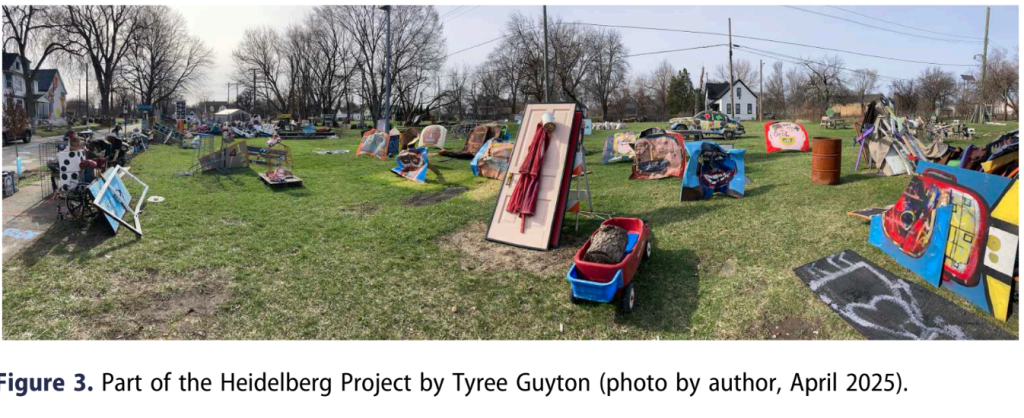
The Heidelberg Project, founded by Tyree Guyton in the mid-1980s, is perhaps Detroit’s most well-known – and controversially discussed – outdoor art environment. Spanning a block of vacant houses and lots, the project comprises a dense assemblage of discarded objects. . . (accessed online athttps://www.tandfonline.com/doi/full/10.1080/02723638.2026.2676282)
And yet, the blisteringly obvious in the photo is that the space is NOT vacant. It’s full of repurposed objects (about which, by the way, you know little unless described further). Such however is the powerful imaginary that “vacant” still carries with it.
II
So what?
Just what does this mean for “the management of vacancy,” be it in peri-urban Detroit or low-density (mixed use) rangelands of East or Southern Africa?
It means we have to think more granularly than snapshot reality could ever permit.
For example, what if the former settler ranches in parts of Africa now subject to the mixed (arable, horticultural, animal) uses are in fact the result of that having, as Dr. Griffin put it, “to think about innovative and productive ways to manage and transform [really-existing] vacancy“?
In Detroit, white urban farmers have moved into some of these depopulated neighborhoods. In Africa examples, the racial demographics are largely reversed, but the analogy remains strong: Just as this urban farming has been mistakenly criticized as failed gentrification (the first wave of Detroit urban farmers never saw themselves as gentrifiers), so too arable and agro-pastoral farmers are mistakenly criticized for falling short of specialized livestock rearing or crop production thought to be more suitable by governments and their experts.
More important (for me) the policy implications differ depending on the benchmark against which to assess really-existing use variety on the ground. Is it any wonder that “gentrification”, like “dryland livestock ranching”, have no agreed-upon definitions? (Academics are still debating the causes and consequences of gentrification here in the US.) Is it any wonder then that both concepts are never so fiercely argued over as when they’re offered up as “solutions”? Ideal types are just another version of blueprint development.


One thought on “Managing vacancy across urban and rural landscapes”