When it comes to the performing arts contribution to the public sphere, we probably think of plays, concerts and performances with social content or political impact. So too for paintings, sculpture and installations. Here, though, I’m more interested in instances where, if you will, these arts perform policy analysis. Below are six examples of what I mean. I conclude with the upshot I take from these and like cases.
1. Rethinking policy through a radical lens
—The optic.
[Mary Ellen] Carroll’s current exhibition at the Contemporary Arts Museum Houston (CAMH), “How to Talk Dirty and Influence People,” . . .took seven years of planning, and it shows. The curator, Rebecca Matalon, worked with the artist, known also as MEC, to showcase some forty years of often confoundingly immaterial work. The spine of the exhibition, structured around six themes — Doubling, Climate, Policy, Media, Sovereignty, and Being—is the artist’s ever-growing library of index cards [e.g.]. . . .
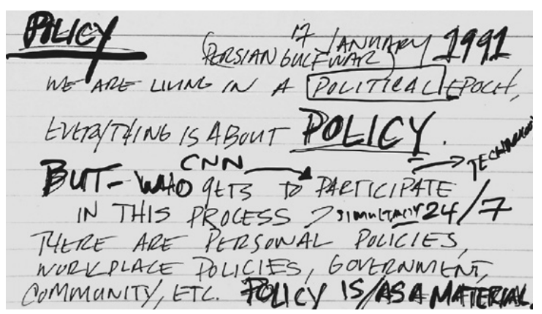
ON JANUARY 17, 1991, the day the Gulf War became the first war broadcast live on television, MEC wrote the following lines on an index card: “we are living in a political epoch, everything is about policy. but—who (cnn) gets to participate (technology) in this process simultaneously 24/7 there are personal policies, workplace policies, government, community, etc. policy is/as a material.”
Matalon, when I met her in Houston, suggested to me that nearly everything Carroll has made could be read through the lens provided by this one card. In her catalogue essay she went further, asking whether MEC’s entire career is one long performance devoted to bearing out the idea that the propositional and the real, the political and the practical, are not only mutually contingent, but inseparable.
(Kat Herriman. “Pushing Paper: Kat Herriman on Mary Ellen Carroll’s daredevil encounters with red tape.” Artforum [November 2026]: 39 -43; my bold)
—An application.
against policy (a tiny manifesto): The notion of “policy” presumes a state or governing apparatus which imposes its will on others. “Policy” is the negation of politics; policy is by definition something concocted by some form of elite, which presumes it knows better than others how their affairs are to be conducted. By participating in policy debates the very best one can achieve is to limit the damage, since the very premise is inimical to the idea of people managing their own affairs.
(David Graeber [2004]. Fragments of an Anarchist Anthropology. Prickly Paradigm #14. Prickly Paradigm Press. The University of Chicago Press.
WRONG. Life’s too sketchy to write up policy and politics like that.
2. Failed performance? Recasting 9/11 through a Gerhard Richter painting
–In a 2002 interview, painter Gerhard Richter was asked if he would paint the 9/11 terrorists (as he’d done earlier with Baader-Meinhof members): “Definitely not. This horrific form of global terror is something I cannot fathom”.
“September 11 bothered me more than I expected,” Richter admitted later. By 2005, when an interviewer asked about a small painting appearing to show the World Trade Center’s towers, Richter said: “These here are only failed attempts. I couldn’t get this stereotypical image of the two towers, with the same billowing out of them across the deep blue sky, out of my mind.” He went on to say that the painting in question “couldn’t work; only when I destroyed it, so to speak, scratched it off, was it fit to be seen”.
–Below is his September, a 2005 photo-painting of the event and relatively small at approximately 28” x 20”:

The image you are seeing was rendered from a photograph showing the south tower of the World Trade Center as it was hit. The specific photo was, in Richter’s words, “very typical…Colorful—red, yellow, fire” “I painted it first in full colour, and then I had to slowly destroy it. . . ”
“I failed,” he told a friend; the painting “shows my helplessness. In German, my scheitern, failure.”
–Really? Is the painting in a failed state? Look at September again. Do you see the active, living absence of the deep red and yellow that initially tripped Richter up? By extension, do you see the active, living absence of the new democracies coming into being from presently failing states, including—dare we say—parts of the US?
3. Songwriting’s reframing policy, implementation and evaluation
Although most songwriting teams in the Great American Songbook wrote music first and lyrics second, most studies of music-text interaction in this repertoire still evince a lyrics-first mindset, in which the music is viewed as text-setting. In this article, I propose the opposite approach: considering lyrics as a form of music-setting, in which the lyricist’s superimposition of a verbal form (the rhyme scheme) upon the composer’s pre-existing musical form counts as an act of analysis. . . .
Not all performances from this era make the same changes as Hepburn [Audrey Hepburn singing in the 1957 film Funny Face]. But her performance is nonetheless representative of an evolutionary process that propagates throughout this repertoire: the composer supplies a musical form; the lyricist superimposes a different form above it; and the performer implicitly revises the music to better tally with the lyrics.
John Y. Lawrence (2023). Lyricist as Analyst: Rhyme Scheme as Music-Setting in the Great American Songbook. Music Theory Spectrum XX: 1 – 15 (accessed online at https://academic.oup.com/mts/advance-article-abstract/doi/10.1093/mts/mtad015/7492927?redirectedFrom=fulltext)
For some, it’s the shortcut: Policy is about writing the lyrics, implementation about rendering those words with real voice, and evaluation about assessing the good and bad in those words and performances.
That policy instead is the music and that implementers are like lyricists trying to find, among many possibilities, an implementation that fits better than others offers a revealing twist. Also revealing is the notion that “fits better” means “fits suggestively” for ongoing interpretations: namely, future evaluations, formal and informal, of the policy-as-implemented are performed in ways that offer up nuanced interpretations of what is seen, heard and done.
Revealing? For one thing, this suggests that the closure posed to policy by its implementation is not once and for all as long as evaluations (interpretations) are ongoing (literally, performed). In this way, repeated evaluation, not implementation on its own, is a de facto policymaking without closure. Or if you will, this is its own kind of democracy.
4. When policy’s long-run is an intertext
–I’m first asking you to look and listen to one of my favorites, a short video clip of Anna Caterina Antonacci and Andreas Scholl singing the duet, “I embrace you,” from Handel (the English translation can be found at the end of the clip’s Comments):
Antonacci’s performance may resonate for some with the final scene in Sunset Boulevard, where Gloria Swanson, as the actress Norma Desmond, walks down the staircase toward the camera. But intertextuality–that two-way semi-permeability across genres–is also at work. Antonacci brings the opera diva into Swanson’s actress as much as the reverse, and to hell with anachronism and over-the-top.
–Let’s now bring semi-permeable intertextuality closer to public policy and management. Zakia Salime (2022) provides a rich case study of refusal and resistance by Moroccan villagers to nearby silver mining–in her case, parsed through the lens of what she calls a counter-archive:
My purpose is to show how this embodied refusal. . .was productive of a lived counter-archive that documented, recorded and narrated the story of silver mining through the lens of lived experience. . . .Oral poetry (timnadin), short films, petitions, letters and photographs of detainees disrupted the official story of mining ‘as development’ in state officials’ accounts, with a collection of rebellious activities that exposed the devastation of chemical waste, the diversion of underground water, and the resulting dry collective landholdings. Audio-visual material and documents are still available on the movement’s Moroccan Facebook page, on YouTube and circulating on social media platforms. The [village] water protectors performed refusal and produced it as a living record that assembled bodies, poetic testimonials, objects and documents
https://onlinelibrary.wiley.com/doi/full/10.1111/dech.12726
What, though, when the status quo is itself a counter-archive? Think of all the negative tweets, billions and billions and billions of them. Think of all negative comments on politics, dollars and jerks in the New York Times. That is, think of these status-quo repositories as a counter-archive of “status-quo critique and dissent.”
–So what?
A genre notion of the status quo as counter-archive means that today’s counter-archive is also to be thought of as semi-permeable and in two-way traffic with other genres. This raises a new possibility: a kind of long-run that is temporally long because it is presently intertextual, indefinitely forwards and back and across different genres.
For example, if the climate emergency is violence and the Big Polluters are culprits, then violent resistance against them is a form of violence reduction. This means the “violence” and the “resistance” are difficult to evaluate, let alone predict, because the long-run over which they are to unfold is itself a current but changing intertext for the Anthropocene.
As in: “the varieties of revolution do not know the secrets of the futures, but proceed as the varieties of capitalism do, exploiting every opening that presents itself”–to paraphrase political philosopher, Georges Sorel.
4. Authentic policy? No chance
Large proportions of the Chinese collection are perhaps copies in the eyes of those collectors and dealers, who believe that authentic African art has become largely extinct due to diminishing numbers of active traditional carvers and ritual practices. However, the ideological structure and colonial history of authenticity loses its effects and meanings in China, where anything produced and brought back from Africa is deemed to be “authentically African” https://www.tandfonline.com/doi/full/10.1080/13696815.2021.1925089
But when. . .researching shanzhai art made in Dafen village, located in Shenzhen, Southern China, and home to hundreds of painter-workers who make reproductions in every thinkable style and period, I was struck by the diversity of the artworks and their makers. The cheerfulness with which artworks were altered was liberating, for example, the ‘real’ van Gogh was considered too gloomy by customers, so the painters made a brighter version (see Image 1).
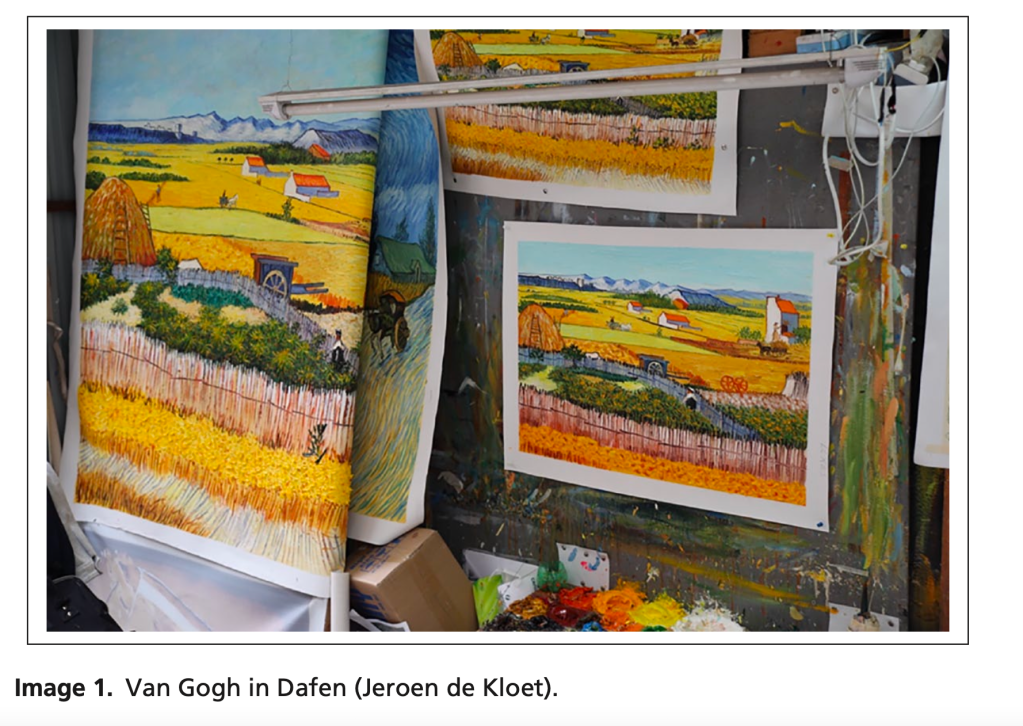
In another instance, I witnessed the face of Mona Lisa being replaced by one’s daughter to make it fit the household. When I brought an artwork home, the gallery called me later to ask if it matched my interior. Otherwise, I could change it. Such practices do turn conventional notions about art topsy-turvy. And shanzhai does not only concern art, it extends to phones, houses, cities, etc. As Lena Scheen (2019: 216) observes,
‘What makes shanzhai truly “unique” is precisely that it is not unique; that it refuses to pretend its uniqueness, its authenticity, its newness. A shanzhai resists the newness dogma dominating Euro-American cultures. Instead, it screams in our faces: “yes, I’m a copy, but I’m better and I’m proud of it”.’ https://journals.sagepub.com/doi/10.1177/13675494251371663
So what?
Any realistic attempt of ecological restoration with cloned bucardo [the Pyrenees ibex] would have to rely on hybridisation with other subspecies at some point; the genetic material from one individual could not be used to recreate a population on its own. Juan hypothesised: “we would have had to try to cross-breed in captivity, but you never know what could be possible, with new tools like CRISPR developing… and those [genome editing] technologies that come in the future, well, we don’t know, but maybe we could introduce some genetic diversity. This highlights a fundamental flaw in cloning as a means of preserving ‘pure’ bucardo—not only are ‘bucardo’ clones born with the mitochondrial DNA of domestic goats, but the hypothetical clone would also be subjected to further hybridisation. This begs the question, could such an animal ever be considered an authentic bucardo?” https://rgs-ibg.onlinelibrary.wiley.com/doi/10.1111/tran.12478
5. What Shakespeare’s missing lines tell us about war
The playhouse manuscript, Sir Thomas More, has been called “an immensely complex palimpsest of composition, scribal transcription, rewriting, censorship and further additions that features multiple hands”. One of those hands was Shakespeare–and that has contemporary relevance.
–The authoritative Arden Shakespeare text renders a passage from Shakespeare’s Scene 6 as follows (this being Thomas More speaking to a crowd of insurrectionists opposing Henry VIII):
What do you, then,
Rising ’gainst him that God Himself installs,
But rise ’gainst God? What do you to your souls
In doing this? O, desperate as you are,
Wash your foul minds with tears, and those same hands,
That you, like rebels, lift against the peace,
Lift up for peace; and your unreverent knees,
Make them your feet to kneel to be forgiven.
Tell me but this: what rebel captain…
The last two lines had been edited by another of the play’s writers (“Hand C”), deleting the bolded lines Shakespeare had originally written,
Make them your feet. To kneel to be forgiven
Is safer wars than ever you can make
Whose discipline is riot.
In, in to your obedience. While even your hurly
Cannot proceed but by obedience.
What rebel captain….
What has been effaced away by the deletion is, first, the notion that contrition is itself a kind of war and a safer war at that.
–According to the Arden Shakespeare, “The act of contrition might be described as wars because the former rebels would enlist themselves in the struggle of good and evil, and would fight against their own sin of rebellion.” In either case—contrition or rebellion—obedience is required. Actually, nothing was less safe than rebellion whose “discipline is riot”.
What had been scored out, in other words, from Shakespeare’s original passage is the clear accent on contrition and peace over continued upheaval.
–But the absence of contrition by those involved in the formulation and implementation of war policies is precisely what we have seen and are seeing today.
For to prioritize contrition would mean refocusing obedience from battle to a very different struggle in securing peace and security, a mission in which our Ministries of Interior and Defence are notably inferior, be they in Russia, the US, China or elsewhere.
6. The entire point of revolt may be revolts
–For Gotthold Ephraim Lessing, 18th century German Enlightener, the point is not for the sculptor or painter to portray a crisis at its climax, when visualizing a single moment. Better to choose a moment before or after the apex of destruction, so as to allow the viewers’ imaginations freer rein over what is to come. That way, Lessing argues, the narrative continues in an arc of reflection that is not cut short by any climax’s overpowering intensity:
[S]ince the works of both the painter and the sculptor are created not merely to be given a glance but to be contemplated. . .it is evident that the single moment and the point of view from which the whole scene is presented cannot be chosen with too great a regard for its effect. But only that which allows the imagination free play is effective. The more we see, the more we must be able to imagine. And the more we add in our imagination, the more must think we see. In the full trajectory of an effect, no point is less suitable for this than its climax. There is nothing beyond this, and to present to the eye what is most extreme is to bind the wings of fancy and constrain it, since it cannot. . .shun[ ] the visible fullness already presented as a limit beyond which it cannot go.
One problem with today’s crisis narratives is the preoccupation with or fixation on that visualized climax. In today’s catastrophe scenarios, the worst is imagined and imagination stalls there–like shining deer at night. But our unrelieved stream of crisis scenarios is itself proof that a prophesied climax can’t do all the talking. In reality, each scenario is something more than that, like recordings of musicians whose grunts and movements are also part and parcel of the performance.
–So what?
Any disappointment that one or more revolts–Occupy, Yellow Vests, Hong Kong protests, Arab Spring, the Extinction Rebellion–have not culminated into “far-reaching substantive change” is but one scenario. One only, because the climax scenario may not be the most fruitful, suggestive moment to focus on anyway, let alone be overawed by. In this sense, the entire point of revolt is revolts.
Upshot
If “power is the master narrative of politics,” then imagine how narrow life must be!


